Kanban Bin Carts
T-slot aluminum mobile bin carts engineered for two-bin Kanban replenishment systems, supermarket lane staging, and visual pull signal management. Adjustable bin rails, gravity-feed options, and Kanban card holder integration support lean material flow without exception processing or paperwork at the point of use.
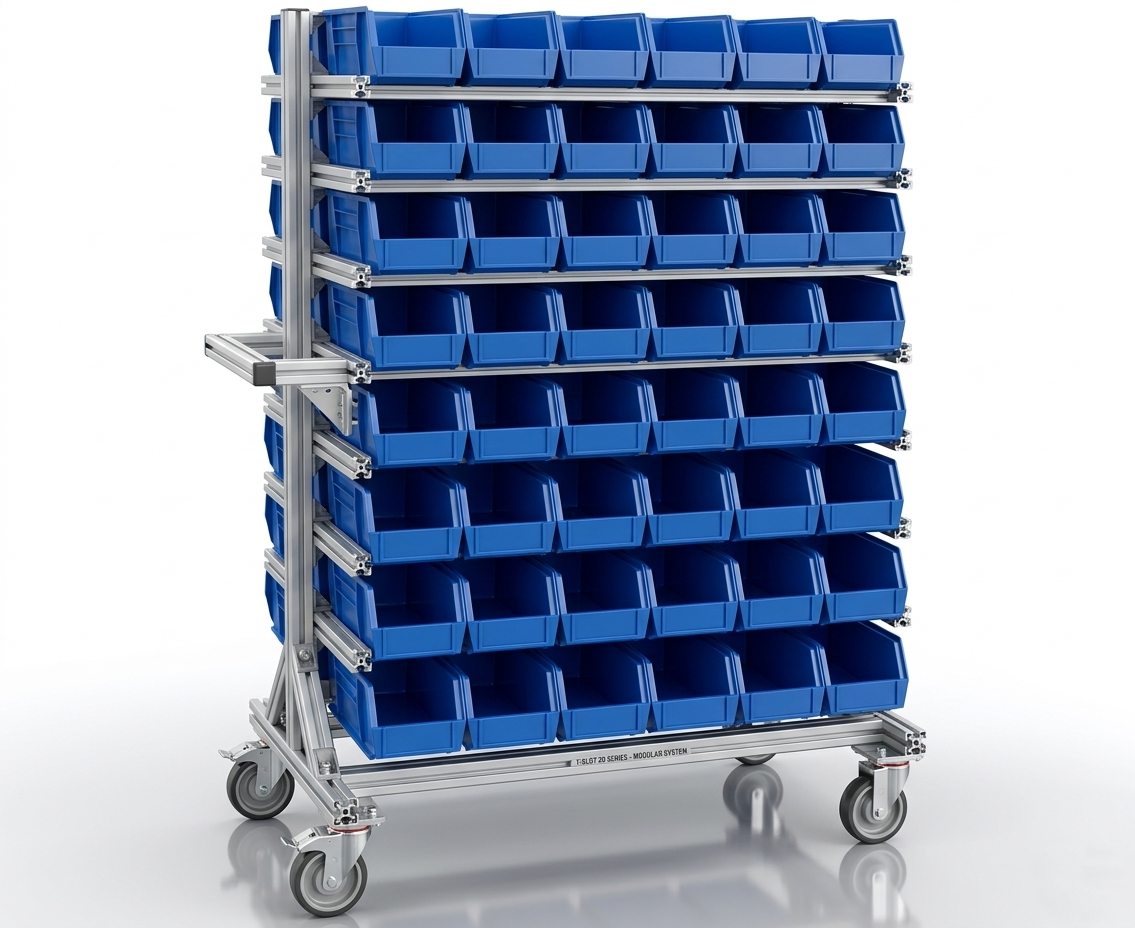
Why Choose Modular Solutions for Kanban Bin Carts?
Kanban systems fail when the physical hardware doesn't match the process design. Our carts are built to the exact bin system, part mix, and replenishment cycle of your specific production operation.
True Two-Bin Configuration
Active and reserve bin positions are defined in the cart structure — not just two bins placed on an undifferentiated shelf. The two-bin layout makes the replenishment signal self-evident and the bin exchange action obvious, reducing training requirements and eliminating signal failures caused by operator uncertainty.
Compatible with Standard Bin Systems
Bin rail spacing accommodates Akro-Mils, Quantum, Orbis, SSI Schaefer, and custom bin footprints. Mixed bin sizes on the same cart are supported — a single cart can serve both high-volume parts needing large bins and low-volume items using smaller bins at the same station.
Gravity-Feed Options
Gravity-feed inclined rails advance the reserve bin to the active position automatically when the front bin is removed. Gravity feed eliminates the manual bin advance step, ensuring the replacement bin is always at the point of use without requiring an operator action beyond removing the empty bin.
Visual Management Built In
Label holders, Kanban card pockets, empty bin staging hooks, and color-coded bin rail zones are integrated into the cart structure. The cart surface communicates the Kanban status and part identity without requiring external label posts or floor tape additions at each position.
Supermarket Lane Configuration
Carts designed for specific supermarket lane positions with consistent dimensions that allow same-width carts to be arranged in a lane without gaps. Lane-position markings on the cart base can be incorporated as T-slot label positions for lane assignment identification.
Dual-Side Access for Water Spider Flow
Supermarket Kanban carts with dual-side access allow material handlers to restock from the aisle side while assembly operators pull from the station side simultaneously — eliminating the restocking conflict that forces production to stop when a water spider services the cart.
Key Features & Benefits
Mechanical and organizational features that support reliable daily Kanban system operation.
Adjustable T-Slot Bin Rails
Bin rails mount to T-slot uprights using standard T-slot fasteners, adjustable to any height for any bin size. Rail width adjustment handles the full range of standard bin footprints without secondary drilling, cutting, or welded bracket replacement.
Kanban Card Pocket Integration
Clear acrylic or aluminum Kanban card pockets mount to the T-slot frame at each bin position. Card pockets hold the Kanban card face-visible for identification and are sized for the specific card format used in the facility's Kanban system.
Empty Bin Staging Hooks
A dedicated empty bin staging zone at the cart top or bottom holds emptied bins as a visible replenishment signal accumulation point. The staging hooks are sized for the bin footprint and positioned to be visible from the aisle for water spider identification of outstanding replenishment needs.
Bin Stop Rail and Front Lip
A front bin stop rail prevents bins from being inadvertently pulled completely off the cart during active bin use. Bin lip height is set for the specific bin depth being used — high enough to retain the bin under normal use, low enough to allow one-hand bin removal during exchange.
Part Number Label Position
T-slot label rail channels at each bin position hold part number, description, and reorder quantity labels face-visible from the operator position. Label holders are sized for the facility's standard label format and are replaceable without tools when part assignments change.
Total-Lock Caster Option
Total-lock casters prevent cart movement during the production shift and are released only for replenishment cart exchanges. Stationary operation reduces the risk of accidental cart displacement during bin exchanges and maintains the lane position accuracy required for aisle-facing supermarket configurations.
Common Applications
Deployed in lean assembly environments, supermarket staging areas, and production cell point-of-use positions.
- Assembly Cell Fastener Supply - Two-bin Kanban carts at assembly stations holding nuts, bolts, clips, and fasteners in bins sized for the consumption rate per model, with gravity feed advancing the reserve bin automatically on active bin removal.
- Electronic Component Staging - Kanban bin carts at board assembly and wire harness stations holding component bins in part-number-labeled positions with Kanban card pockets for pull signal generation.
- Supermarket Lane Replenishment Carts - Full-height Kanban carts in supermarket lanes between stores and assembly, restocked by water spiders on a takt-time pull cycle from the parts supermarket staging area.
- MRO Supply Point-of-Use Staging - Maintenance Kanban carts at repair stations with bins holding commonly consumed maintenance items — filters, fittings, seals, and consumables — on a two-bin replenishment cycle from the MRO stores room.
- Packaging Material Supply - Kanban carts at packaging operations holding labels, bags, dividers, and inserts in bins sized for the packaging batch quantity, with empty bin pull signals triggering stores restocking.
- Kitting Station Component Supply - Kanban bin carts at kitting tables holding components for kit assembly, with bin counts and sizes matched to the kit quantity per shift and the replenishment cycle time from the feeder operation.
Specifications & Configurations
Standard design parameters for Kanban bin carts. Part mix, bin sizes, and cycle quantities are incorporated into the design.
| Specification | Detail |
|---|---|
| Frame Profile | 45 Series T-slot aluminum |
| Bin Compatibility | Akro-Mils, Quantum, Orbis, SSI Schaefer, custom sizes |
| Part Positions per Cart | 4 to 24 positions depending on bin size and cart dimensions |
| Kanban System | Two-bin standard; gravity-feed option available |
| Visual Management | Kanban card pockets, label holders, empty bin staging hooks, color-coded zones |
| Access Type | Single-sided or dual-sided (water spider / production) |
| Casters | 4 in. swivel with total-lock option; brake standard on 2 of 4 casters |
| Lead Time | 2 to 4 weeks from approved design |
Frequently Asked Questions
Common questions about Kanban bin carts from Modular Solutions.
What is a two-bin Kanban cart and how does it work?
A two-bin Kanban cart holds two bins per part number — one active bin being consumed at the production station and one reserve bin staged behind it. When the active bin empties, the operator moves the reserve bin forward and sends the empty bin to the replenishment point as the visual pull signal for restocking. The replenished bin returns to the reserve position behind the active bin, completing the cycle. Two-bin Kanban carts are designed so this bin exchange takes seconds and requires no paperwork or electronic transaction to trigger replenishment.
How are bin sizes and slot widths configured for Kanban carts?
Bin rails on T-slot Kanban carts are positioned using the T-slot channel system, allowing bin slot width and depth to be adjusted for any standard or custom bin footprint. Common bin systems including Akro-Mils, Quantum, Orbis, and custom-sized bins are all accommodated by adjusting the bin rail spacing on the T-slot uprights. Mixed bin sizes on the same cart are supported — larger bins for high-consumption parts, smaller bins for low-volume items.
Can Kanban carts use gravity feed to advance parts automatically?
Yes. Gravity-feed Kanban carts use slightly inclined bin rails so that when the front bin is removed, the rear bin slides forward automatically by gravity, eliminating the manual bin-advance step. Gravity feed is used for lightweight bin contents where the bin weight creates sufficient rolling force on the inclined rail. Rail inclination is typically 5 to 10 degrees and is set at fabrication based on the expected bin weight.
What visual management features are built into Kanban carts?
Kanban carts support label holders for part numbers and Kanban card pockets at each slot position. Color-coded bin rails or bin rail label strips are used to differentiate active and reserve zones. Empty bin staging hooks or pockets at the bottom of the cart collect empty bins for visual identification of outstanding replenishment signals. Additional visual indicators such as signal flags or Andon light mounts can be integrated into the cart frame using T-slot accessories.
Can Kanban carts be designed for supermarket aisle staging?
Yes. Kanban bin carts are a primary component of supermarket storage systems in lean production environments. Carts are designed to fit precisely in marked supermarket lanes with consistent cart-to-cart spacing that matches the part family assignment and bin count per station. Aisle-facing carts allow water spider or material handler restocking from the lane aisle while assembly operators pull from the production side without conflict.
Ready to Build Your Kanban System?
Tell us your bin system, part mix, replenishment cycle time, and station layout. We'll design Kanban bin carts that make your pull system work the way it was designed to.
Modular Solutions — 4280 Giddings Rd, Auburn Hills, MI 48326