Roll-In Rack Systems
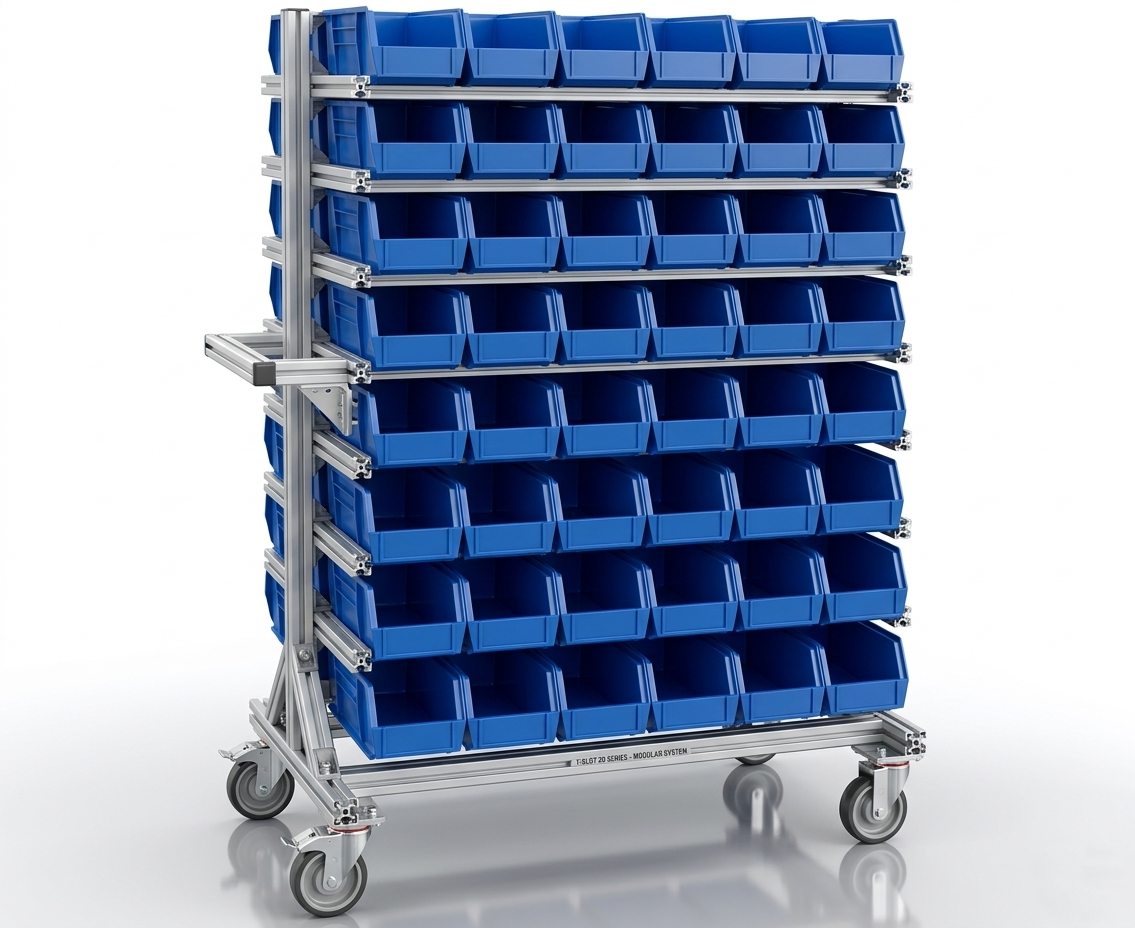
Full-height T-slot aluminum rack frames on heavy-duty caster bases for mobile industrial shelving, container staging, and pallet-level storage on wheels. Roll-in racks move fully loaded into fixed staging positions, delivery vehicles, or production cells — eliminating the load-transfer step between stationary storage and mobile transport.
Why Choose Modular Solutions for Roll-In Rack Systems?
Loading and unloading contents between a stationary rack and a transport cart is the most common source of wasted material handling time at the shipping and receiving interface. Roll-in racks eliminate the transfer entirely.
Eliminate the Load-Transfer Step
Contents loaded onto a roll-in rack stay on the rack from origin to destination. No unloading into a cart, no cart transport, no reloading at the destination. The rack is the container — it rolls in loaded and stays until contents are consumed at the point of use.
Full-Height Rack on Stable Caster Base
Roll-in racks combine full industrial shelf height with a heavy-duty caster base rated for the total loaded rack weight. The caster base is engineered for the specific rack height, loaded weight, and transport conditions — not a standard cart base with a rack frame added on top.
Sized for Vehicle or Dock Interface
Roll-in racks for vehicle deployment are designed to the internal dimensions of the specific vehicle — trailer interior width, door opening height, and floor anchor positions. The rack rolls through the door opening with minimal clearance and locks into position using standard vehicle floor anchors.
Precision Positioning for Staged Deployment
Floor guide channels, bump stops, and positioning pockets locate roll-in racks precisely in their staging positions without measurement. Consistent rack positioning enables visual management, aisle lane marking, and rack-to-rack spacing standards to be maintained across rack exchanges.
Configurable Shelf Systems
T-slot uprights carry the full range of shelf options — solid plate for containers, wire grid for airflow and visibility, beam shelves for pallet-level fork access, and custom part fixture shelves for dedicated component staging. Shelf heights are adjustable for different container depths at each rack tier.
Scalable Fleet for Lean Flow
Roll-in rack systems work in sets — a loaded rack rolls in as an empty rack rolls out. Rack fleet size is calculated from the replenishment cycle time and the number of rack positions per station. We help size the fleet and design the exchange flow for the target takt time and replenishment interval.
Key Features & Benefits
Structural and operational features that make roll-in rack systems reliable in daily high-cycle production and logistics environments.
90 Series Upright Construction
Roll-in racks use 90 Series T-slot uprights for column stiffness under the combined loading of full rack height, multi-tier shelf loads, and the dynamic forces generated during rack transport. Profile selection is reviewed against the total loaded height and tier load distribution at the design stage.
Heavy-Duty Swivel Caster Base
Caster wheels are sized for the full loaded rack weight including a dynamic load factor for transport on standard industrial floors. Caster spacing is designed for the rack footprint with casters at the four corners plus intermediate positions for long rack bases. Total-lock casters standard on all four positions.
Rack Tie-Down Provisions
Vehicle floor anchor provisions — load rings, strap hooks, or chain anchor points — are integrated into the rack base frame for compliance with in-transit securement requirements. Tie-down point locations match standard vehicle floor anchor layouts.
Cross-Brace Stability Structure
Horizontal cross-bracing at the rack back and optionally at mid-height provides lateral stiffness that prevents racking deformation under uneven shelf loads and lateral impact during transport. Cross-brace design maintains an unobstructed front face for forklift or manual shelf loading access.
Floor Guide Rails and Stops
Matching floor guide rails at the rack staging position guide the roll-in rack into alignment on the final approach and engage a positive stop at the correct position. Guides eliminate the alignment uncertainty that causes rack mis-positioning and the resulting aisle lane clearance problems in high-density staging areas.
Rack Identification System
T-slot label positions on the rack front face carry rack ID, contents assignment, and destination information. For shuttle systems, color-coded rack identification at a distance allows material handlers to select the correct return rack without approaching each rack individually.
Common Applications
Used in inter-plant logistics, sequenced parts delivery, returnable container systems, and high-volume production staging.
- Inter-Plant Parts Delivery - Roll-in racks loaded at a supplier or feeder plant roll directly into a delivery trailer, transit to the receiving plant, and roll out into the production area without unloading and reloading at either end of the journey.
- Sequenced Assembly Delivery - Roll-in racks with shelf positions organized in assembly sequence order deliver pre-sequenced parts kits from kitting to the assembly line, eliminating the assembly-side staging step by presenting parts in the exact pull order required.
- Returnable Container Management - Roll-in racks as the standard container for returnable packaging programs — loaded at the customer for return to the supplier without repacking into secondary containers.
- Production Line Buffer Storage - Roll-in racks staged at production cells as buffer storage between upstream and downstream operations, exchanged on the production cycle rather than moved individually per container.
- Finished Goods Staging - Roll-in racks accumulating finished goods at the end of the production line before rolling to the shipping dock as a complete loaded unit, reducing dock staging time and forklift movements.
- MRO and Maintenance Supply Delivery - Roll-in racks delivering weekly or shift-based MRO supply replenishment from the central stores room to department staging positions, with empty racks exchanged for loaded racks on the replenishment route.
Specifications & Configurations
Design parameters for roll-in rack systems. Total load, vehicle interface, and shelf configuration are application-specific.
| Specification | Detail |
|---|---|
| Frame Profile | 90 Series T-slot aluminum; hybrid T-slot / structural steel for heavy-duty applications |
| Rack Width | 24 in. to 96 in.; vehicle-matched widths available |
| Rack Height | 60 in. to 96 in.; limited by vehicle interior height for vehicle applications |
| Shelf Tiers | 2 to 6 tiers; shelf heights adjustable on T-slot uprights |
| Per-Tier Load Rating | 200 lb to 2,000 lb per shelf depending on profile and span |
| Casters | 6 in. to 10 in. heavy-duty swivel; total-lock standard; all-swivel or steer-fixed options |
| Vehicle Interface | Tie-down provisions; door opening clearance; floor anchor compatibility |
| Positioning | Floor guide rail sets and bump stops available; optional floor anchor chain |
| Lead Time | 4 to 6 weeks from approved design |
Frequently Asked Questions
Common questions about roll-in rack systems from Modular Solutions.
What is a roll-in rack system and how is it different from a standard cart?
A roll-in rack system is a full-height industrial shelving or racking frame mounted on a heavy-duty caster base, designed to roll in and out of fixed rack positions, shipping containers, delivery vehicles, or staging areas as a complete loaded unit. Unlike a standard cart which is loaded and unloaded at a station, a roll-in rack is designed to be the rack — contents stay on the rack during transport and the rack rolls into its storage or delivery position fully loaded. Roll-in racks are used where the loading and unloading of the rack itself would be time-consuming or impractical.
What load capacities are available for roll-in rack systems?
Roll-in rack systems are designed to the specific loaded weight requirement of the application. Light-duty roll-in racks using 45 Series T-slot frames handle shelf loads of 100 to 200 pounds per tier. Medium-duty racks with 90 Series uprights handle 200 to 500 pounds per shelf. Heavy-duty roll-in racks using structural steel upright reinforcements or hybrid T-slot and steel weld construction handle tier loads above 500 pounds and total rack loads exceeding 2,000 pounds with appropriate heavy-duty caster assemblies.
Can roll-in rack systems be used inside delivery vehicles or trailers?
Yes. Roll-in rack systems for delivery vehicle or trailer use are designed to the internal dimensions of the specific vehicle body, with rack width and height matched to the vehicle door opening and interior height. Rack tie-down provisions engage with standard vehicle load ring anchors to prevent rack movement during transit. Vehicle-based roll-in racks are a common configuration for parts delivery between plants, parts distribution operations, and mobile service operations where the loaded rack rolls directly into the vehicle.
How are roll-in racks positioned and locked in their staging location?
Roll-in racks are positioned using floor guide rails, bump stops, or positioning pockets that locate the rack precisely in its staging position without measurement. Locking is achieved through total-lock casters that engage when the rack is in position, floor-mounted anchor chains or cables for very heavy racks, or clip-on rack-to-rack connectors when multiple roll-in racks are staged in a row. The positioning and locking system is designed to allow a single operator to position and lock the rack in under 30 seconds.
What shelf types are compatible with roll-in rack systems?
Roll-in rack systems support the full range of T-slot shelf options including solid aluminum plate, perforated aluminum, wire grid, pallet-level beam shelves for fork access, and custom shelf fixtures for part-specific staging. Shelf selection is based on the load type — loose parts use wire grid or perforated plate for visibility and airflow, container-based storage uses solid plate for uniform support, and palletized load staging uses wide-span beam shelves designed for fork truck loading.
Ready to Eliminate the Load-Transfer Step?
Tell us your payload, rack position dimensions, vehicle interface requirements, and replenishment cycle. We'll design a roll-in rack system that makes your material flow faster and leaner.
Modular Solutions — 4280 Giddings Rd, Auburn Hills, MI 48326