Conveyor-Fed Flow Racks
Carton flow rack systems with integrated conveyor in-feed for automated, hands-free lane replenishment from upstream sortation conveyors, AS/RS systems, or goods-to-person shuttles. Continuous replenishment maintains full pick lanes without manual carton handling — designed for the highest-throughput distribution operations.
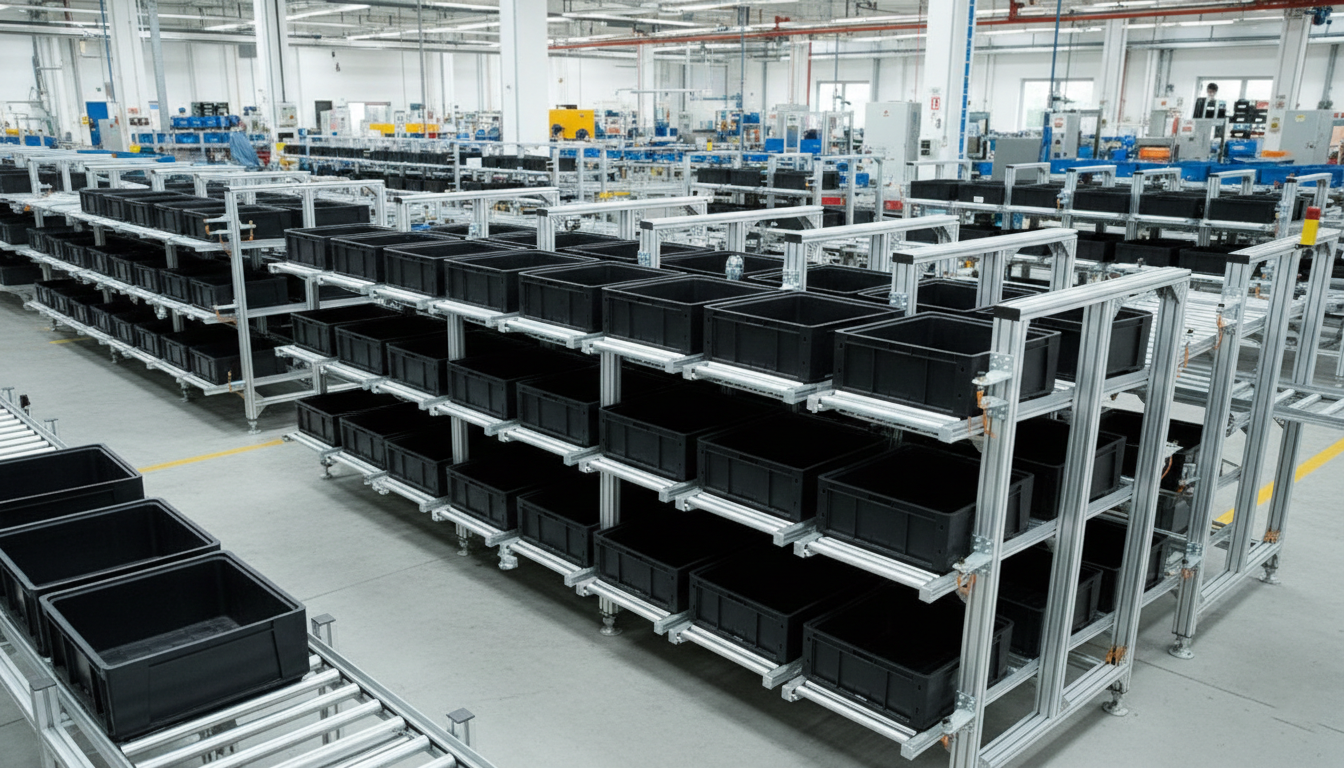
Conveyor-Fed Flow Racks Features
Modular aluminum carton flow rack systems engineered for reliability, flexibility, and lean material flow in any production or distribution environment.
Direct Conveyor In-Feed Integration
Conveyor-fed lanes receive cartons directly from an upstream belt, roller, or powered accumulation conveyor feeding the rear of each lane. Cartons transfer from the conveyor to the gravity flow track automatically — no manual carton placement required.
Divert & Sortation System Interfaces
Conveyor in-feed systems include divert points that route each carton to the correct lane based on SKU barcode scan. Divert options include pop-up transfers, pusher diverters, and angled transfer plates depending on carton dimensions and throughput rate.
AS/RS & Shuttle Integration
Conveyor-fed flow racks receive cartons directly from automated storage and retrieval systems — unit-load AS/RS, mini-load AS/RS, or shuttle-based systems — providing hands-free replenishment from dense automated storage to the pick face.
Buffer & Accumulation Conveyors
Upstream buffer conveyors accumulate cartons before lane transfer, smoothing replenishment rate peaks from sortation systems. Accumulation prevents lane overloading during sortation surges and maintains even lane depth across all lanes.
Lane Full Detection
Photoelectric sensors at the lane rear detect the full-lane condition and signal the sortation WCS to divert additional cartons to buffer storage rather than attempting to load a full lane. Lane-full sensing prevents jam conditions and carton damage.
High-Throughput Replenishment Rates
Conveyor-fed systems achieve replenishment rates of 500–2000 cartons per hour depending on conveyor speed, divert cycle time, and lane configuration — far exceeding manual replenishment throughput for high-velocity DC operations.
Technical Specifications
Standard configurations for conveyor-fed flow racks systems. Custom lane widths, depths, heights, and track types available for any carton size or facility requirement.
Applications & Industries
Conveyor-Fed Flow Racks systems deliver reliable carton flow performance across a wide range of manufacturing, distribution, and fulfillment environments.
- High-Throughput Distribution Centers — Automated replenishment from sortation conveyors maintains full pick lanes continuously during peak picking periods without manual replenishment labor.
- AS/RS-Integrated Pick Faces — Mini-load or shuttle AS/RS delivers cartons to conveyor in-feed at the rear of flow rack lanes — bridging automated storage and manual case/each picking in the same facility.
- Goods-to-Person Hybrid Systems — Conveyor-fed flow racks serve as a goods-to-person buffer where the rack presents the carton at the operator position — a hybrid of goods-to-person automation and traditional flow rack pick face ergonomics.
- Pharmacy & Healthcare Distribution — Automated conveyor replenishment of pharmaceutical carton flow lanes ensures continuous FIFO stock rotation with minimal manual intervention. Lot and expiry tracking through WCS scan at lane in-feed.
- Grocery DC Replenishment — Automated replenishment of dry grocery carton flow pick faces from reserve pallet storage via conveyor. Replenishment triggered by lane-level inventory signals from the WMS.
- Beverage & Heavy Case DCs — Powered conveyor in-feed manages heavy beverage case transfer to gravity flow lanes, replacing manual case stacking at lane load positions with mechanized transfer.
- E-Commerce Fulfillment — Conveyor-fed flow rack replenishment from goods-to-person tote AS/RS — product arrives at the flow rack in-feed by conveyor from automated storage and replenishes the pick face without operator travel.
- Frozen & Refrigerated DCs — Automated cold chain replenishment from freezer AS/RS to frozen pick face flow racks — minimizing time cartons spend outside controlled temperature during replenishment versus manual handling.
Frequently Asked Questions
Common questions about conveyor-fed flow racks specification, configuration, and deployment.
How does automated conveyor replenishment work for carton flow racks?
A WMS or WCS monitors lane inventory levels (via sensors or pick transaction counting) and triggers replenishment orders when a lane falls below a threshold depth. The replenishment carton is retrieved from reserve storage, conveyed to the flow rack in-feed conveyor, scanned for SKU verification, and routed by a divert mechanism to the correct lane. Gravity flow then advances the carton to the pick face position.
What barcode scanning is needed for conveyor-fed flow rack systems?
A fixed barcode scanner reads each carton at the conveyor in-feed divert point to confirm SKU, lot, and expiry data before routing to the lane. A second scan at the lane load point confirms correct lane assignment. Scan data feeds the WCS for inventory position tracking and the WMS for replenishment order closure.
Can any conveyor type interface with carton flow rack in-feed?
Most common conveyor types — belt, roller, powered accumulation, and zero-pressure accumulation — interface with carton flow rack in-feed through standard transfer plates or powered transfer sections. The interface design depends on the carton size, weight, and flow rate. Conveyor speed, lane entry angle, and carton presentation orientation are engineered for each specific carton profile.
What happens if a lane is full and the conveyor sends another carton?
Photoelectric sensors at the rear of each lane detect the full-lane condition and signal the WCS to divert the incoming carton to a buffer conveyor loop or redirect to reserve storage. The WCS updates lane inventory to "full" and delays the next replenishment order for that SKU until the lane depletes to the reorder level. Without lane-full detection, jams and carton damage occur — sensors are standard on all conveyor-fed systems.
What throughput rate is achievable with conveyor-fed flow rack replenishment?
Throughput rate depends on conveyor speed, divert cycle time, and number of divert points. A single conveyor in-feed line with one divert point typically achieves 300–600 cartons per hour. Multiple parallel in-feed conveyors with multiple divert points can achieve 1500–3000 cartons per hour. System throughput is confirmed in a traffic and simulation model during the design phase.
How is conveyor-fed flow rack replenishment integrated with WMS?
The WMS manages replenishment order generation based on minimum lane depth rules. The WCS manages the physical conveyor routing, scan verification, and divert actuation. Real-time lane inventory is maintained in the WMS by counting pick transactions (depletion) and replenishment confirmations (additions). The WMS and WCS interface via standard TCP/IP API, ERP integration, or message queue depending on the WMS platform.
Automate Your Pick Face Replenishment
Conveyor-fed carton flow rack systems engineered for your conveyor interface, throughput rate, and WCS integration. Full engineering and integration package included.
Request a Quote Email Our Team