E-Commerce Pick Flow Racks
High-density carton flow pick faces designed for the velocity, SKU depth, and order accuracy requirements of e-commerce fulfillment. Each-pick lane presentation, pick-to-light integration, and ergonomic dense-SKU configurations for B2C parcel, omnichannel, and same-day fulfillment operations.
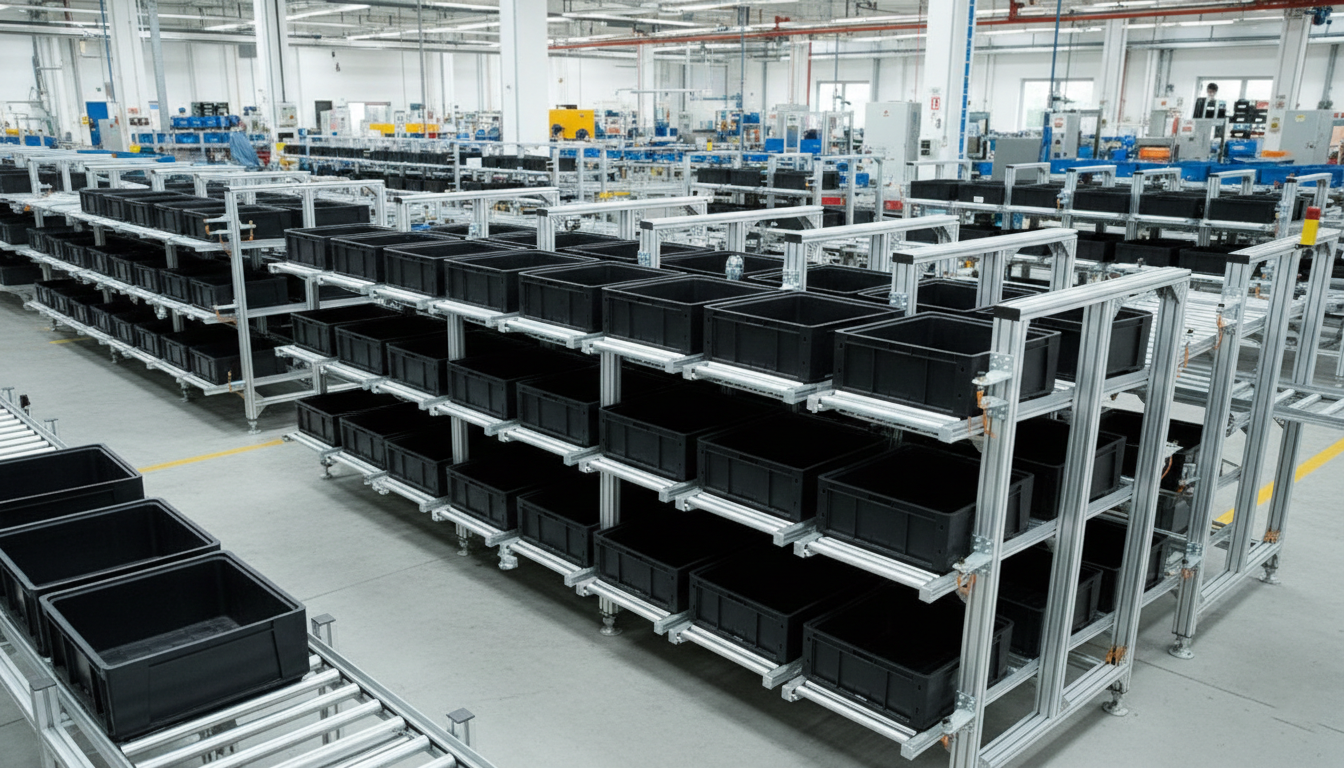
E-Commerce Pick Flow Racks Features
Modular aluminum carton flow rack systems engineered for reliability, flexibility, and lean material flow in any production or distribution environment.
Each-Pick Lane Presentation
Individual unit pick positions use open-face carton presentation with bin rail and unit stop — the front carton in the lane is held open at the pick face for each-unit extraction. When the front carton empties, the next full carton flows forward automatically.
High-Density SKU Configuration
E-commerce pick faces are designed for maximum SKU density per bay — narrow lane widths, high tier counts, and dense pick face layouts achieve 100+ active pick positions per linear aisle meter. Critical for omnichannel operations requiring thousands of active SKUs in a single pick zone.
Pick-to-Light Lane Indicators
Pick-to-light (PTL) display units at each lane position confirm the correct lane and quantity for each order line. PTL-guided picking achieves 99.9%+ order accuracy without RF scanner scanning delays — critical for high-rate parcel fulfillment.
Put-to-Light Compatible Layout
E-commerce flow rack bays are designed to accommodate put-to-light walls or order consolidation totes adjacent to the pick face. Put-wall integration connects flow rack pick positions to downstream batch order consolidation in high-velocity each-pick operations.
Velocity-Slotted Pick Face Design
A-items (top 20% by each-pick frequency) are slotted in the ergonomic primary pick zone. B-items in secondary reach positions. Velocity slotting analysis and lane numbering plan are provided as part of the pick face design deliverable.
Returns Processing Integration
E-commerce returns restocking positions are integrated into the pick face layout — dedicated restocking lanes receive returned units at the front face for immediate pick availability. Returns restocking at the pick face eliminates separate receiving and putaway for fast-moving SKUs.
Technical Specifications
Standard configurations for e-commerce pick flow racks systems. Custom lane widths, depths, heights, and track types available for any carton size or facility requirement.
Applications & Industries
E-Commerce Pick Flow Racks systems deliver reliable carton flow performance across a wide range of manufacturing, distribution, and fulfillment environments.
- B2C Parcel Fulfillment — High-velocity each-pick flow rack zones for consumer parcel orders — 200–600 picks per operator hour with PTL guidance and tote conveyor discharge.
- Omnichannel Retail Fulfillment — Combined B2B case-pick and B2C each-pick flow rack zones in a single DC — shared infrastructure for store replenishment cases and direct-to-consumer parcel each-picks.
- Subscription Box Fulfillment — Dense each-pick flow racks for subscription commerce kitting — all SKUs in each month's box accessible at the kitting station without operator travel.
- Same-Day & Last-Mile Fulfillment — Ultra-fast each-pick flow rack configurations for same-day fulfillment micro-DCs — maximum SKU density in minimum floor space for city-center fulfillment node operations.
- Health & Beauty E-Commerce — Dense high-SKU pick faces for fragrance, cosmetics, and personal care e-commerce operations. High SKU count with small carton sizes requires maximum lane density per bay.
- Apparel & Fashion Fulfillment — Style/size/color matrix pick faces with high lane count per bay. Velocity-slotted to place bestselling size-color combinations in primary pick positions.
- Pharmaceutical Mail Order — FIFO each-pick flow racks for mail-order pharmacy fulfillment. Lot-controlled expiry rotation with PTL-guided unit pick confirmation and lot scan at each-pick face.
- Electronics & Tech Accessories — Dense each-pick flow racks for consumer electronics accessories — high SKU count small-carton configurations with PTL accuracy confirmation for high-value unit picking.
Frequently Asked Questions
Common questions about e-commerce pick flow racks specification, configuration, and deployment.
What is each-pick vs. case-pick carton flow rack configuration?
Case-pick lanes present a full sealed carton at the pick face — the operator picks the entire carton as an order line. Each-pick lanes present an open carton at the pick face — the operator extracts individual units from the open carton. Each-pick positions include a bin rail to hold the carton open, a unit stop to prevent carton movement during pick, and a front label holder for SKU identification. Most e-commerce operations use each-pick configurations for direct-to-consumer orders.
How does pick-to-light improve e-commerce order accuracy?
Pick-to-light (PTL) illuminates the specific lane position and quantity to pick for each order line — the operator looks at the lit lane, picks the indicated quantity, and presses the confirm button. This reduces the cognitive load of reading a paper pick list or RF scanner screen, eliminates mispick from adjacent lanes, and achieves accuracy rates of 99.9%+ even at high pick rates. PTL is particularly effective in dense high-SKU e-commerce pick faces where adjacent lanes are very close together.
How many SKUs can an e-commerce carton flow rack zone hold?
SKU density depends on lane width and tier count. A standard 1200 mm wide bay with 6 tiers and average 150 mm lane widths holds approximately 48 lanes per face = 48 active SKUs per bay face. A double-sided aisle with 10 bays per side = 960 active SKUs per aisle at 20 m of aisle length. Full DC-scale e-commerce zones with multiple parallel aisles accommodate 5,000–50,000+ active SKUs depending on DC size.
What pick rate is achievable with e-commerce carton flow racks?
Experienced pickers with PTL guidance achieve 300–600 each-picks per hour in dense ergonomic flow rack pick zones, depending on pick density (picks per order), tote/cart change time, and zone balancing. Compare this to 100–150 picks per hour from flat shelf picking without PTL. E-commerce flow rack with PTL typically doubles or triples operator pick rate versus non-flow rack alternatives.
How is returns processing integrated into e-commerce pick flow racks?
Returns restocking lanes are positioned at convenient intervals in the pick face layout — typically one restocking position per 10–20 pick lanes. Returns arrive at the restocking position on a separate induction conveyor or cart and are loaded into the flow rack lane from the front. The restocked unit flows to the pick face where it is immediately available for the next order. This eliminates separate receiving, putaway, and system update steps for returned e-commerce units.
How is velocity-based slotting applied to e-commerce flow rack pick faces?
Velocity analysis ranks all active SKUs by each-pick frequency over a rolling 30–90 day period. Top 20% (A-items) are assigned to the primary ergonomic zone (900–1800 mm from floor, minimum travel distance from aisle entry). Next 30% (B-items) fill secondary ergonomic positions. Bottom 50% (C-items) occupy less ergonomic tiers. Slotting is refreshed periodically as velocity profiles change seasonally. Modular Solutions provides the velocity analysis and slotting assignment plan as part of the pick face design.
Build Your E-Commerce Pick Face
High-velocity each-pick carton flow racks designed for your SKU depth, pick rate target, and PTL system. Velocity-slotted, ergonomic, and accuracy-ready.
Request a Quote Email Our Team