Gravity Carton Flow Racks
Inclined gravity-fed lanes delivering cartons to line-side pick faces with zero energy — smooth roller track, adjustable pitch, and modular aluminum frames sized to your carton and replenishment cycle.
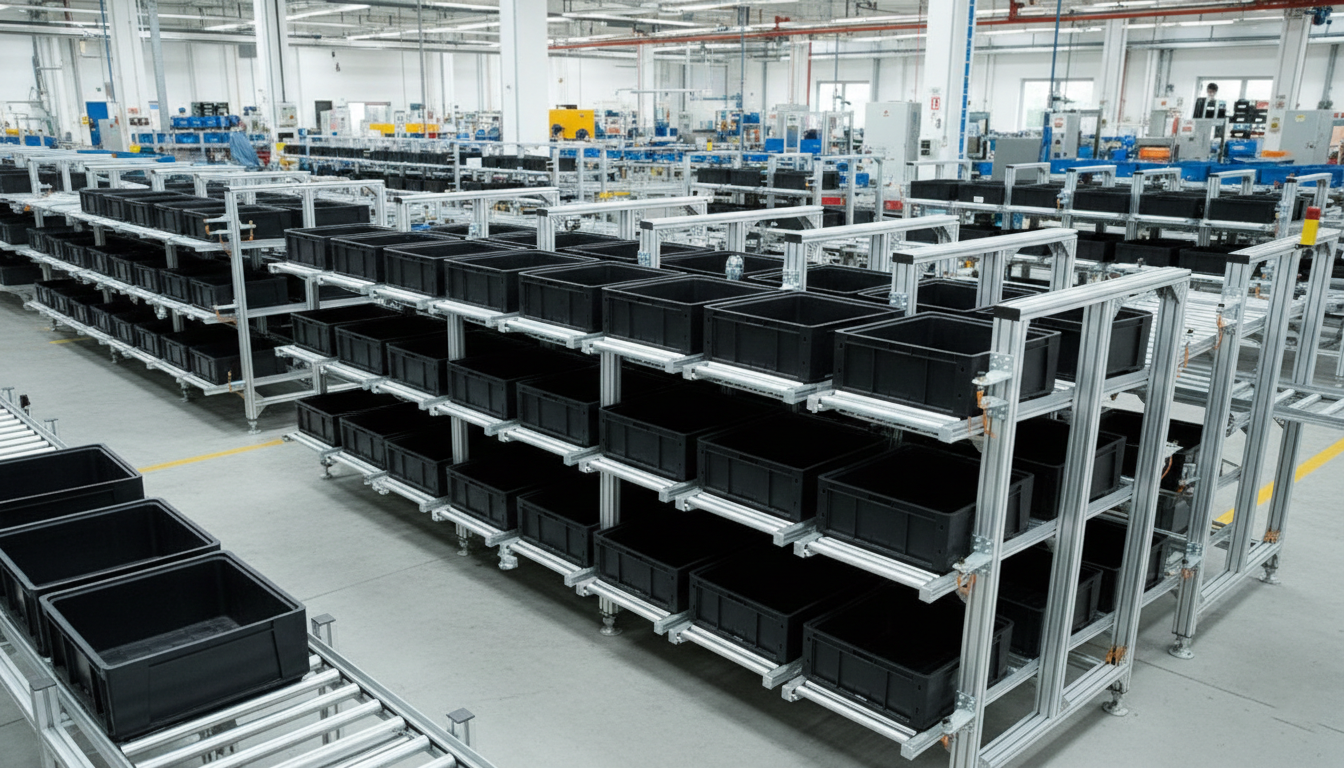
Gravity Carton Flow Racks Features
Modular aluminum carton flow rack systems engineered for reliability, flexibility, and lean material flow in any production or distribution environment.
Zero-Energy Gravity Feed
Inclined lane geometry delivers cartons forward under gravity alone. No motor, no conveyor belt, no energy cost — cartons slide smoothly from load end to pick face whenever the front position empties.
Precision Roller & Wheel Track
Plastic wheel track or steel roller track selected to match carton weight and base material. Sealed bearings resist dust and contamination. Track pitch is adjustable to control flow speed for heavy cartons or sensitive product.
Adjustable Lane Pitch
Lane angle adjusts in the field to calibrate carton speed. Heavy cartons run at lower pitch; lighter cartons may need less inclination. Fine-tuning eliminates jamming and prevents cartons from arriving too fast at the pick face.
Lane Depth Sized to Replenishment Cycle
Lane depth is calculated to hold the number of cartons needed between replenishment events — typically one to three shifts. Longer lanes reduce operator replenishment frequency; depth is sized to fit available floor space.
FIFO Inventory Rotation Built In
Rear-load / front-pick geometry ensures the oldest carton is always at the pick face — first in, first out by design. No operator discipline required; rotation is enforced by the physical lane configuration.
Modular Aluminum Frame
T-slot aluminum extrusion frames accept any lane width, height, or depth without custom fabrication. Accessories — Kanban holders, label frames, dividers, and bin stops — attach without drilling.
Technical Specifications
Standard configurations for gravity carton flow racks systems. Custom lane widths, depths, heights, and track types available for any carton size or facility requirement.
Applications & Industries
Gravity Carton Flow Racks systems deliver reliable carton flow performance across a wide range of manufacturing, distribution, and fulfillment environments.
- Automotive Assembly — Line-side carton flow racks feeding subassembly workstations with JIT kitting cartons. Gravity flow eliminates manual pushing and ensures FIFO part rotation at every station.
- Lean Manufacturing — Supermarket lanes for kanban pull systems — empty lane triggers replenishment signal. Gravity feed keeps visual management simple and operator effort minimal.
- Food & Beverage Distribution — Date-coded carton rotation using gravity FIFO lanes. Cold-room compatible aluminum and plastic wheel track for refrigerated warehouse applications.
- Pharmaceutical Warehousing — FIFO lot rotation for expiry-managed carton inventory. Smooth roller track prevents carton damage; lane depth calibrated to batch replenishment schedules.
- E-Commerce Fulfillment — Pick face lanes for each-pick and multi-item carton operations. High lane density in gravity rack bays maximizes SKU count per bay.
- Electronics Manufacturing — ESD-safe lane options for static-sensitive component cartons. Gravity feed to kitting carts at assembly workstations without forklift access.
- 3PL Distribution — Configurable gravity flow racks shared across multiple clients — adjustable lane width and depth for rapid changeover between product profiles.
- Tier-1 Automotive Suppliers — Mixed carton size gravity lanes for sequenced production delivery. Lane-per-part-number organization supports Andon-triggered pull replenishment.
Frequently Asked Questions
Common questions about gravity carton flow racks specification, configuration, and deployment.
What carton sizes work with gravity flow rack lanes?
Gravity carton flow lanes are configured to specific carton footprints. Lane width is set to the carton width plus a small clearance (typically 10–20 mm). Lane depth accommodates the carton length. Standard RSC carton sizes from small parts boxes (150×100 mm) to full master cartons (600×400 mm) are supported. Mixed carton sizes in the same bay require individual lane width adjustment.
How do I determine the correct lane pitch?
Lane pitch is set based on carton weight, base material, and desired flow speed. Light cartons on smooth bases flow at 2–3°; heavy cartons on rough corrugated bases may need 5–7°. Modular Solutions specifies initial pitch from carton data and adjusts in the field during commissioning. Field-adjustable pitch brackets are standard on all systems.
Can gravity flow racks operate in cold storage?
Yes. Aluminum frames do not corrode in cold or humid environments. Plastic wheel track components operate reliably at temperatures as low as −20 °C. Stainless steel fasteners are specified for high-humidity cold rooms. Lane pitch may require slight increase at very low temperatures due to reduced wheel rolling efficiency.
How deep should gravity carton flow lanes be?
Lane depth is calculated from the carton length × the number of cartons needed per replenishment cycle. A common target is 4–8 hours of supply per lane. For example, 30 cartons at 300 mm length each requires approximately 9 m of lane depth — typically divided across two back-to-back bay depths. Modular Solutions balances lane depth against available floor space.
What stops cartons at the pick face?
A fixed or adjustable carton stop at the front of each lane prevents the lead carton from falling off. The stop is sized to the carton height and allows easy front-face pick without lifting over the stop. When the front carton is removed, the next carton flows forward. Optional metering stops are available for high-pitch or heavy-carton lanes to decelerate the incoming carton.
How are gravity carton flow racks integrated with Kanban?
Kanban card holders mount to the front face of each lane. The card for the lane's SKU rides with the last carton in the lane — when that carton is picked, the card is visible and the material handler takes it to the replenishment queue. The empty or near-empty lane provides a visual reorder signal. Two-bin Kanban divides each lane into a front active bin and a rear reserve bin using a physical lane stop.
Specify Your Gravity Flow Lanes
Gravity carton flow racks designed to your carton sizes, replenishment cycle, and facility layout. Modular, adjustable, and built for lean production environments.
Request a Quote Email Our Team