Mobile Carton Flow Racks
Carton flow rack systems on heavy-duty casters that reposition between production stations, model changeover positions, and line-side staging zones without disassembly. Load the rack at the warehouse, roll it to the line, and roll it back for the next program — continuous flow delivered to wherever it's needed.
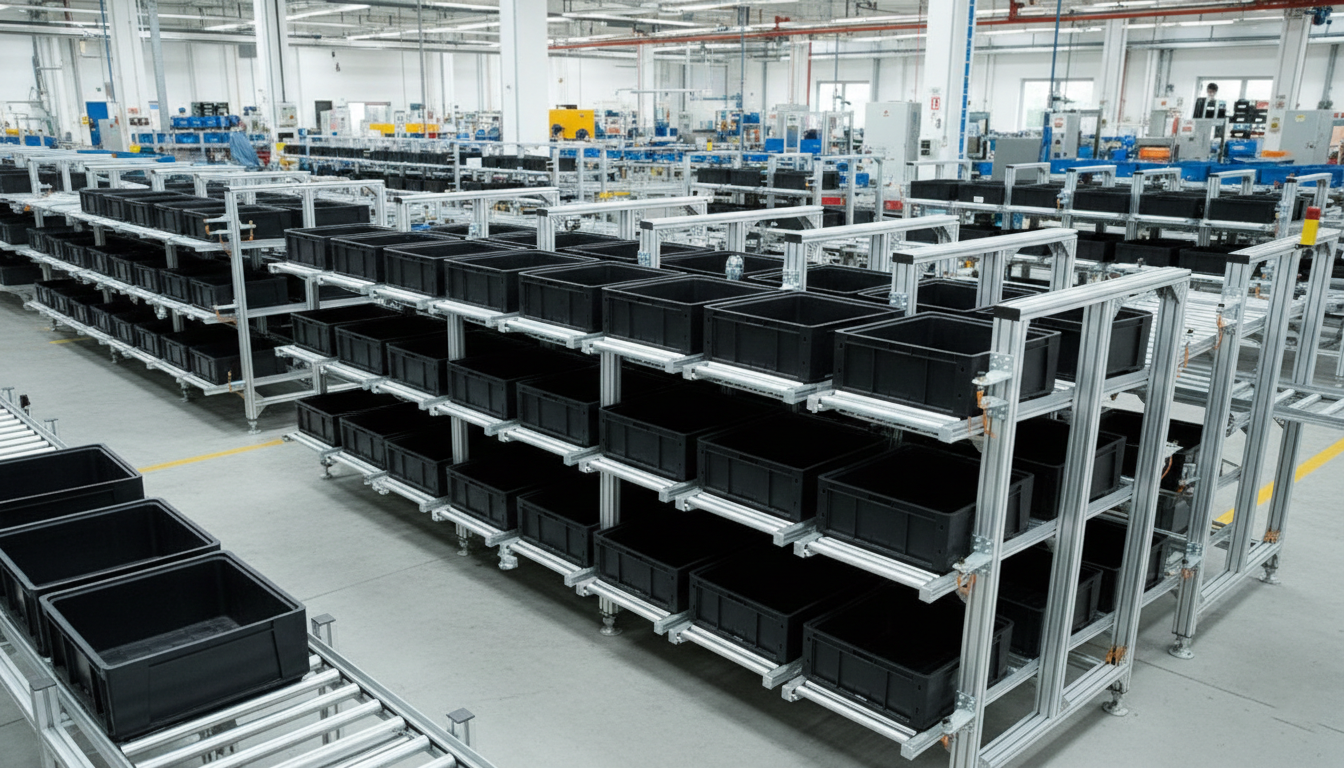
Mobile Carton Flow Racks Features
Modular aluminum carton flow rack systems engineered for reliability, flexibility, and lean material flow in any production or distribution environment.
Heavy-Duty Swivel & Locking Casters
Mobile flow racks roll on industrial-grade 200–250 mm swivel casters rated to the full loaded rack weight. Locking casters immobilize the rack at the work position — foot-operated locks engage without tools and release with a kick.
Warehouse-to-Line Material Flow
Racks are loaded at the warehouse/supermarket area and rolled to the production line — eliminating the intermediate handling step of unloading a pallet and hand-stacking cartons at the line-side rack. The entire loaded rack moves as a single unit.
Model Changeover Without Rack Replacement
Different model builds require different carton configurations. Mobile racks pre-configured for each model kit roll in and out of the line position during model changeovers — no lane reconfiguration at the line, no replenishment during changeover window.
Tugger Train Compatible
Mobile carton flow racks are engineered with standard tugger train hitch points for tow-train delivery from a warehouse supermarket to multiple line positions. Single route delivery of multiple loaded racks to multiple stations in one tugger pass.
Adjustable Lane Configuration Per Rack
Each mobile rack is configured for the carton sizes of the program it serves. When a rack is reassigned to a different program, lane widths and depth stops adjust at the supermarket before the next load.
Ergonomic Reach Height on Wheels
Mobile rack heights are designed so all pick levels remain ergonomic when the rack is positioned at the workstation. Caster height is accounted for in the frame dimension so lane heights are correct in the working position.
Technical Specifications
Standard configurations for mobile carton flow racks systems. Custom lane widths, depths, heights, and track types available for any carton size or facility requirement.
Applications & Industries
Mobile Carton Flow Racks systems deliver reliable carton flow performance across a wide range of manufacturing, distribution, and fulfillment environments.
- Automotive Mixed Model Assembly — Per-model carton racks pre-loaded at supermarket and exchanged at line position during model changeover. One rack per model per station — zero line-side replenishment during production.
- Lean JIT Production Lines — Tugger train delivery of loaded mobile carton racks from warehouse supermarket to multiple line-side positions in a single route pass. Empties return on the same route.
- Flex Manufacturing Cells — Reconfigurable production cells that move between programs need mobile carton racks that move with the cell. The same rack infrastructure serves the cell at any floor position.
- Kitting & Pre-Assembly Areas — Mobile flow racks pre-staged with kitting BOM cartons at the warehouse and rolled to the kitting station at the start of each kit build run. Kitted contents depleted; empty rack returned.
- Maintenance & Repair Operations — MRO parts carton racks on casters moved to the work area when maintenance is planned. Common parts stay in the rack; rack moves to the asset being maintained.
- Trade Show & Demo Environments — Mobile flow rack systems demonstrate modular material flow concepts at trade shows and customer site demos. Roll in, set up, and roll out without installation.
- Seasonal Production Surge — Extra capacity mobile racks stored during regular production and deployed to supplement fixed line-side racks during peak seasonal production periods.
- Pharmaceutical Packaging Lines — Mobile carton racks pre-loaded with the packaging BOM cartons for each product campaign. Roll to the packaging line at campaign start; roll out at completion for the next campaign setup.
Frequently Asked Questions
Common questions about mobile carton flow racks specification, configuration, and deployment.
What floor surface is required for mobile carton flow racks?
Mobile carton flow racks require a smooth, level concrete floor rated for the loaded rack weight. Forklift-grade epoxy or sealed concrete floors are ideal. Expansion joint crossings, floor drains, and elevation changes require caster wheel diameter selection and approach speed management. Unsealed aggregate or rough concrete floors damage wheel track bearings and reduce caster life significantly.
How are mobile flow racks integrated into a tugger train route?
Mobile racks are fitted with standard A-frame or horizontal pin tow hitches that connect to tugger train carts or directly to the tugger. Hitches are installed at the rear of each rack. Route planning sizes the rack to the tugger train cart width standard used in the facility. A single tugger route delivers multiple loaded racks to line positions and retrieves empties in one pass.
Can mobile carton flow racks handle the same weights as fixed racks?
Yes, subject to caster load rating. The caster system is specified to the gross rack weight at full lane capacity with an additional safety margin. Heavy carton applications (20–30 kg per carton) require larger-diameter, higher-load-rated casters and a more rigid frame structure. The caster selection is confirmed by calculating the total live load of all lanes simultaneously at full capacity.
How are mobile racks stabilized to prevent movement during picking?
Foot-operated locking casters immobilize the rack at the work position. All four casters lock independently — locking all four casters creates a stable fixed position that withstands normal picking force and operator lean. For high-force operations (heavy carton pull), additional toe-down locking brackets can be specified.
How is per-program lane configuration managed for mobile racks?
Each mobile rack is labeled for the program or model it currently serves. At the warehouse supermarket, racks are reconfigured and loaded for the next run before delivery to the line. Lane width cards (hanging on the frame) specify the divider positions for each lane. Adjustable dividers are repositioned during the pre-load setup, not at the production line.
What is the maximum safe travel distance for rolling loaded mobile racks?
Safe rolling distance depends on floor condition, rack weight, and caster diameter. Most mobile rack systems travel up to 100–200 m safely on forklift-grade floors. For longer distances, tugger towing is preferred over manual pushing. Manual pushing of racks exceeding 200 kg gross weight is not recommended without mechanical assist.
Put Your Carton Flow Rack on Wheels
Mobile carton flow racks engineered for your carton load, caster floor type, and tugger integration. Full line-side flexibility without fixed installation.
Request a Quote Email Our Team