Narrow Aisle Flow Racks
Compact-depth carton flow racks engineered for narrow aisle picking environments where full-depth FIFO bays won't fit. Shallow bay depths, single-sided configurations, and optimized lane profiles deliver gravity flow pick faces in the tightest production floor and warehouse layouts.
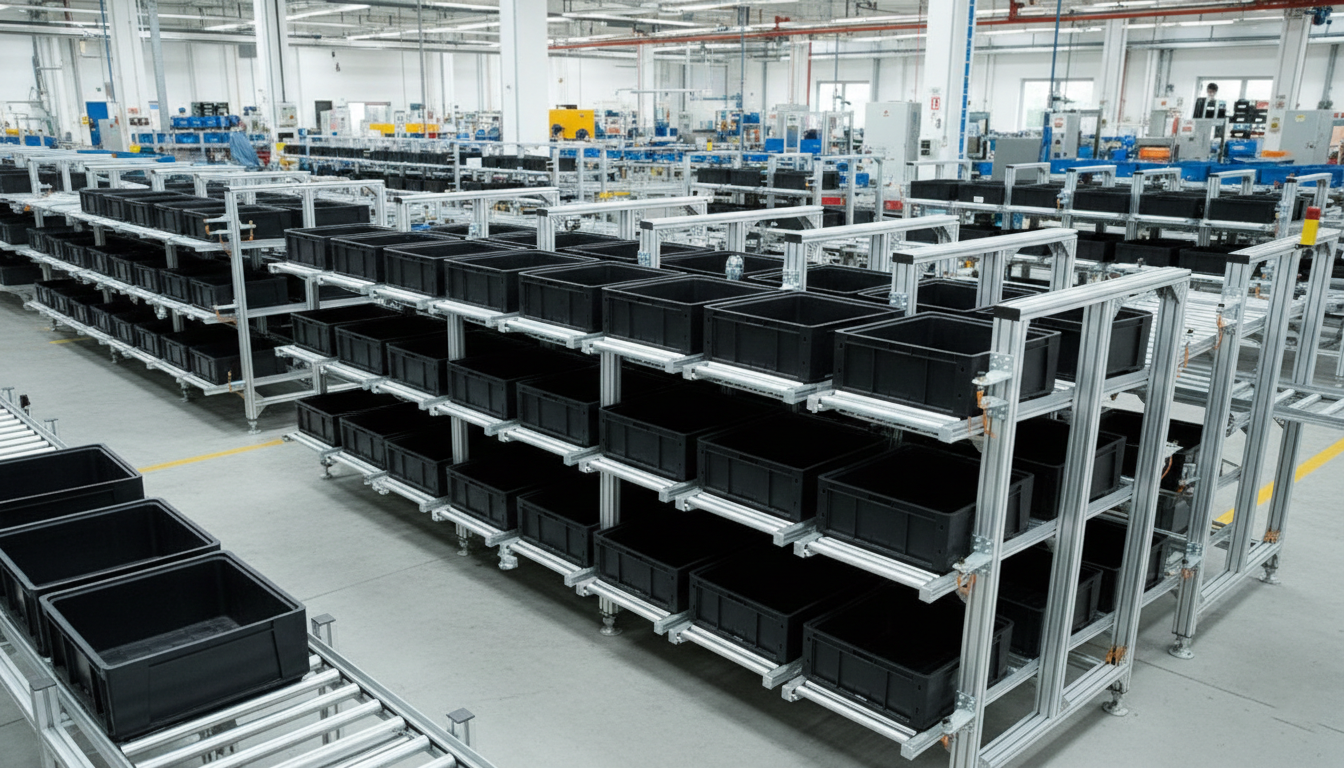
Narrow Aisle Flow Racks Features
Modular aluminum carton flow rack systems engineered for reliability, flexibility, and lean material flow in any production or distribution environment.
Shallow Bay Depth for Tight Aisles
Narrow aisle carton flow racks are designed with reduced bay depths — as shallow as 300–500 mm — for locations where standard 900–1200 mm depths create aisle clearance problems. Shallow depth requires more frequent replenishment but delivers the gravity flow pick face format in constrained spaces.
Single-Sided Aisle Configurations
Narrow aisle systems are typically single-sided — one pick face per aisle with the rack back against a wall or structural column. Single-sided configurations allow narrower aisles (900–1200 mm) compared to double-sided systems requiring 2400+ mm.
Reduced Replenishment Footprint
Narrow aisle flow racks are replenished from the same aisle as picking using a step stool, mini tugger, or cart — eliminating the need for a separate rear replenishment aisle. Replenishment occurs during off-peak periods to avoid pick/replenishment aisle conflicts.
Compact Lane Profile
Narrow aisle lane designs use lower-profile track and dividers to minimize overall rack depth. Roller ball arrays replace full-depth track in the shallowest configurations while maintaining smooth carton flow.
Line-Side Production Floor Applications
Narrow aisle flow racks are particularly suited for line-side production floor applications where aisle space between workstations is limited. A 300–400 mm deep rack feeds 2–4 lanes of cartons to the workstation without consuming the operator's walking aisle.
Modular Extension to Full Depth
If layout constraints change, narrow aisle frames extend to full depth by adding rear frame sections and additional track. No replacement of the original frame investment is required.
Technical Specifications
Standard configurations for narrow aisle flow racks systems. Custom lane widths, depths, heights, and track types available for any carton size or facility requirement.
Applications & Industries
Narrow Aisle Flow Racks systems deliver reliable carton flow performance across a wide range of manufacturing, distribution, and fulfillment environments.
- Line-Side Assembly Stations — Compact flow racks between assembly workstations on tight production floors. 300–500 mm depth feeds component cartons without consuming operator walking clearance.
- Small Warehouse Operations — Narrow DC or warehouse aisles too tight for standard flow rack depth. Single-sided shallow bays maximize pick face SKU density in constrained building footprints.
- Retrofit Into Existing Shelving — Narrow aisle flow rack sections replace static shelving in existing narrow aisle operations — adding gravity flow and FIFO rotation without widening the aisle.
- Cold Storage Pick Rooms — Compact flow racks in refrigerated and frozen pick rooms where every centimeter of cold space is costly. Shallow depth minimizes the volume of cold room occupied by each bay.
- Hospital & Healthcare Storerooms — Supply storeroom narrow aisle carton flow racks for medical supply and pharmaceutical FIFO rotation in tight hospital corridor and supply room applications.
- Retail Backroom Operations — Store backroom carton flow racks for retail receiving and shelf replenishment staging. Shallow depth fits backroom aisles sized for stock carts rather than forklifts.
- Clean Room Environments — Low-profile narrow aisle flow racks for cleanroom and controlled environment pick areas where equipment height and footprint is restricted by cleanroom classification and airflow requirements.
- Mezzanine Level Pick Areas — Mezzanine-level narrow aisle carton flow racks where floor loading and column spacing restrict full-depth bay installation. Shallow bays reduce structural load per unit area.
Frequently Asked Questions
Common questions about narrow aisle flow racks specification, configuration, and deployment.
What is the minimum depth for a functional carton flow rack lane?
The minimum functional depth for carton flow is approximately 300 mm using a roller ball array — enough for a single carton depth per lane. This provides gravity presentation of one carton at the pick face with immediate replenishment required when the carton is removed. Wheel track lanes require a minimum of approximately 500 mm to accommodate the track geometry and carton stop. Most narrow aisle applications use 500–750 mm depth to hold 2–4 cartons per lane.
Can narrow aisle flow racks be replenished from the same aisle as picking?
Yes. Front-load configurations replenish from the pick aisle, typically during off-peak periods or shift breaks. The replenishment person loads cartons from the front face into the rear of the lane — the opposite of FIFO protocols. For operations requiring strict FIFO, front-load configurations are not appropriate; a rear-load aisle or time-separated replenishment protocol is required instead.
How is FIFO maintained in shallow-depth flow rack lanes?
Shallow lanes holding only 1–3 cartons naturally maintain FIFO as long as the lane fully empties before replenishment. If partial lane replenishment is performed, FIFO requires placing new cartons behind remaining old cartons. In very shallow lanes (single carton depth), FIFO is maintained by design — each carton is fully consumed before the next arrives.
What is the minimum aisle width for narrow aisle carton flow rack operations?
Single-sided narrow aisle carton flow operations require a minimum aisle width of 900–1000 mm for pedestrian-only replenishment. Double-sided pick aisles with pedestrian traffic require 1800–2000 mm. If a mini tugger or cart is used for replenishment in the same aisle, 1200–1500 mm is the minimum for safe pedestrian/cart coexistence.
Can narrow aisle flow racks be wall-mounted instead of floor-standing?
Yes. Narrow aisle flow rack frames can be wall-mounted using bracket systems for very tight spaces where floor-standing frames would obstruct the aisle. Wall-mount systems are common in healthcare storerooms, cleanrooms, and retail backrooms. Wall-mount requires structural wall assessment for the combined live load of all lanes at full carton capacity.
How does narrow aisle flow rack depth affect replenishment frequency?
Lane replenishment frequency is inversely proportional to lane depth. A 300 mm lane holding one carton requires replenishment after every pick. A 900 mm lane holding three cartons requires replenishment three times less frequently. The replenishment frequency target should be determined by the available replenishment labor and schedule, then the minimum depth that achieves that target is specified.
Make Your Narrow Aisles Work Harder
Narrow aisle carton flow racks designed for your minimum aisle clearance, carton size, and replenishment method. Maximum pick face density in your tightest spaces.
Request a Quote Email Our Team