Gravity flow racks on casters with built-in kanban card holders, signal flags, and lane-empty indicators — the complete pull-system replenishment station that moves wherever the work is. Engineered for lean manufacturing environments.
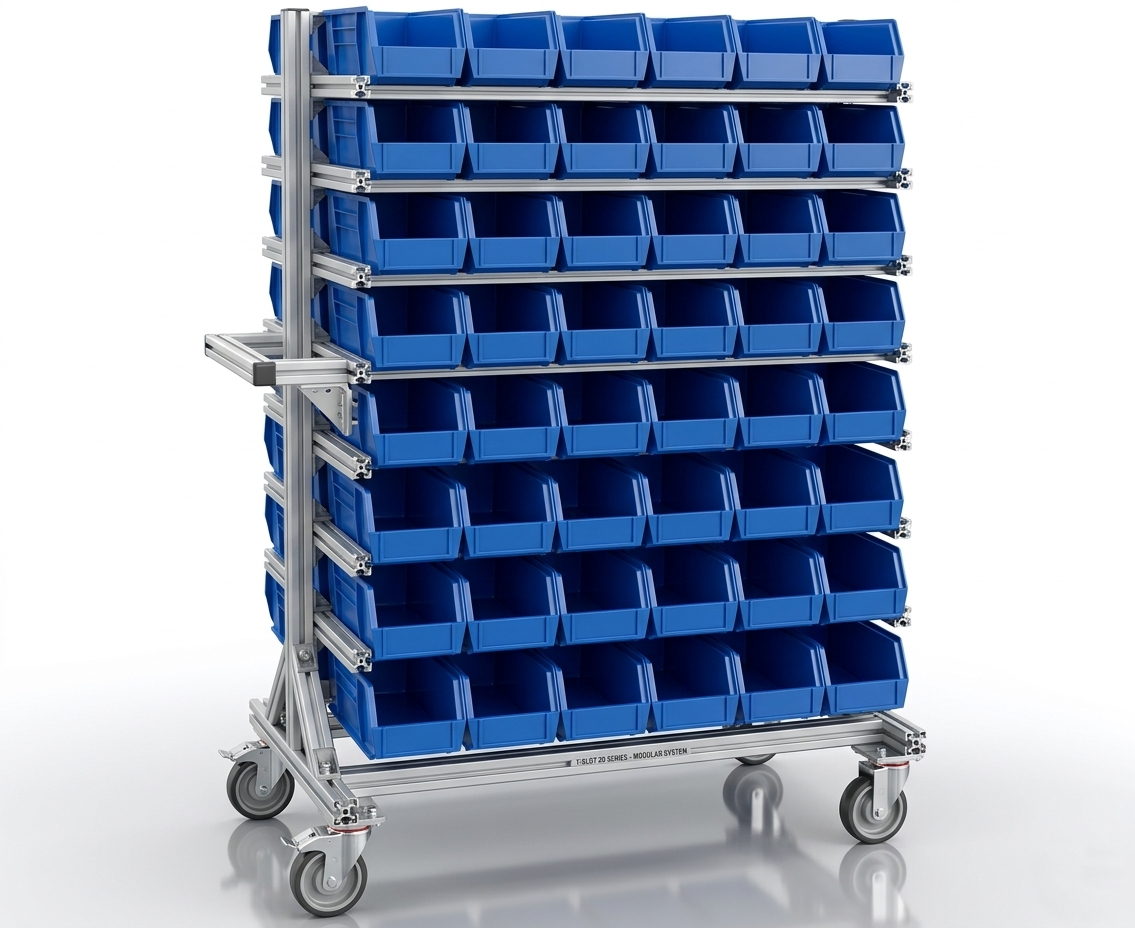
Mobile kanban racks combine gravity-fed FIFO lanes with integrated visual management — all on a caster base that repositions without disassembly.
Each lane has a dedicated kanban card holder at the front rail. The card is visible the moment the lane empties, triggering replenishment without any counting, scanning, or WMS query by the line operator.
Color-coded lane tags, header boards, and flag brackets attach to the T-slot frame — red/yellow/green status is visible from across the floor so supervisors can read replenishment status at a glance.
Lane depth is sized to hold exactly two containers. When the front container is consumed, the rear container slides forward and the kanban card triggers replenishment — zero stock-out, zero excess inventory.
Lane-empty sensors and andon signal lights mount directly on the rack frame. Wireless kanban signals can transmit lane-empty events to WMS or ERP systems automatically without operator input.
A single rack manages eight to twenty part numbers depending on lane width and tier count. Lane assignments change by swapping card holders and labels — no structural modification needed during product changeovers.
RFID antenna mounts and barcode scanner brackets attach to the front frame rail — scan-on-pick is triggered automatically when a container is removed from the lane, logging the replenishment event to the WMS.
45mm or 90mm aluminum T-slot extrusion
125mm or 150mm swivel with 2 locking brakes
A5 (148×210mm) or A6 (105×148mm) standard; custom available
Manual flag, andon light tower, or wireless sensor
Roller track, skate wheel, or poly-wheel rail
1–4 tiers per frame
8–20 part numbers per rack depending on lane width
Up to 1000kg total distributed load
Natural anodized aluminum; color-coded lane tags
Mobile kanban racks support lean pull-system material flow across a wide range of manufacturing, assembly, and distribution operations.
Position at workstations and manage 8-20 part numbers per rack with per-lane kanban triggers and zero stock-out risk.
Reposition the rack as the cell layout evolves without rebuilding the kanban system — card holders and signals follow the rack.
Change lane assignments between production models by swapping card holders and lane tags in minutes, not hours.
Use as a moveable supermarket station that delivers kanban-triggered containers from warehouse to point-of-use on a milk-run schedule.
Kanban card holders are T-slot clip-on accessories that attach at the front or rear of each lane. The card travels with the last container in the lane — when that container is consumed, the card is visible and is routed to the warehouse for replenishment. The holder position, card size, and attachment orientation are configured per lane at the time of rack manufacture.
Yes. Lane-empty sensors (photoelectric or weight-based) can be wired to an andon signal light tower mounted on the rack frame using DIN rail hardware in the T-slot. When a lane empties, the sensor signals the andon light and can also transmit a wireless kanban signal to a warehouse management system. Modular Solutions can supply the sensor and wiring, or coordinate with your existing WMS integration team.
Standard kanban card holders accommodate A5 (148mm x 210mm) and A6 (105mm x 148mm) cards. Custom holder widths are available for non-standard cards or laminated tag formats. Holders are available in clear polycarbonate for card visibility or colored plastic for lane color-coding.
In a two-bin system, the rack lane holds two containers. A kanban card is placed behind or beneath the rear container. When the front container is emptied and removed, the rear container slides forward to become the active pick container — and the kanban card is now visible, signaling that a replacement container needs to be replenished into the rear loading position. This gives the line uninterrupted supply while the replenishment cycle completes.
Yes. Each lane is assigned one part number with its own kanban card holder, color-coded lane tag, and reorder point label. A single rack can manage eight to twenty part numbers depending on lane width and tier count. Lane assignments can be changed by swapping card holders and labels — no physical modification to the rack structure is needed.
Share your part list, container sizes, and replenishment trigger requirements — we will configure a rack that supports your pull system from day one.
Request a Quote