Mobile gravity flow carts for routing sub-assemblies, carriers, and WIP containers through production cells and assembly lines — maintaining FIFO sequence, tracking identity, and buffering inter-operation inventory on the move.
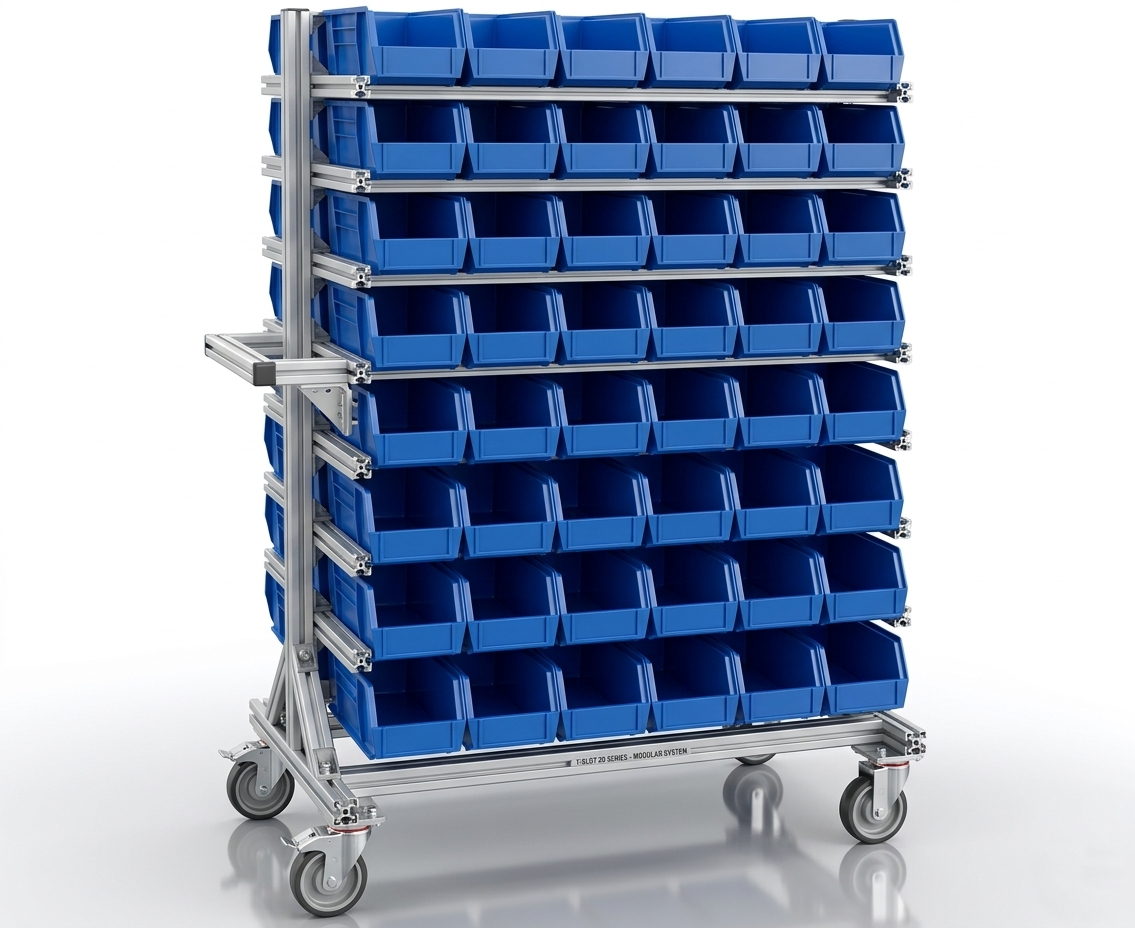
WIP flow carts replace flat-shelf staging trolleys with structured, sequenced, gravity-fed lanes — reducing operator search time, preserving build order, and enabling cell-level WIP control without floor space for fixed buffering.
Gravity lanes ensure that sub-assemblies leave each operation in the same order they entered. Serial number and lot traceability are maintained end-to-end without operator sorting or re-sequencing.
Lane rails and end stops are configured to locate steel carriers, foam-padded fixtures, or custom dunnage trays precisely at the pick face — supporting robotic and operator access without positioning fixtures on each cycle.
Lane-full and lane-empty sensors provide real-time WIP level data to the cell controller or MES. Supervisors see buffer levels at a glance without walking the floor to count containers.
Presence sensors in each lane can signal the cell controller to hold the next operation start if the previous operation did not return a container to the lane — preventing skipped operations and missed inspections.
RFID antenna mounts and barcode scanner brackets at lane entry and exit log each sub-assembly as it moves through the WIP route — providing full genealogy traceability without paper travelers.
Lane depth is calculated from the operation cycle times and planned WIP buffer for each cell. Modular Solutions delivers a cart that holds exactly the right number of containers — no over-buffering, no starvation.
45mm or 90mm aluminum T-slot extrusion
100mm–150mm swivel with 2 locking brakes
Steel carriers, foam fixtures, custom dunnage trays
Photoelectric presence, weight-based, or RFID
1–4 tiers per frame
Up to 800kg total distributed load
RFID antenna mount, barcode scanner bracket
Sized to operation cycle times and planned buffer level
Natural anodized aluminum; stainless hardware available
WIP flow carts support in-process material routing across a wide range of discrete manufacturing, assembly, and quality operations.
Move sub-assemblies between production cells on a gravity-fed cart, maintaining build sequence and WIP visibility at each handoff point.
Buffer inter-operation inventory at the assembly line with a defined lane capacity that prevents over-accumulation and line starvation.
Stage quality-hold containers in a dedicated flow cart lane with visual red-tag identification, isolated from the main production route.
Route rework containers through repair cells on a dedicated WIP cart with FIFO tracking so oldest rework items are processed first.
A WIP flow cart has gravity-fed lanes on each tier instead of flat shelves. Sub-assemblies or containers are loaded at the rear and gravity-feed to the front pick position. This eliminates the operator reaching past work to retrieve a container and maintains FIFO sequence through the production route — which is especially important for date-coded components, serialized assemblies, or operations with first-fail-first-fix rework tracking.
Yes. WIP flow cart lanes can be configured to hold steel carriers, foam-padded fixtures, or custom dunnage trays. The lane width and rail height are set to match the carrier footprint. Locating pins or end stops position carriers precisely at the pick face for robot or operator access.
Cart ID plates, RFID tag mounts, and barcode label holders are standard T-slot accessories. Scan points can be set at each cell entry and exit to log the cart and its contents through the route. Modular Solutions supplies the mounting hardware; the customer specifies or supplies the scanning and tracking system.
Yes. Presence sensors in the cart lanes can signal the cell controller when a container is removed or returned. If the correct container is not returned to the lane after the operation, the sensor detects the missing item and the cell controller can hold the next operation start. Sensor mounting brackets attach to the T-slot frame without welding.
A three-tier WIP flow cart can typically buffer one to three operations depending on container size and cycle time. Carts are designed for the production cell's target WIP buffer — Modular Solutions calculates the required lane capacity from the operation cycle times and planned WIP levels specified by the customer.
Share your cell layout, container types, cycle times, and WIP buffer targets — we will design a cart that fits your route and keeps your production flowing.
Request a Quote