Inclined Flow Frames

Pre-set and adjustable-incline frame assemblies providing the gravity slope for reliable FIFO container feed — welded and bolted incline frame structures in standard and custom angles for roller track, skate wheel, and pipe-and-joint lane systems.
Why Choose Inclined Flow Frames

Fixed-Angle Pre-Set Frames

Standard incline frames are pre-fabricated at fixed incline angles of 2.5°, 3.5°, and 5° — the three angles that cover the vast majority of carton, bin, and tote gravity flow applications. Fixed-angle frames are the lowest-cost option, ship pre-assembled, and require only upright installation at the facility.

Adjustable-Angle Frames

Adjustable incline frames use a pivot-and-lock mechanism at the front and rear rail supports, allowing the lane incline to be set anywhere from 1° to 10° after installation. Adjustable frames are specified when the container mix is expected to change, or when the correct incline for the container and lane hardware combination is uncertain at order time.

Multi-Tier Frame Structures

Inclined flow frames are available in single-tier, two-tier, and three-tier configurations. Multi-tier frames share common uprights between tiers to reduce material cost and floor footprint. Tier heights are adjustable in 50mm increments to match the container height and provide ergonomic operator access to each tier.

Frame Material Options

Standard frames are 6063-T5 anodized aluminum extrusion with welded or bolted joints. Powder-coated mild steel frames are available for higher load capacities. 304 or 316L stainless steel frames are available for washdown, food-grade, and pharmaceutical environments. All frame material options accept the same lane hardware and accessories.

Leveling Feet and Casters

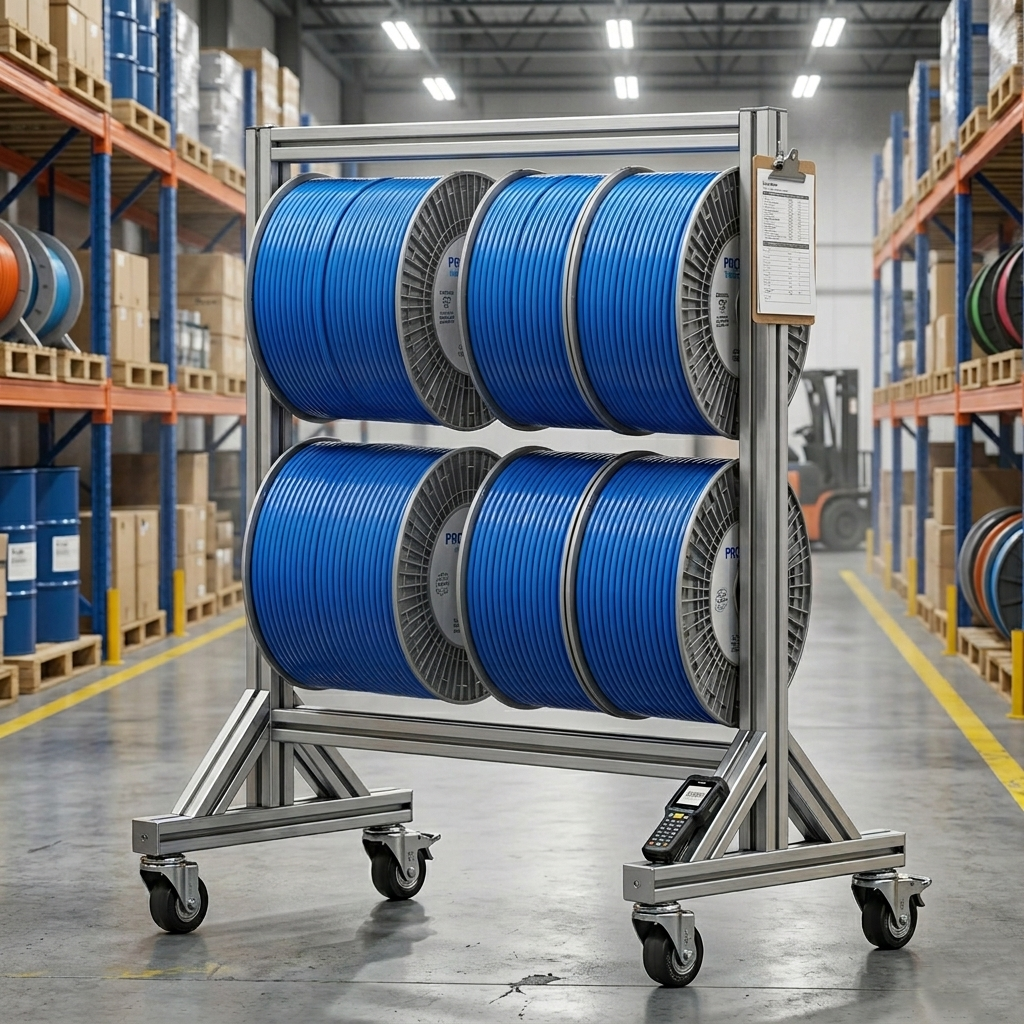
All incline frames include leveling feet adjustable over a 50mm range to compensate for uneven floors without shimming. Optional swivel and locking casters allow the frame to be repositioned within the production cell between shifts, enabling flexible cell layouts and production line rebalancing without tools.

Integrated Cross-Bracing

Incline frames include diagonal cross-bracing in the rear upright plane for racking resistance. Cross-bracing is designed to clear the rear-loading aisle depth while providing the structural rigidity required for fully loaded frames in seismic and vibration-intensive production environments.

Specifications

Fixed Angles

2.5°, 3.5°, 5° standard; custom on request

Adjustable Range

1° to 10° continuous; pivot-and-lock mechanism

Frame Material

Anodized aluminum, powder-coated steel, SS 304/316L

Tier Configurations

1, 2, or 3 tier; shared uprights

Tier Height Adjustment

50mm increments; matches container height

Leveling Feet

50mm range; standard on all frames

Caster Option

Swivel locking casters; tool-free repositioning

Cross-Bracing

Rear-plane diagonal; clears rear aisle depth

Load Capacity

Up to 1000kg distributed per bay (material dependent)

Applications

Manufacturing Supermarkets

Line-side supermarket flow rack frames for production pull systems where fixed-angle incline frames provide consistent container feed across all lanes in the cell.

Warehouse Pick Modules

Multi-tier incline frames in warehouse order fulfillment pick modules where two and three-tier configurations maximize vertical SKU density per floor footprint.

Flexible Production Cells

Caster-mounted adjustable incline frames in flexible manufacturing cells that are repositioned between product runs or reconfigured for new product introductions.

Regulated Environments

Stainless steel incline frames for pharmaceutical, food-grade, and cleanroom production environments where the frame structure must meet material and sanitation requirements.

Frequently Asked Questions

What incline angle should I specify for my application?

The correct incline angle depends on the container weight, the lane track type, and the container base material. As a starting point: 2.5 degrees for heavy containers on roller track, 3.5 degrees for standard cartons and bins on roller track or skate wheel, and 5 degrees for light or soft-sided containers on skate wheel. These are starting values — Modular Solutions performs a flow analysis for each application to confirm the incline before frame fabrication.

Can incline frames be modified after installation to change the angle?

Fixed-angle frames cannot be adjusted after fabrication without structural modification. If the incline needs to change, an adjustable incline frame should be specified at order time. Adjustable frames add approximately 15% to the frame cost but eliminate the risk of specifying an incorrect fixed angle. For new applications with an unproven container and lane hardware combination, Modular Solutions recommends specifying adjustable frames for the first installation.

How is the incline frame attached to the floor?

Standard incline frames are anchor-bolted to the floor through the leveling foot base plate using 3/8-inch or 1/2-inch anchor bolts. Anchor hole locations are shown on the installation drawing supplied with each frame. In production environments where floor anchoring is not permitted, frames can be free-standing if the bay-to-bay structure is cross-tied and the total frame weight with product is sufficient to resist tip-over under normal operating conditions.

What is the maximum bay width for inclined flow frames?

Standard frame bays are 900mm, 1200mm, and 1500mm wide. Maximum bay width for aluminum frames is 1800mm — beyond this width, rail deflection under load becomes a factor in lane geometry and roller track alignment. For bays over 1800mm, an intermediate upright is added at the bay midpoint. Steel frames can span up to 2400mm without an intermediate upright at equivalent load capacities.

Are adjustable incline frames compatible with pipe and joint lane systems?

Yes. Adjustable incline frames can be specified with pipe-and-joint compatible top rail interfaces. The adjustable incline mechanism sets the rail angle, and the pipe-and-joint lane system is assembled on the inclined rails in the same way it would be assembled on a fixed-angle frame. This combination is useful in lean manufacturing environments where pipe-and-joint lane flexibility is needed but the incline angle must be tunable for each product family.

Design Your Inclined Flow Frame

Share your container dimensions, weight, lane count, tier count, and environment — we will calculate the correct incline angle and specify the right frame configuration.

Request a Quote