Lean-tube pipe and ABS joint connector systems for rapid, tool-free flow rack construction and reconfiguration on the shop floor — the lowest-cost structural system for manufacturing supermarkets, lean cells, and kaizen-driven production environments.
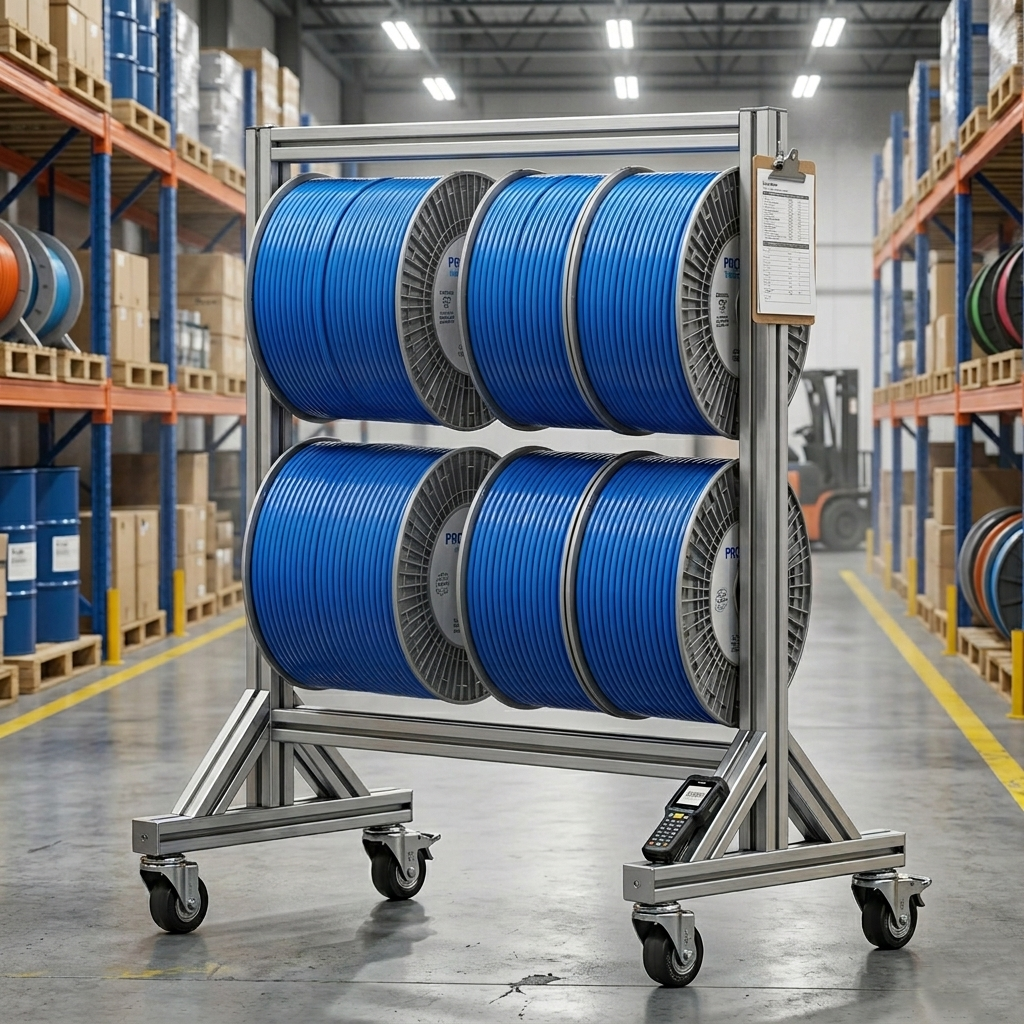


All structural joints are made with ABS or nylon joint connectors that press-fit onto round steel or aluminum pipe sections. No welding, no drilling, and no tools are required for assembly or disassembly. Any operator can build, modify, or disassemble a pipe-and-joint flow rack in minutes, enabling kaizen-driven layout changes without maintenance or engineering support.
Round steel tube (28mm and 42mm diameter) and round aluminum tube (28mm diameter) are the standard pipe sizes. Steel pipe provides higher load capacity for heavy tote lanes. Aluminum pipe is lighter and corrosion-resistant for food-adjacent and cleanroom environments. Pipe cuts to length with a standard hand saw or pipe cutter — no special tooling required.
The joint connector library covers every construction angle needed for flow rack structures: straight connectors, 90-degree corner joints, T-joints (2-way and 3-way), 45-degree diagonal joints, adjustable-angle joints (for incline frame construction), and flange connectors for floor and wall attachment. Every joint angle in a standard flow rack can be assembled from the standard joint library.
Pipe-and-joint frames accept standard roller track and skate wheel rail sections using standard rail-to-pipe bracket accessories. Lane sections clip or bolt onto the pipe frame rails in the same way they would attach to a T-slot extrusion frame. Lane incline is set during frame construction by adjusting the front and rear horizontal rail heights.
Pipe sections are available in pre-painted colors — standard colors include red, green, blue, yellow, and gray — for visual factory lean management systems that use color-coded structures to identify rack function, cell ownership, or product family. Custom colors are available on request.
Pipe-and-joint systems have the lowest materials cost of any structural system for flow racks. Standard pipe sizes and joint types are stocked for immediate shipment. A complete frame kit for a 6-lane, 2-tier supermarket rack can typically be shipped within 3 business days of order.
28mm and 42mm round steel; 28mm aluminum
ABS or nylon; press-fit assembly
Straight, 90-deg, T, 45-deg, adjustable, flange
None required; hand saw or pipe cutter for cutting
Red, green, blue, yellow, gray standard; custom available
Roller track and skate wheel rail via bracket adapters
Up to 120kg per bay (28mm steel)
Standard components stocked; 3-day ship typical
Manufacturing supermarkets, lean cells, kaizen events
Pipe-and-joint flow racks are the standard structural system for lean manufacturing cells where layout changes occur frequently and operator-driven kaizen events must be implemented without maintenance department support.
Rapid kaizen event flow rack builds where the complete rack structure must be assembled, modified, and relocated within a single-day or weekend kaizen event window.
Temporary production layout validation racks for new product introductions where the rack geometry is expected to change after initial production feedback.
Light-duty component and small-part supermarkets where container weights are under 30kg per lane and the low-cost pipe system is the most economical structural choice.
Load capacity depends on the pipe diameter and the joint configuration. Standard 28mm steel pipe frames are rated to approximately 120kg distributed load per bay for a single-tier structure with rear cross-bracing. 42mm steel pipe frames support approximately 250kg distributed per bay. Load ratings assume properly configured cross-bracing and floor anchor attachment. Pipe-and-joint systems are not recommended for loads over 250kg per bay; T-slot or welded steel frames are specified for higher load requirements.
Lane incline is set during frame construction by adjusting the relative heights of the front and rear horizontal pipe rails. The front rail is set lower than the rear rail by a calculated drop distance — for example, a 3.5-degree incline on a 900mm deep lane requires approximately 55mm of height difference between front and rear rail. Adjustable-angle joint connectors allow fine adjustment of the incline after the frame is assembled. The lane hardware (roller track or skate wheel rail) then sits on the inclined pipe rails.
Yes. Pipe-and-joint racks can be moved as assembled structures if they are free-standing (not floor-anchored) by lifting and carrying or using pallet jacks under the base frame pipes. For longer distances or where the rack must pass through doorways, the rack can be partially disassembled at selected joints, moved, and reassembled in under 30 minutes. This is a key advantage over welded or bolted steel frame structures.
Aluminum pipe with ABS joints and stainless steel bracket hardware can be used in food-adjacent and cleanroom environments where no ferrous materials are permitted. ABS joint connectors are NSF-accepted and do not absorb moisture or harbor bacteria. For direct food-contact environments (not common for flow rack structures), stainless steel tube with stainless steel compression fittings is specified instead of press-fit ABS joints.
Pipe sections cut with a standard hand saw using the same technique as cutting wooden dowel — the pipe is marked with a wrap-around tape guide or marking tool to ensure a square cut, then cut with a hacksaw or fine-tooth handsaw. A pipe cutter (scissor-type or rotating wheel type) produces a cleaner square cut with less effort and is recommended for installations cutting more than 20 pipe sections. Cut ends should be deburred with a file or deburring tool before joint assembly.
Share your lane count, container dimensions, load per lane, and production environment — we will supply a complete pipe, joint, and lane hardware kit ready for same-week assembly.
Request a Quote