Large-format gravity flow lanes for bumpers, fascias, body panels, doors, chassis components, and large automotive subassemblies — designed from your dunnage container specifications to deliver Class A surface protection and FIFO build-sequence presentation at every assembly station. Manufactured in Auburn Hills, MI.
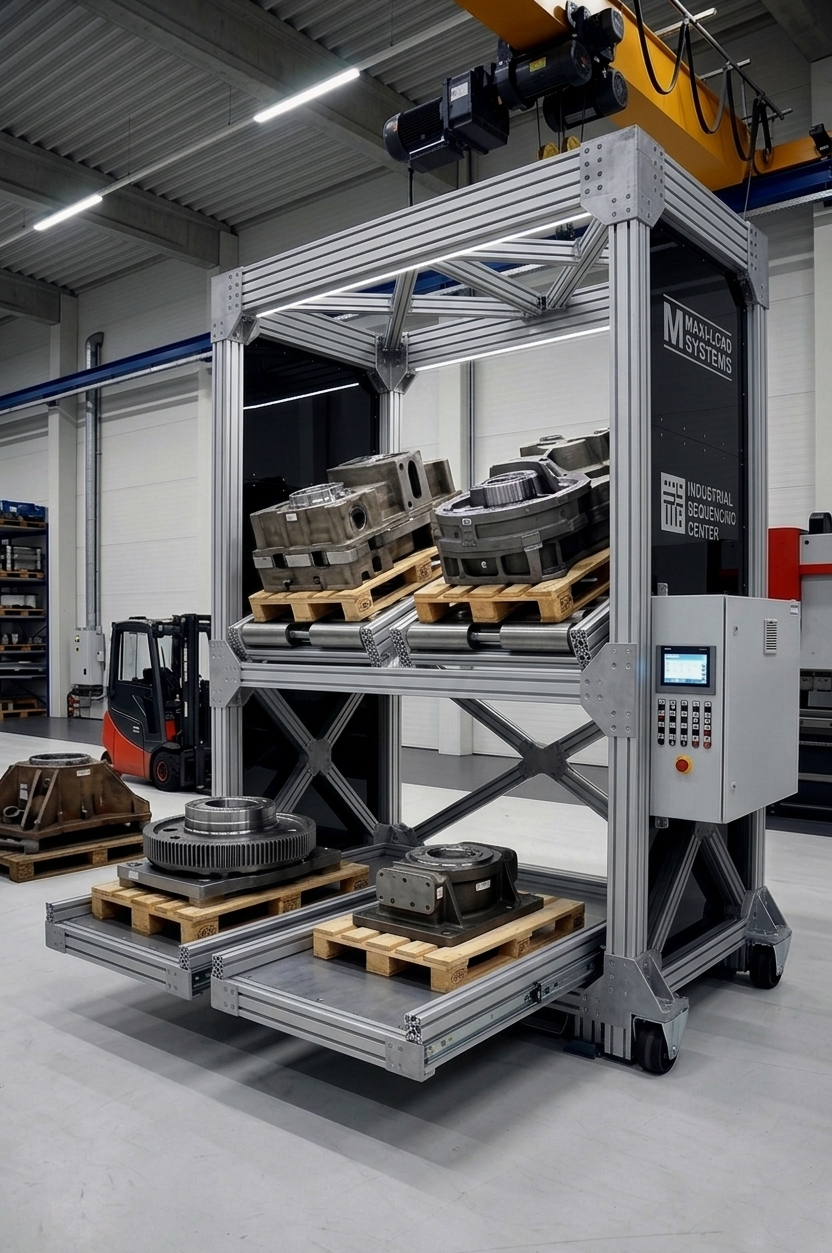
Every lane is designed from the customer's dunnage container drawing — width, runner contact points, and guide geometry matched to the container for consistent lane behavior across all build volumes.
Non-marring rubber roller covers, foam-padded guide rails, and plastic-capped end stops prevent paint scuffs, scratches, and pressure marks on exterior panel dunnage containers.
Rear-load lanes accommodate tugger train pushcart delivery, forklift placement, or manual push — pick face is always in a separate delivery aisle, eliminating replenishment interference with assembly operators.
Multi-platform rows use lane dividers and width-adjustable guide rails to carry different platform dunnage in adjacent lanes — with visual management and RFID entry scanning to prevent platform mix errors.
Flow lanes replace fork-dependent spotting of individual dunnage containers, eliminating the dedicated aisle space required for forklift maneuvering between each container position.
Flow rack designs conform to lean line-side material standards including standard work documentation, visual status indicators, and 5S-compatible label and location systems.
Custom to dunnage container; typical 48–84 in. for bumper/fascia lanes; up to 96 in. for hood and door lanes
Up to 2,500 lbs per dunnage container position; rated per dunnage + stacked part weight
Steel standard; rubber-coated rollers available for dunnage surface protection on Class A part lanes
2-deep to 5-deep; depth matched to line takt time, replenishment frequency, and floor space
Foam-padded or rubber-faced side guides; entry funnel guides for forklift/tugger loading accuracy
Rubber or foam-cushioned pick-face stop; stop force calculated per container velocity and mass
2.5–4% per dunnage container weight; speed controllers per lane where slope exceeds 3%
Floor-level single tier; elevated two-tier for high-cube storage; custom tier heights available
Color-coded lane labels, platform ID, and kanban status tags integrated into lane structure
Front and rear fascia dunnage lanes at paint-to-assembly interface and final assembly stations.
Hood, fender, door, and deck lid dunnage lane staging at body shop and final assembly trim stations.
Frame section, crossmember, and subframe pallet lanes at underbody and frame assembly stations.
Build-sequence dunnage lanes at tier 1 assembly supplier shipping docks for OEM JIT delivery.
Large interior panel and instrument panel dunnage lanes at trim assembly and final fit stations.
Windshield and glass dunnage container lanes at glazing installation stations with padded surface contacts.
Seat carrier and module dunnage lanes at seat installation stations for JIT sequenced delivery.
Complete powertrain module and cradle dunnage lanes at chassis marriage and drivetrain drop stations.
Painted exterior panels — bumpers, fascias, hoods, and doors — require Class A surface protection throughout the flow rack lane. Panels are shipped and stored in their dedicated dunnage containers or racks. The flow lane is designed for the dunnage container, not the bare panel. All contact surfaces use non-marring materials: rubber roller covers, foam-padded guide rails, and plastic-capped end stops to prevent paint scuffs, scratches, or pressure marks.
Bumper and fascia dunnage containers typically require lane widths of 60–80 inches depending on the vehicle platform and stacking configuration. Modular Solutions designs lane width from the customer's dunnage container drawing, not from a catalog dimension. Fascia lanes often stack 4–6 parts per container, and the flow rack accounts for the height and center-of-gravity shift as the stack height varies.
Yes. Multi-platform rows use lane dividers and separate guide rail widths per platform, allowing adjacent lanes to carry different platform dunnage containers. Color-coded lane labels, visual management, and RFID scanning at the lane entry can be integrated to ensure the correct platform parts enter the correct lane and prevent mixed-platform errors.
Flow rack pick faces are positioned at the delivery aisle immediately adjacent to the assembly line station. Tugger train deliveries replenish from the rear of the lane. Operators at the assembly station pull dunnage containers from the pick face directly to the line-side position. The flow rack eliminates the intermediate staging and forklift dependency that would otherwise be required for lane replenishment.
Typical lane depths for bumper and fascia dunnage containers are 3-deep to 5-deep, providing 1–2 hours of line supply buffer per lane. Deeper lanes require either longer flow rack structures or angled bay configurations in constrained floor plans. Modular Solutions optimizes lane depth against available floor space and replenishment cycle time to minimize inventory while ensuring the pick face is never empty.
Provide your dunnage container drawings, part weights, lane count, and assembly station layout — our engineers will design a system that protects your parts and supports your production rate.
Request a Quote