Precision roller rail tracks engineered for consistent pallet guidance throughout the full lane depth — matching roller rail centers to your specific pallet stringer or runner spacing for reliable, low-friction gravity flow. Manufactured in Auburn Hills, MI.
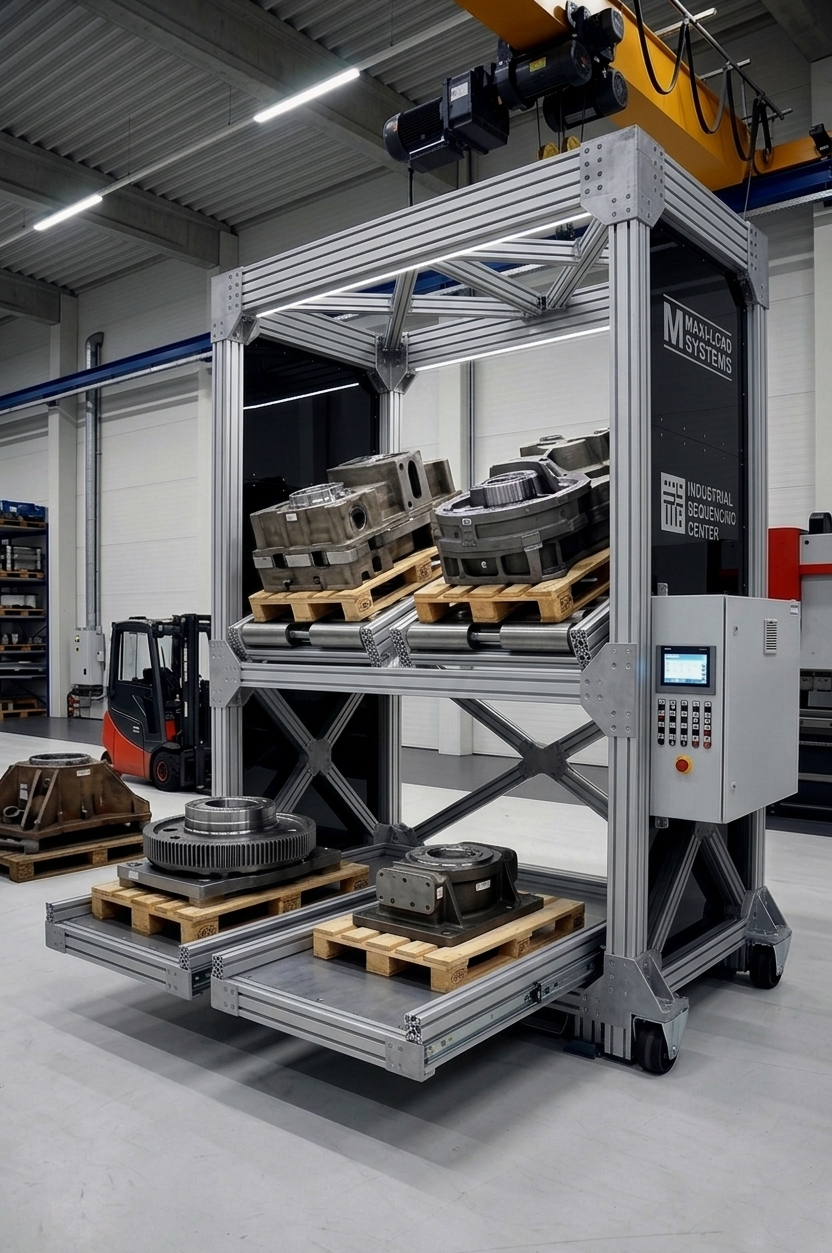
Roller rail center-to-center spacing is set to match your specific pallet stringer or runner width — ensuring full roller contact across the entire pallet bottom for stable, drift-free lane travel.
Two-rail configuration reduces roller count compared to full-width beds — lowering lane cost for wide pallet widths while maintaining the same load capacity per roller position.
Rail mounting brackets allow slope adjustment in the field. Lanes can be reconfigured for different pallet weights without removing the upright structure — reducing future change-over cost.
Entry and exit guide rails center the pallet as it enters and holds it aligned as it approaches the pick face — preventing side drift from forklift misalignment on loading.
Lane entry positions can be dimensioned to precise AGV navigation tolerances, allowing automated guided vehicles to load lanes without manual forklift operation.
Roller rails hook to standard compatible beam profiles and can be retrofit into existing racking bays without replacing uprights — protecting prior rack investments.
Custom to pallet stringer/runner spacing; typical 30–40 in. for GMA; EUR/ISO stringer widths standard
60–90mm per load rating; minimum 3-roller support per rail at all pallet positions
Up to 4,000 lbs per pallet position; heavier ratings with 90mm+ rollers and heavier rail gauge
3–4% standard; speed controllers per lane at slopes ≥3% to control pick-face velocity
2-deep to 7-deep; rail lengths fabricated to exact lane depth specification
Entry funnel guides and exit stop guides standard; intermediate guides for lanes >4-deep
Formed high-strength steel; powder coat or galvanized finish; stainless rail available
Hook-on or bolt-on to rack beams; angle adjustable for slope tuning after installation
GMA, EUR/ISO, custom pallets; wood stringer, steel runner, composite deck pallet types
FIFO pallet storage in distribution centers where pallet stringer dimensions vary by product line.
Production skid and EUR/ISO pallet supply lanes for sequenced automotive body and powertrain assembly.
Date-coded product rotation in cold-chain and ambient distribution using precise FIFO roller rail lanes.
Lane entry positions dimensioned to AGV tolerances for fully automated pallet replenishment.
Fast-moving SKU lanes with minimal manual replenishment in high-throughput retail distribution operations.
Narrow-base drum and container staging using closely spaced roller rails for non-standard load bases.
FEFO rotation lanes with positive pallet stop and lane status sensing for regulated pharmaceutical product.
Multi-tier roller rail lanes for compact LTL and freight accumulation with dense FIFO lane capacity.
A roller rail pallet system uses two parallel formed steel rails, each carrying a row of rollers, that run the full depth of the lane. The pallet rides on the two rails only — not on a full-width roller bed — which reduces roller count, lowers cost for wide lanes, and allows the skid bottom or pallet stringer to contact the rollers directly for low-profile configurations.
Roller rail systems work with wood GMA pallets, EUR/ISO pallets, two-way and four-way entry pallets, and production skids with flat steel or wood runner bottoms. The roller rail centers are set to match the stringer or runner spacing of your specific pallet type to ensure consistent roller contact throughout the lane.
Roller rails hook over or bolt to the horizontal beams of the rack frame, similar to standard pallet flow track. The mounting connection allows angle adjustment to set the required lane slope. Rails can be removed and adjusted without disassembling the upright structure.
Roller rail systems include side guide rails at the entry and exit ends of each lane to prevent pallets from drifting sideways during loading. Intermediate side guides can be added for long deep lanes. The guide rail design accounts for the forklift approach angle during loading and provides self-centering for pallets that enter slightly off-axis.
Yes. Roller rail lane entry positions can be designed to precise AGV positioning tolerances so an automated guided vehicle can load the lane without a human forklift operator. This requires precise lane datum positioning relative to the AGV navigation path, which Modular Solutions coordinates with the AGV system integrator during design.
Share your pallet dimensions, stringer spacing, load weight, and lane count — our engineers will configure and quote a precision system.
Request a Quote