Gravity flow rack systems designed around your production skid fleet — matching roller rail centers to your skid runner dimensions for reliable FIFO lane flow in automotive assembly, heavy manufacturing, and powertrain production environments. Manufactured in Auburn Hills, MI.
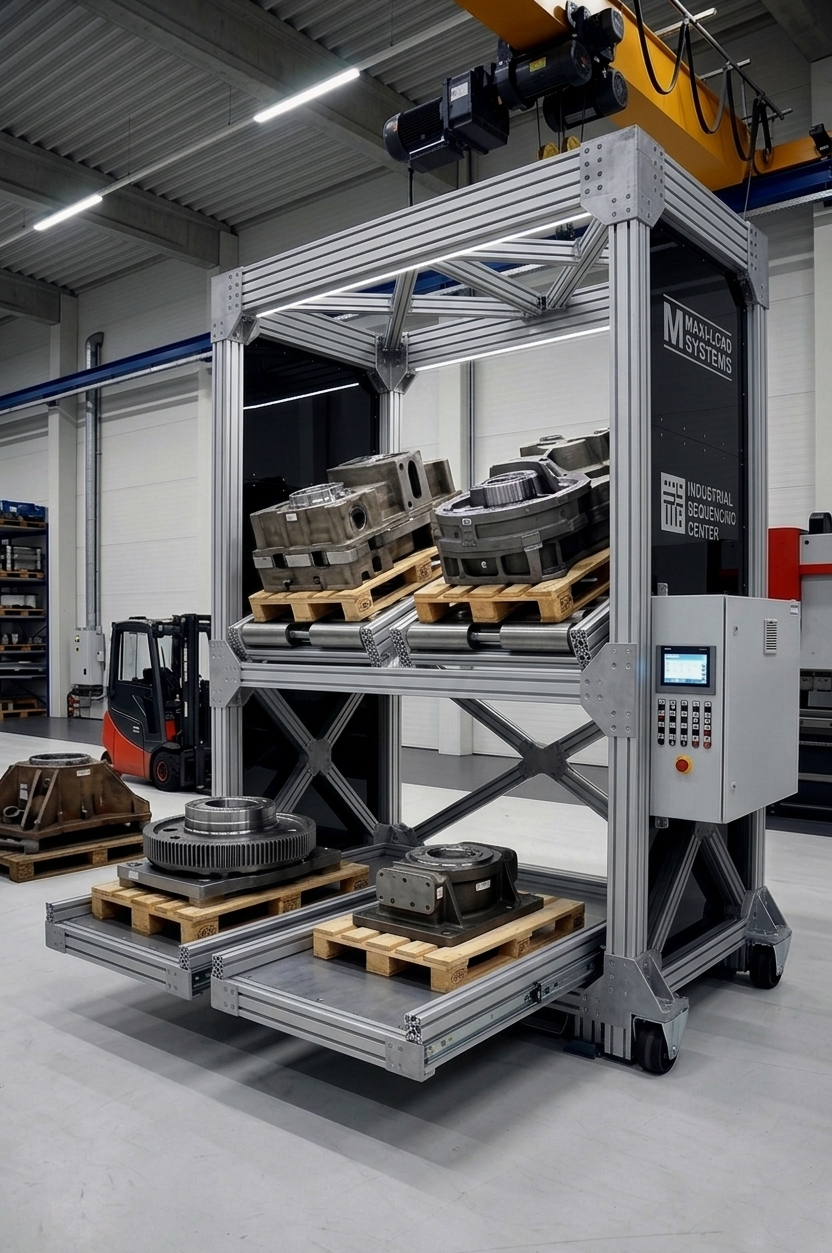
Lane roller rail centers, width, and guide rail geometry are designed from your actual skid drawings — ensuring consistent runner contact and reliable gravity flow with your existing skid inventory.
Multi-lane skid flow systems present parts in build sequence at the assembly station — eliminating operator searching and reducing line-stop risk from skid mis-sequencing.
Pick-face discharge heights and roller centerlines can be designed to interface directly with plant conveyor, chain transfer, or tugger delivery systems for seamless in-plant material flow.
Lane entry and exit positions are dimensioned for your tugger, forklift, or AGV. Push-pull attachment interfaces and AGV positioning datum targets can be built into the lane structure.
Lanes are rated for your specific skid gross load — from light assembly skids under 500 lbs to large casting or structural skids above 5,000 lbs — with roller and frame members specified by load calculation.
Gravity flow eliminates the powered conveyor footprint between storage and line-side, recovering plant floor space for production fixtures, tooling, or operator work zones.
Custom to skid runner width; designed from customer skid drawing; any center dimension achievable
500 lbs to 6,000+ lbs per skid position; roller and frame per structural calculation
60–100mm per load; minimum 3-roller contact per rail at all lane positions
2.5–5%; speed controllers per lane; adjusted for skid runner surface and load weight
2-deep to 6-deep; custom depth to match plant floor plan and replenishment cycle
Floor-level, elevated, or conveyor-height pick face; custom discharge for AGV, forklift, or tugger
Entry centering guides and exit positive stops; side guides for misaligned skid correction
Powder coat standard; galvanized for wash-down; paint-match to plant color standard available
Skid presence sensors at pick face; lane-empty signals to plant WMS or andon system available
Stamped panel and body structure skid staging in FIFO lanes at weld cell and assembly stations.
Engine block and transmission skid sequencing gravity lanes at powertrain final assembly stations.
Large casting and fabricated weldment skid supply to machining and assembly lines.
Subassembly skid staging for JIT delivery sequence to OEM production lines.
Vehicle component and armor panel skid supply to heavy assembly stations with controlled FIFO sequencing.
Large structural weldment and drivetrain skid staging at construction and agricultural equipment assembly.
Cut-to-length steel skid staging for gravity-fed delivery to welding, punching, and bending cells.
Large frame section skid supply lanes for railcar body and truck assembly operations.
A production skid is a flat steel or wood platform, typically without pallet deck boards, that a part or assembly sits on or is welded/bolted to for transport through the plant. Skids often have custom runner widths, steel-frame bases, and load-specific mounting features. Skid flow racks are configured to match the specific skid runner width and overall base dimensions of the customer's existing skid fleet.
Yes. Skid flow rack roller rails are positioned to match any runner width. Since automotive and heavy manufacturing skids are often custom to each plant, the lane design starts with the customer's skid drawing, not a catalog standard. Both parallel and perpendicular runner orientations can be accommodated.
Skid flow rack lanes are designed to the gross skid load weight specified by the customer. Typical automotive powertrain and body structure skids range from 500 lbs to 4,000 lbs gross. Heavy-duty fabricated steel skids for large castings or assemblies can exceed 6,000 lbs per position, which requires appropriately rated rollers, rail, and structure.
Skids are typically loaded using forklift, tugger cart with push-pull attachment, or robotic transfer cart at the rear of the lane. The skid gravity-feeds forward to the pick face. At the pick face, a pallet jack, forklift, or AGV removes the skid for delivery to the production station. The removal method determines the required pick-face clearance height and floor-level access design.
Yes. Skid flow lanes can be designed to discharge directly onto roller conveyor or chain transfer systems. The interface height and roller centerline are matched to the receiving conveyor dimensions. Powered transfer sections can be added at the pick-face end to push skids from the flow lane onto an adjacent conveyor without manual handling.
Provide your skid drawings, load weights, lane count, and pick-face access method — our engineers will design a system matched to your production environment.
Request a Quote