Rear-load, front-pick gravity flow lanes that guarantee first-in, first-out rotation across every part number in the supermarket — without operator discipline, barcode scanning, or system enforcement. Purpose-built for date-coded and lot-tracked components.
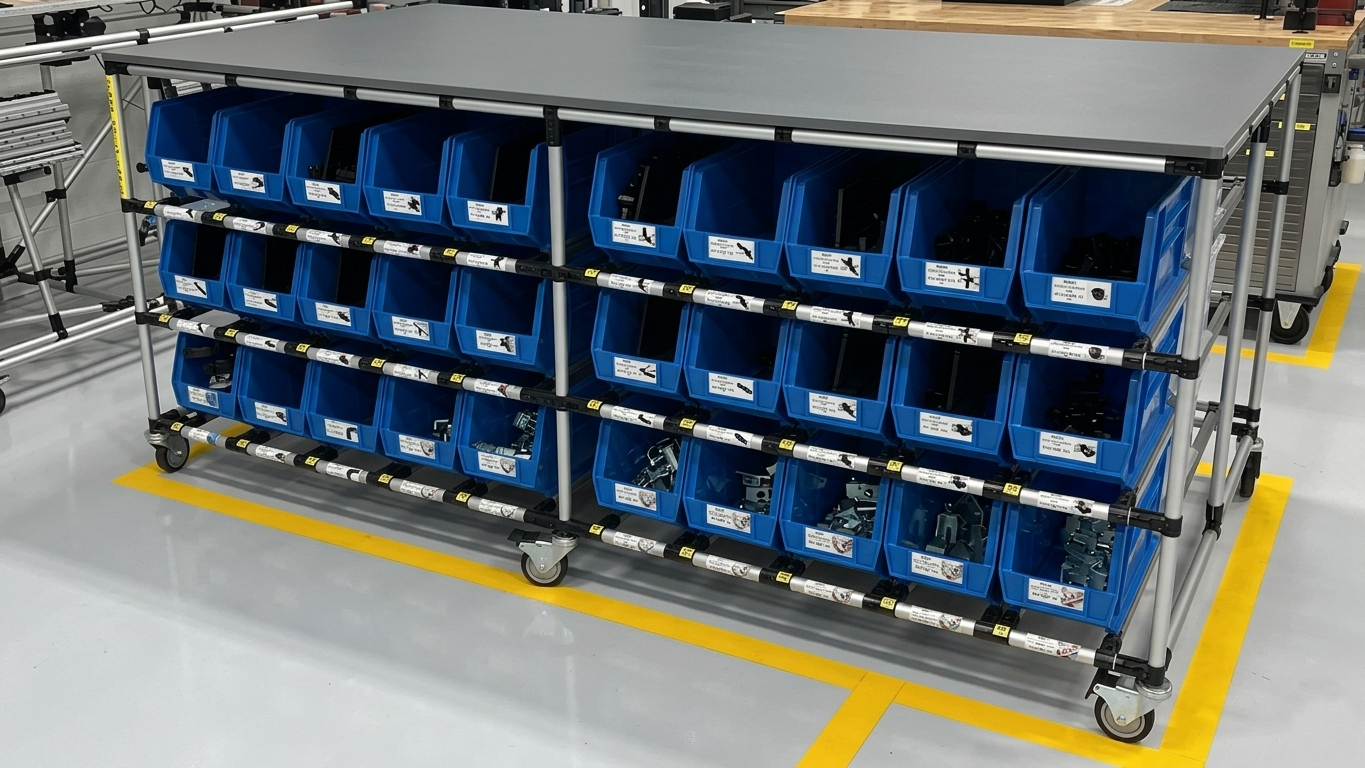
When FIFO rotation is a quality system requirement — not just a preference — the rack geometry must enforce it physically, not rely on operator behavior.
Parts enter at the rear of the lane and gravity-slide to the pick face. The oldest container is always at the front — the rack structure enforces FIFO without any additional process control.
Lane side panels and front stops prevent any container from being accessed out of sequence. An auditor can verify FIFO compliance by inspection of the rack geometry alone — no process documentation is required to prove the rotation order.
Container labels face forward at the pick point. The operator reads the date code or lot number of the front container without touching other containers — supporting point-of-use date verification without slowing the pick cycle.
Lane pitch is set at 2%–8% per tier to match the container weight and rolling resistance. Heavier containers slide on lower pitch to prevent impact at the front stop; lighter containers use steeper pitch to ensure positive forward movement.
Three to five tiers of independently pitched lanes handle the full part number range of the supermarket in a single rack bay. Each lane is independently configurable for width, depth, and pitch to match its assigned part number.
Modular Solutions provides rack design drawings showing rear-load and front-pick access points, lane geometry, and front stop configuration for inclusion in quality system records during automotive, aerospace, or medical device audits.
45mm or 90mm aluminum T-slot extrusion
Roller track, skate wheel rail, or poly-wheel lane
2%–8% adjustable per tier; set to container weight
Positive front stop on all lanes; prevents run-off
Independently set per lane; 50mm–600mm range
2–5 tiers; rear-load, front-pick on all tiers
Up to 1000kg total distributed load per bay
Rear loading aisle; front pick aisle; no side access
Design drawings supplied for quality system records
FIFO supermarket systems are required wherever shelf life, lot traceability, or regulatory compliance demands that the oldest inventory is always consumed first.
Short shelf-life adhesives, sealants, and lubricants require strict FIFO to prevent expired material reaching the assembly line.
Any component with a lot number and quality hold process requires FIFO rotation so that a hold on a lot number immediately surfaces the affected containers at the front of the lane.
Battery cells and energy storage components have date-dependent performance characteristics — FIFO rotation ensures the oldest cells are consumed first regardless of delivery batch timing.
Automotive Tier 1, aerospace, and medical device assembly lines where IATF 16949, AS9100, or ISO 13485 quality audits require demonstrable FIFO compliance at the line-side supermarket.
Gravity flow racks guarantee FIFO through their rear-load, front-pick geometry. Parts are loaded into the rear of the lane and slide forward under gravity to the pick face. The first container loaded is always the first to reach the pick face — the rack geometry makes it physically impossible to pick a newer container before an older one without removing all containers between them.
Any date-coded, lot-tracked, or perishable part requires guaranteed FIFO. This includes adhesives, sealants, lubricants, rubber components, organic gaskets, battery cells, calibration-sensitive sensors, and any part with a shelf life or expiry date. In regulated industries such as automotive, aerospace, and medical devices, FIFO compliance is a quality system requirement that auditors verify.
Lane depth is sized to hold the replenishment quantity plus the consumption quantity between milk-run cycles. For a daily milk-run cycle, the lane depth holds two days of consumption at minimum — one day consumed while the other day's quantity is in transit from the warehouse. Modular Solutions calculates lane depth from the customer's consumption rate, container quantity, and replenishment frequency.
Yes. Each lane width is set independently during manufacture. A single rack bay can include lanes of different widths to accommodate different container sizes. Lane dividers are adjustable after installation for minor container size changes, but major width changes require a revised lane configuration.
During a quality audit, the auditor confirms FIFO compliance by checking that all lanes are rear-load, front-pick; that no bypass loading or side access is possible; and that date codes or lot numbers on the front container are older than any container behind it. Modular Solutions provides rack design documentation showing the lane geometry and load/pick access points for inclusion in the quality system record.
Share your part list, container sizes, date-code requirements, and replenishment cycle — we will design a FIFO supermarket rack that meets your quality system requirements.
Request a Quote