Physical safety barrier systems engineered for Automated Guided Vehicle and Autonomous Mobile Robot travel corridors. Route-guiding barriers, bump protection panels, pedestrian crossing warning zones, and integrated mounting provisions for photo-eye sensors, safety light curtains, and warning light towers — creating safe co-existence between autonomous vehicles and production workers.
Request a Quote
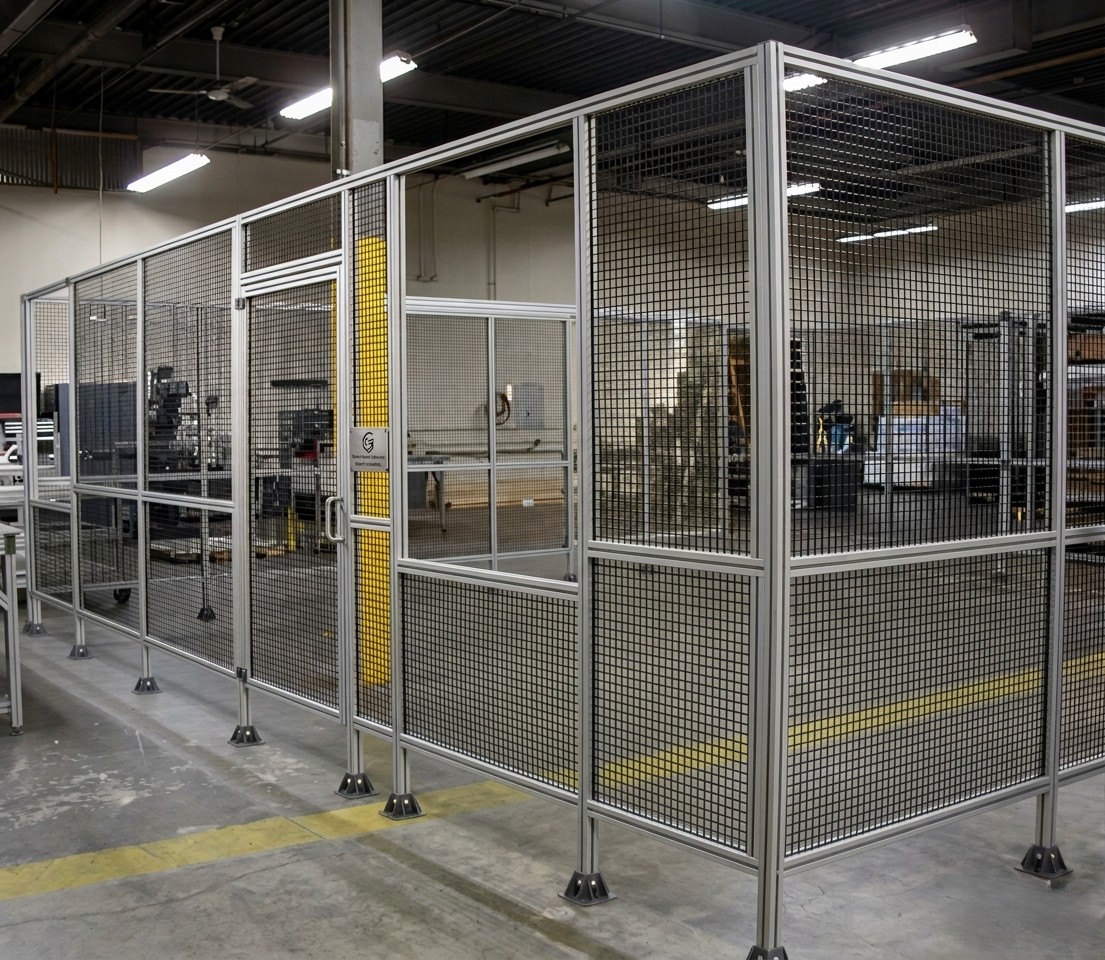
AGV and AMR deployments require physical infrastructure that complements vehicle onboard safety systems — providing redundant protection at routes, crossings, and station areas.
Low-profile barrier rails and channel guides alongside AGV travel paths physically channeling vehicles along their defined routes — preventing AGV drift into pedestrian zones during navigation drift or sensor degradation.
Shock-absorbing bumper rails at AGV turn points, station approaches, and corners — protecting the vehicle, payload, and building structure from damage during low-speed contact events.
Controlled crossing points with fencing on both sides of the AGV path — concentrating pedestrian crossings at designated, visible locations where sensor and warning systems are positioned.
Structural brackets and cable conduit routing in barrier posts for photo-eye emitter/receiver pairs, safety laser scanners, and area presence detectors at crossings and station approaches.
Integrated tower light mounting positions at AGV crossing points — stack lights triggered by AGV approach provide visual warning to pedestrians before entering an active vehicle crossing.
Barrier systems engineered as part of an overall AGV safety architecture compatible with IEC 62061 safety function requirements and ISO 3691-4 industrial truck safety standards.
AGV safety barriers from Modular Solutions address the specific physical safety infrastructure needs of automated vehicle deployments.
Retroreflective tape strips and marker targets on barrier profiles compatible with AGV navigation sensors — barriers become part of the vehicle's optical navigation reference infrastructure.
Physical barriers around AGV battery charging stations and inductive charging pads — preventing unauthorized personnel access to charging zones and protecting charging hardware.
Funnel-shaped entry guide barriers at AGV pick and drop stations — guiding vehicle approach alignment to station docking positions for consistent pallet or tote placement accuracy.
Physical approach barriers at mezzanine elevator and scissor lift landings for AGV vertical transport — preventing pedestrian approach to the AGV landing zone during vehicle transition.
E-stop push button mounting positions at barrier crossing points and station approaches — allowing manual emergency stop of the AGV system by any worker encountering an unsafe condition.
Barrier panels and posts that disassemble and reassemble when AGV routes are updated — protecting physical infrastructure investment through route changes and facility rearrangements.
AGV safety barriers support automated vehicle deployments across manufacturing, warehousing, and distribution environments.
AGV safety barriers are typically 400mm to 600mm tall — high enough to be visible to pedestrians and to physically redirect errant AGVs, but low enough to allow sightlines across the facility floor. Where the AGV route crosses a pedestrian aisle, the barrier height drops to 200mm (bump bar) with a warning light or audible signal to alert pedestrians without blocking their view.
Modular Solutions AGV safety barriers are constructed from T-slot aluminum extrusion frames with HDPE or powder-coated steel infill panels. Aluminum is preferred over steel for non-impact-critical guiding barriers because it is lighter, corrosion-resistant, and will visibly deform on AGV contact rather than causing damage to the vehicle. For high-speed AGV corridors with heavy vehicles, steel-reinforced bases are specified.
Yes. T-slot frame uprights accept standard DIN rail and sensor mounting brackets, allowing photo-eye sensors, safety light curtains, warning towers, and proximity detectors to be mounted directly on the barrier at the designed detection point. Cable routing channels are integrated into the frame uprights to keep wiring protected and organized. All sensor mounts are adjustable on the T-slot rail after installation.
Yes, floor anchoring is strongly recommended for any barrier in an AGV path. Unanchored barriers can be displaced by an AGV contact event, which is a hazard rather than a safeguard. Standard base plates with floor anchor holes are supplied with each barrier section. Anchor bolt type (wedge anchor, epoxy anchor, or drop-in anchor) is specified based on the floor construction and expected impact force from the AGV type.
Modular Solutions AGV barriers are designed for relocation. Sections unbolt from floor anchors, split into manageable lengths, and reconnect at the new route position without cutting or welding. New anchor points are drilled at the revised location. For facilities with frequently changing AGV routes, a pre-engineered barrier kit with extra straight and corner sections allows the route to be reconfigured in-house by maintenance staff.
Contact our engineering team for AGV safety barrier systems designed to your vehicle type, travel routes, and facility safety architecture.
Request a Custom Quote