Modular industrial safety fencing systems that define and protect entire production areas, manufacturing departments, and restricted facility zones. OSHA-compliant heights, high-visibility powder coat finishes, access control integration, and fully modular panel systems that reconfigure as production layouts change — protecting workers and equipment at the facility perimeter level.
Request a Quote
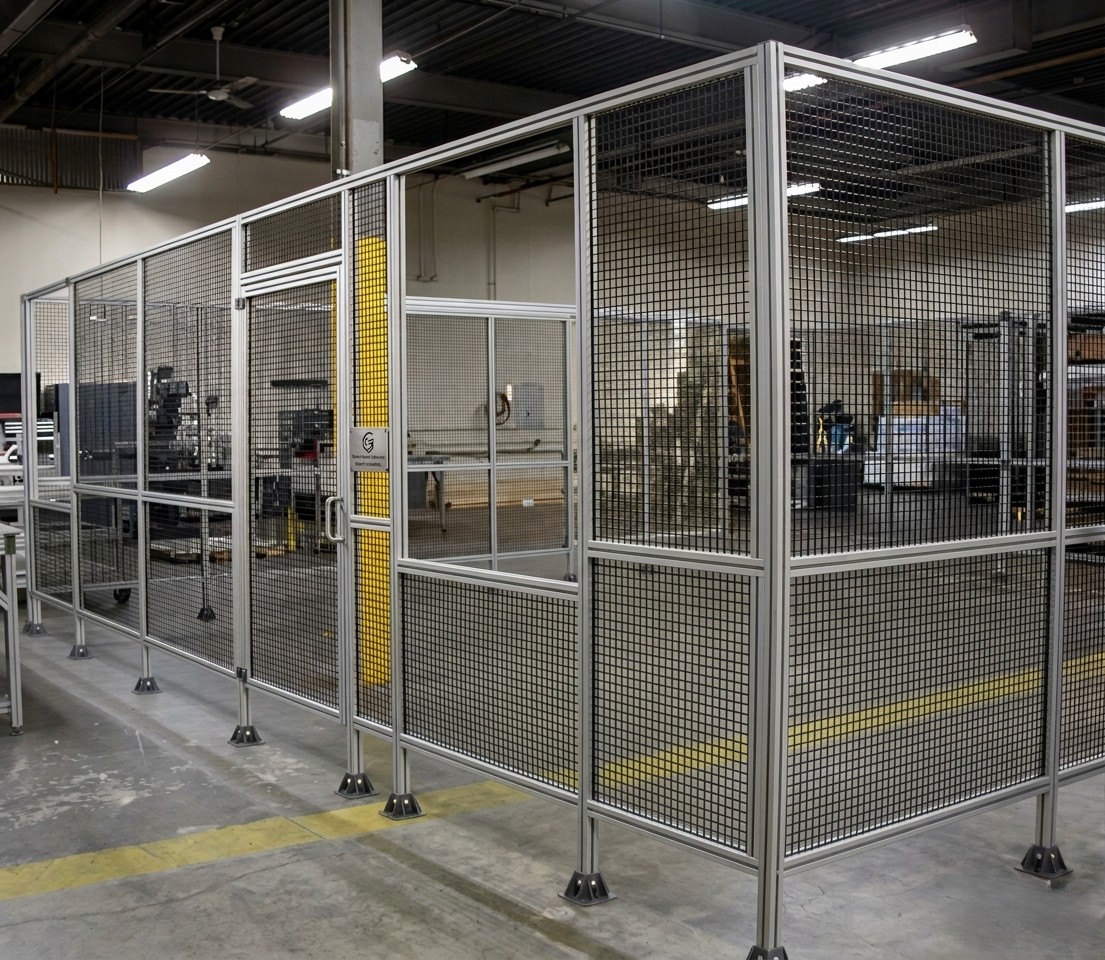
Factory floor perimeter fencing defines production zones, restricts unauthorized access, and creates measurable safety boundaries — all while maintaining the flexibility to reconfigure as operations evolve.
Perimeter fencing systems that clearly define the boundaries of production departments, automated equipment areas, and restricted operational zones from public corridors and visitor walkways.
Controlled-access perimeter systems preventing unauthorized entry into production areas — reducing liability exposure and meeting insurance and regulatory requirements for facility hazard containment.
Gate hardware, keypad mounting provisions, card reader brackets, and door strike wiring conduit routing integrated into the fence framing for card access, keypad, and turnstile control systems.
Panel and post system that disassembles and reassembles in new configurations — fence lines relocated without tools and materials when production layout changes require new perimeter definitions.
Standard panel heights of 1200mm, 1800mm, and 2000mm meeting OSHA CFR 1910.23 requirements for fixed industrial safety barriers and fall protection at elevated platform perimeters.
Safety yellow, safety orange, and custom RAL color powder coat finishes that provide clear visual communication of production area boundaries throughout the facility floor.
Factory perimeter fencing from Modular Solutions is engineered for the operational and safety demands of industrial manufacturing facilities.
Rigid welded wire mesh infill panels in 50x50mm or 50x100mm grid patterns — providing visibility into protected areas for supervisor sightlines and emergency response while maintaining solid physical barriers.
Solid aluminum or acoustic infill panels for areas requiring visual privacy, overspray containment, or noise attenuation along the perimeter — same post system accommodates mixed infill types.
Swing gates, sliding gates, and bi-parting gates in personnel and material handling widths — self-closing hinges, panic hardware provisions, and safety interlock options available.
45° and 90° corner post assemblies and custom-angle connector hardware for non-orthogonal perimeter layouts — following equipment footprints, aisle curves, and building column lines.
Integrated sign brackets and panel insert positions for safety, restricted area, PPE requirement, and visitor information signage — consistent and professional appearance throughout the facility.
Post base plates for concrete anchor installation in permanent deployments, or floor plate straddle bases for non-anchor installations where concrete penetration is not permitted.
Factory perimeter safety fencing defines boundaries and controls access across every type of industrial manufacturing facility.
Machine guarding perimeter fencing in the USA is primarily governed by OSHA 29 CFR 1910.217 (mechanical power presses), 1910.212 (general machine guarding), and ANSI/RIA R15.06 (robotic systems). For general area fencing that separates pedestrian traffic from production equipment, OSHA 1910.22 (walking-working surfaces) and 1910.36 (means of egress) also apply. Modular Solutions designs perimeter fencing to comply with the most stringent applicable standard for your equipment type.
ANSI/RIA R15.06 for robotic systems specifies a minimum fence height of 1400mm (55 inches) for robot cell perimeters. For general machine guarding fencing, OSHA 1910.217 and industry practice specify a minimum of 42 inches (1067mm) for barrier rails and 48 inches (1220mm) for solid panel fencing. The specific height for your application depends on the hazard type, the reach distance of the equipment, and whether the fencing is supplemented by additional safeguarding devices such as light curtains.
Access gates are engineered into the perimeter fence layout during the design phase. Standard options include hinged swing gates, sliding gates for high-traffic access points, and interlocked gates with safety switches that interrupt machine operation when the gate is opened. Gate hardware (hinges, latches, and safety switches) is selected based on the required access frequency, the size of materials or equipment passing through, and the required safety integrity level (SIL) for the interlocking function.
Yes. Perimeter fencing can combine solid panels (for areas requiring visual blocking or debris containment) with wire mesh or expanded metal panels (for areas requiring ventilation or visibility). The safe opening size in any mesh or perforated panel is calculated from the hazard distance: ISO 13857 (Safety distances) specifies maximum opening size at each distance from the hazard so a hand or arm cannot reach through the mesh to contact the moving machinery.
Perimeter fence sections connect to existing walls, columns, and equipment frames using T-slot compatible wall brackets and column clamps. The fence can terminate at a wall or column without requiring a freestanding corner post, reducing footprint and hardware cost. For seismically active regions, additional bracing and connection details are designed to meet local structural requirements.
Contact our engineering team for factory perimeter fencing designed to your facility layout, access requirements, and compliance standards.
Request a Custom Quote