Heavy-duty industrial barriers engineered to physically separate powered industrial truck traffic from pedestrian zones in manufacturing and warehouse facilities. Safety yellow with black hazard stripe powder coat finishes, concrete floor anchors, energy-absorbing base designs, and deflector rails redirect forklift contact forces away from barrier posts — protecting workers and building structure.
Request a Quote
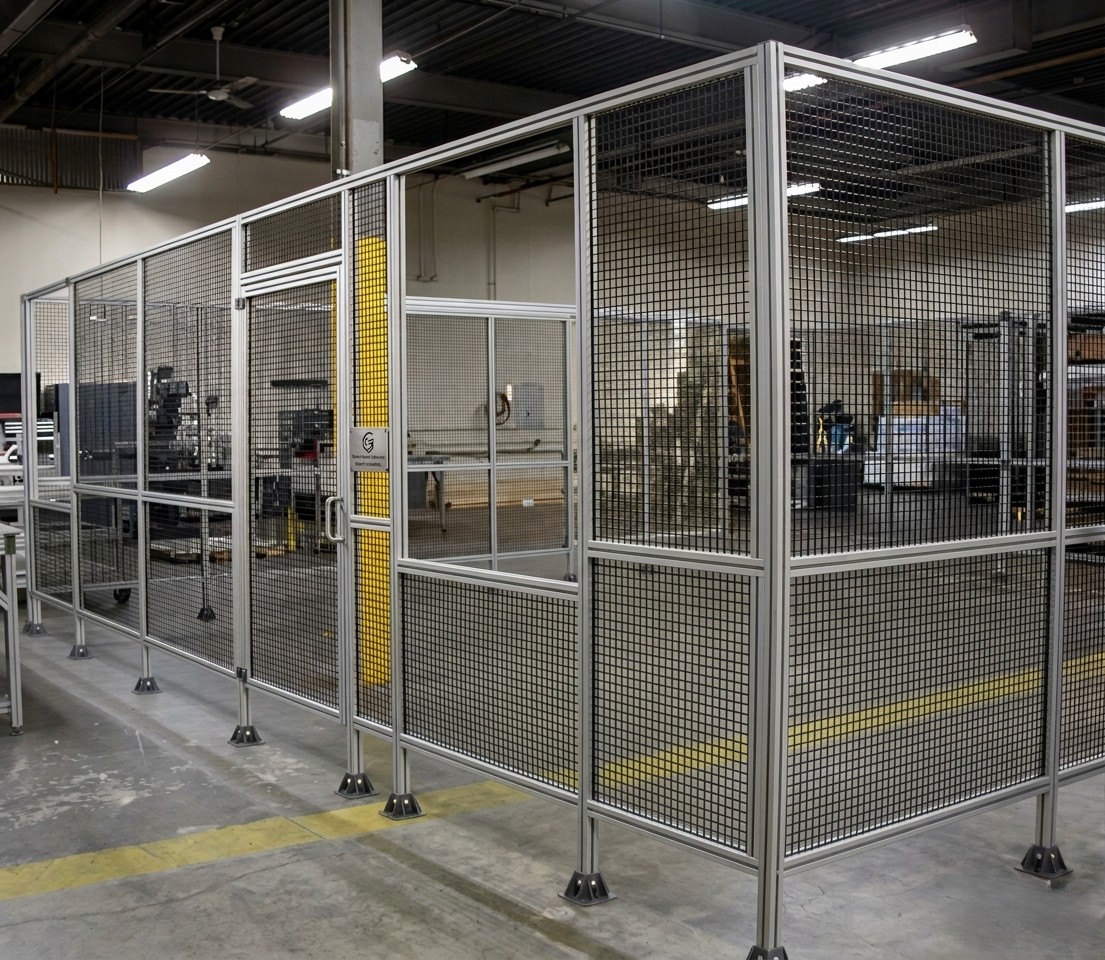
Standard safety fencing is not engineered for repeated forklift contact. Our forklift separation barriers are purpose-built to withstand impact, recover without collapse, and protect workers in high-traffic material handling environments.
Barrier rails and posts fabricated from heavy-profile 6000-series aluminum extrusion — engineered to accept repeated incidental forklift contact forces without post failure, rail deformation, or concrete anchor pullout.
Spring-return and energy-absorbing post base designs that deflect under forklift impact and return to upright position — reducing concrete anchor stress and preventing post shear failure at the floor plate.
Angled and chamfered deflector rails at barrier ends and corners redirect forklift counterweight contact forces laterally — preventing direct post impact and rail end snagging on approaching trucks.
High-visibility yellow powder coat with alternating black hazard stripes at post and rail positions — meeting ANSI Z535.1 color standards for physical hazard warning in industrial environments.
Engineered post base plates with multiple anchor bolt patterns sized for the barrier load case — with anchor embedment depth specifications for concrete floor thickness and condition.
Post base sleeves, rail end caps, and bumper inserts designed as replaceable wear components — damaged elements field-replaced without removing posts from concrete anchors or complete barrier disassembly.
Forklift separation barriers from Modular Solutions address the full range of barrier configurations needed in active material handling environments.
Long runs of barrier rail defining forklift aisle boundaries — post spacing and rail height sized for the forklift class operating in the aisle, typically 42 to 48 inches rail height.
Individual barrier post configurations protecting building columns, mezzanine support columns, electrical panels, and fixed equipment from forklift approach and impact.
End-of-aisle barrier configurations protecting pallet rack end frames from forklift approach — mounted at safe distance from rack uprights with deflector ends redirecting truck path toward aisle center.
Swing gate inserts at designated pedestrian crossing points within barrier runs — self-closing hardware, high-visibility finish, and optional lock-out provisions for controlled crossing management.
Barrier configurations at dock door approaches — guiding forklift approach centerline while protecting door hardware, leveler edges, and dock workers staging at door positions.
Barrier systems expand with additional rails and posts using the same anchor pattern — new sections added in line or at corners as facility layout evolves without replacing installed anchored posts.
Forklift separation barriers are deployed throughout manufacturing and warehouse facilities where powered industrial trucks and pedestrians share floor space.
Forklift separation barriers are typically specified to absorb the impact energy of a forklift travelling at 4 to 6 km/h at the time of contact. The required impact rating depends on the forklift class and weight: a 3000kg counterbalance truck requires significantly heavier barrier construction than a 1500kg reach truck. Modular Solutions uses the equipment weight and maximum travel speed to calculate the required impact energy absorption and specifies the barrier post spacing, base plate dimensions, and anchor bolt pattern accordingly.
The clearance distance between the barrier and the protected equipment or pedestrian area is determined by the forklift turning radius and the stopping distance from the maximum travel speed. As a general rule, barriers should be placed at least 600mm from the protected surface to allow the barrier to absorb impact energy without transmitting the load to the equipment or structure behind it. For high-speed forklift corridors, 1000mm to 1500mm clearance is recommended.
For primary forklift impact barriers (those designed to absorb forklift contact), heavy-gauge steel posts and rails are standard because their higher yield strength and ductility allow them to absorb energy through plastic deformation without catastrophic failure. Aluminum is used for secondary barriers, visual separation systems, and lightweight panel frames in areas where forklift contact is possible but not expected. Modular Solutions specifies the appropriate material based on the expected impact energy and the consequence of barrier failure.
Yes. Pedestrian swing gates and turnstile gates can be integrated into the barrier line to allow worker access without compromising the forklift separation. Gates include a positive-latching mechanism that prevents the gate from swinging open on forklift impact. For forklift crossover points where forklifts and pedestrians must share a passage, a controlled crossing gate with traffic light signaling ensures only one traffic type can proceed at a time.
Modular Solutions separation barrier sections are designed for field replacement after impact. The damaged section unbolt from the floor anchors and adjacent sections without requiring tools beyond a wrench. A replacement section ships as a pre-assembled drop-in unit. Modular Solutions maintains spare section inventory for repeat customers to minimize the time between an impact event and barrier reinstatement.
Contact our engineering team for forklift traffic separation barriers designed to your traffic conditions, aisle dimensions, and safety requirements.
Request a Custom Quote