Cleanroom-grade modular partition systems for medical device manufacturing environments — designed to support ISO 14644 cleanliness classifications when equipped with appropriate HVAC and filtration. Anodized aluminum framing, sealed panel-to-frame connections preventing particle shedding, HEPA-compatible airflow design, and ESD-safe configurations for electronic medical device assembly areas.
Request a Quote
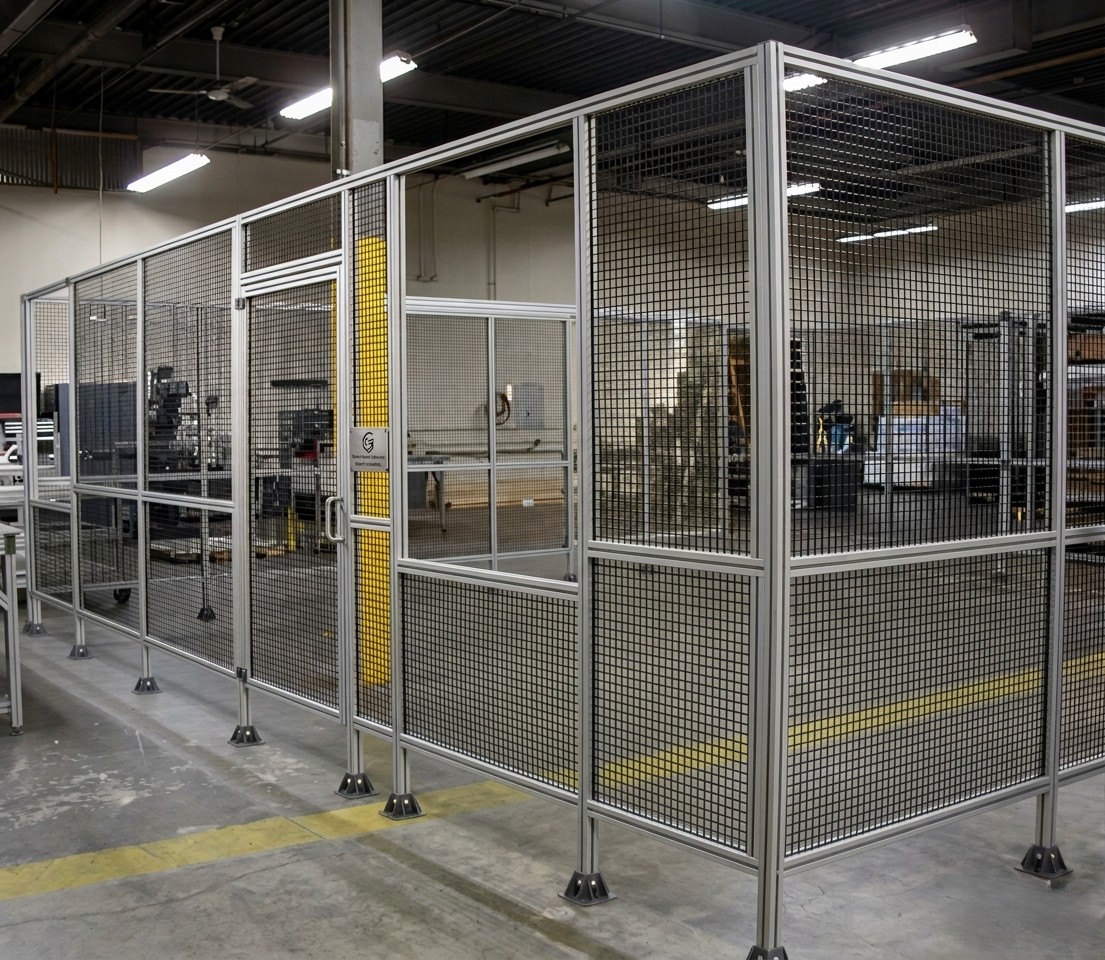
Medical device manufacturing requires partitions that don't compromise your ISO cleanliness classification or FDA 21 CFR Part 820 quality system — while still providing the flexibility to reconfigure as your production evolves.
Hard-coat anodized aluminum extrusion frames providing a dense, sealed surface finish — minimal particle shedding, chemical-resistant, and compatible with IPA and cleanroom-grade cleaning agents.
Panel-to-frame connection profiles with continuous elastomeric seals at all joints — eliminating particle-generating gaps at panel edges and supporting ISO 14644 cleanliness protocol requirements.
Partition configurations designed around your HVAC airflow model — maintaining unidirectional flow patterns within cleanroom zones and preventing turbulence-induced particle re-entrainment at partition surfaces.
ESD-dissipative panel materials and grounded frame systems for electronic medical device assembly areas — preventing electrostatic discharge events that can damage PCB assemblies and active components.
All exposed hardware in 316 stainless steel for implant and sterile device production areas — corrosion-resistant, non-reactive with cleaning agents, and compatible with autoclave-adjacent environments.
Partition systems documented for inclusion in your FDA Quality System Regulation design history file — providing traceable material certificates and installation documentation for regulatory audits.
Medical device production partitions from Modular Solutions support cleanroom zone management and quality system documentation requirements.
Partition systems validated for use in ISO Class 7 and Class 8 cleanroom environments — smooth surface panels with surface roughness values compatible with particle control requirements at each ISO class.
Interlocked pass-through windows and material transfer airlocks at cleanroom boundaries — maintaining differential pressure and particle control during material transfer between cleanliness zones.
Partition framing and door systems configured for personnel airlock pass-through at cleanroom entries — compatible with gowning room design and positive pressure cleanroom maintenance.
Panel surface materials resistant to IPA, quaternary ammonium compounds, hydrogen peroxide vapor, and other common medical device cleanroom disinfection agents.
Sealed penetration provisions for electrical conduit, compressed air, purified water, and data cabling — maintaining cleanroom envelope integrity at all utility pass-throughs through the partition.
Disassembly and reconfiguration procedures that minimize particle generation — allowing cleanroom layout changes without full decontamination shutdowns common with drywall construction.
Medical device production partitions support ISO and FDA-regulated manufacturing environments across the medical device industry.
Modular Solutions partitions with anodized aluminum frames and smooth-surface panel infills (stainless steel, white laminate, or PVC-coated panels) are suitable for ISO Class 7 (100,000 particles per cubic meter) and ISO Class 8 environments. For ISO Class 5 or 6 cleanrooms, the partition frame and all hardware must be designed with no exposed raw aluminum, no open T-slot channels, and sealed joints to prevent particle generation. Modular Solutions works with cleanroom HVAC engineers to ensure partition locations do not disrupt laminar air flow patterns.
Medical device production areas typically specify clear anodized or electropolished aluminum extrusion (smooth, non-shedding), stainless steel 304 or 316 panel infills (wipeable with IPA and bleach solutions), and stainless or nylon fasteners (no carbon steel that can rust or shed particles). All joint sealants are pharmaceutical-grade silicone. EPDM or silicone gaskets are used at panel-to-frame interfaces to prevent particle migration between the partition cavity and the cleanroom air.
Cleanroom partitions in FDA-regulated production areas (21 CFR Part 820, QSR) require documentation supporting the facility qualification (IQ/OQ). Modular Solutions provides material certificates, dimensional drawings, a component BOM with manufacturer part numbers, and as-built inspection records. These documents support the Installation Qualification protocol. Formal cleanroom certification (ISO 14644-2) is performed by a separate cleanroom certification body using particle counting tests — Modular Solutions provides the physical partition, not the air cleanliness certification.
Any structural change to a qualified cleanroom — including moving a wall — typically triggers a re-qualification under FDA 21 CFR Part 820. However, the modular construction means that the re-qualification process is simpler because the changed configuration can be documented precisely using the same documentation templates as the original qualification. Non-structural changes such as adding an accessory to the wall face may not require re-qualification depending on the risk assessment.
Pass-throughs (also called material airlocks or transfer hatches) are engineered into the partition at the design stage. A standard pass-through consists of a double-door interlocked enclosure embedded in the partition wall, where only one door can be open at a time to prevent pressure or particle transfer between zones. Modular Solutions sizes the pass-through opening to accommodate the largest part, tray, or container that must be transferred and specifies the interlock mechanism based on the pressure differential between the two zones.
Contact our engineering team for medical device production partitions designed to your ISO classification, FDA compliance requirements, and production processes.
Request a Custom Quote