Modular guarding systems for conveyor lines — protecting personnel from nip points at drive pulleys and tail sections, side guarding along active conveyor runs, overhead crossover protection, and emergency stop systems. Engineered to OSHA 29 CFR 1910.212 requirements with mesh and polycarbonate panel options for every conveyor type and production environment.
Request a Quote
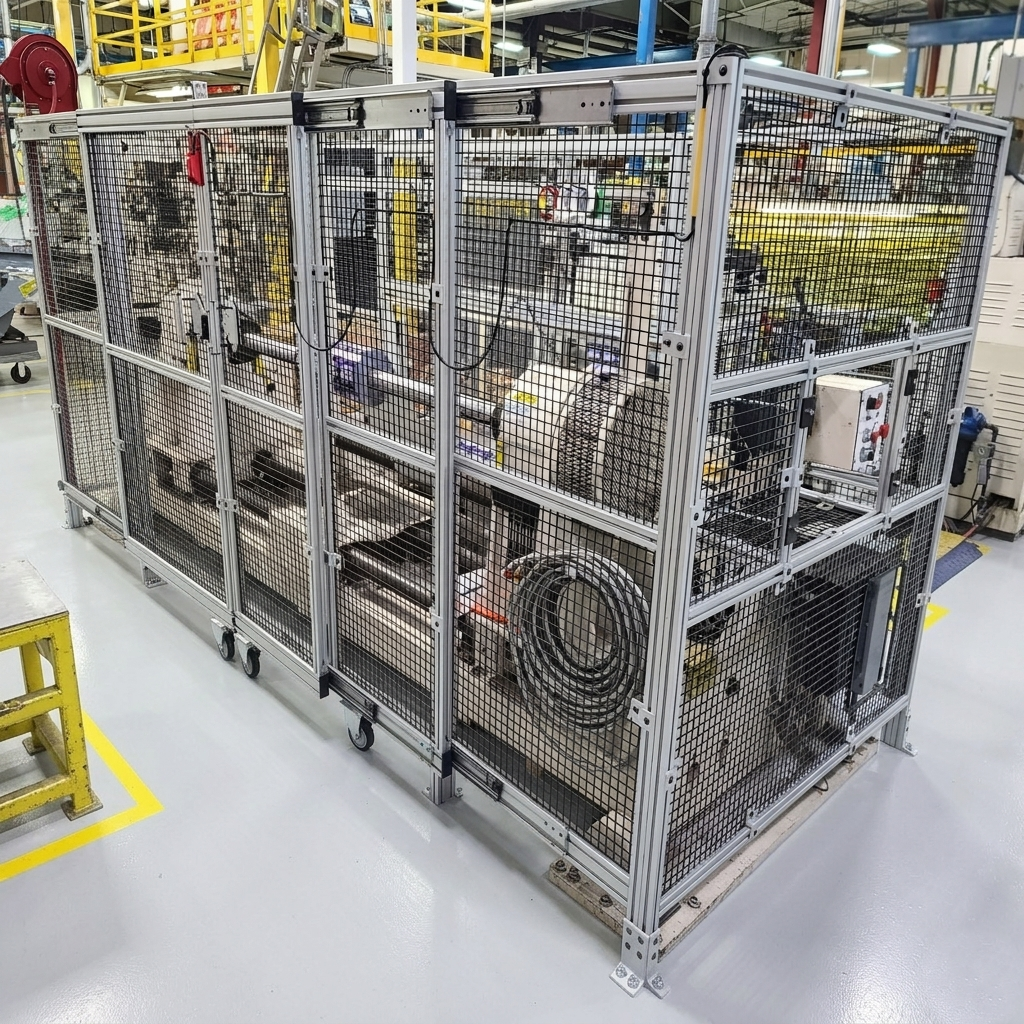
Conveyor hazards — nip points, in-running nips, and shear zones — are among the most common sources of serious industrial injuries. Our guarding systems eliminate those hazards at every point along the line.
Drive pulley, tail pulley, and take-up pulley nip point guards prevent entanglement at every pinch and in-running nip point along the conveyor — OSHA 1910.212 compliant.
Continuous side guard panels along elevated conveyor runs prevent accidental contact with moving belts, chains, and rollers from adjacent walkways and work areas.
Overhead guard panels below elevated conveyors protect personnel walking under the line from falling parts, belt debris, and contamination from above.
Pull-cord and push-button E-stop systems run the full length of the conveyor — providing immediate stop capability at any point along the line without reaching over a guard.
Hinged and removable access panels at belt tensioners, take-up units, and drive sections allow maintenance access with lockout provisions — without dismantling the guard.
Guards fabricated to your exact conveyor dimensions — standard module lengths with custom cuts and splice sections accommodate conveyor runs of any length without gaps.
Conveyor line guarding from Modular Solutions addresses every conveyor hazard type with purpose-built components.
50x50mm or 25x75mm welded wire mesh panels — durable, ventilated, and capable of containing small part ejections common on high-speed assembly and packaging conveyors.
Clear polycarbonate sections at inspection points and operator monitoring stations allow visual checks of product flow without opening the guard or stopping the line.
Enclosed chain drive guards with drip-tight lower lips for oiled chain conveyors — preventing oil spray and drip contamination while containing chain hazards.
Side and end guards for accumulation zones protecting operators from product jams, sudden conveyor restart, and reach-in hazards during accumulation clearing.
Guards at conveyor-to-conveyor transfer points covering the gap hazard between belt edges and the interface between two conveyor sections operating at different speeds.
Guards for inclined belt conveyors addressing the additional rollback and sliding hazards present on angled belt sections — including anti-roll back provisions.
Conveyor line guarding from Modular Solutions is deployed across manufacturing, packaging, and food processing industries.
Representative system parameters — all specifications are custom-engineered to your conveyor type and line layout.
ASME B20.1 and OSHA 1910.212 require that conveyor access points be guarded to prevent contact with nip points, drive components, and moving belts. Access doors in conveyor guards should be interlocked to halt the conveyor when opened. Fixed guards on non-access sections do not require interlocks, but all personnel access doors do.
Guard height is determined by the hazard zone location and applicable safety distance calculations. For most floor-level conveyor drives and nip points, 1200–1500mm is a common starting height. Overhead drive systems require taller guards. Modular Solutions calculates guard height for each specific conveyor configuration.
Nip points — where a belt meets a pulley or roller — are among the highest-risk conveyor hazards. OSHA requires fixed guards over all nip points accessible to workers. Guards must prevent fingers or hands from reaching the nip point at any angle. Modular Solutions designs nip point covers as part of the full conveyor guard system.
Yes. Conveyor guards are routinely designed with product infeed and outfeed openings sized to pass the product while minimizing the gap available for hand or arm access. Tunnel extensions and anti-reach geometry are used at product openings where standard gap limits cannot be met.
Conveyor transfers through walls require guards on both sides with matched panel heights and a transition section at the wall penetration. Modular Solutions coordinates guard design with facility layout to maintain the guarded zone continuously across the wall opening and into the adjacent area.
Contact our engineering team for conveyor line guarding designed to your conveyor type, line layout, and OSHA compliance requirements.
Request a Custom Quote