Safety guarding systems for hydraulic and mechanical press brakes — addressing point-of-operation hazards with front guards, back gauge protection barriers, side safety curtains, and provisions for laser safety system mounting. Engineered to OSHA 29 CFR 1910.212 and ANSI B11.3 for press brake safety.
Request a Quote
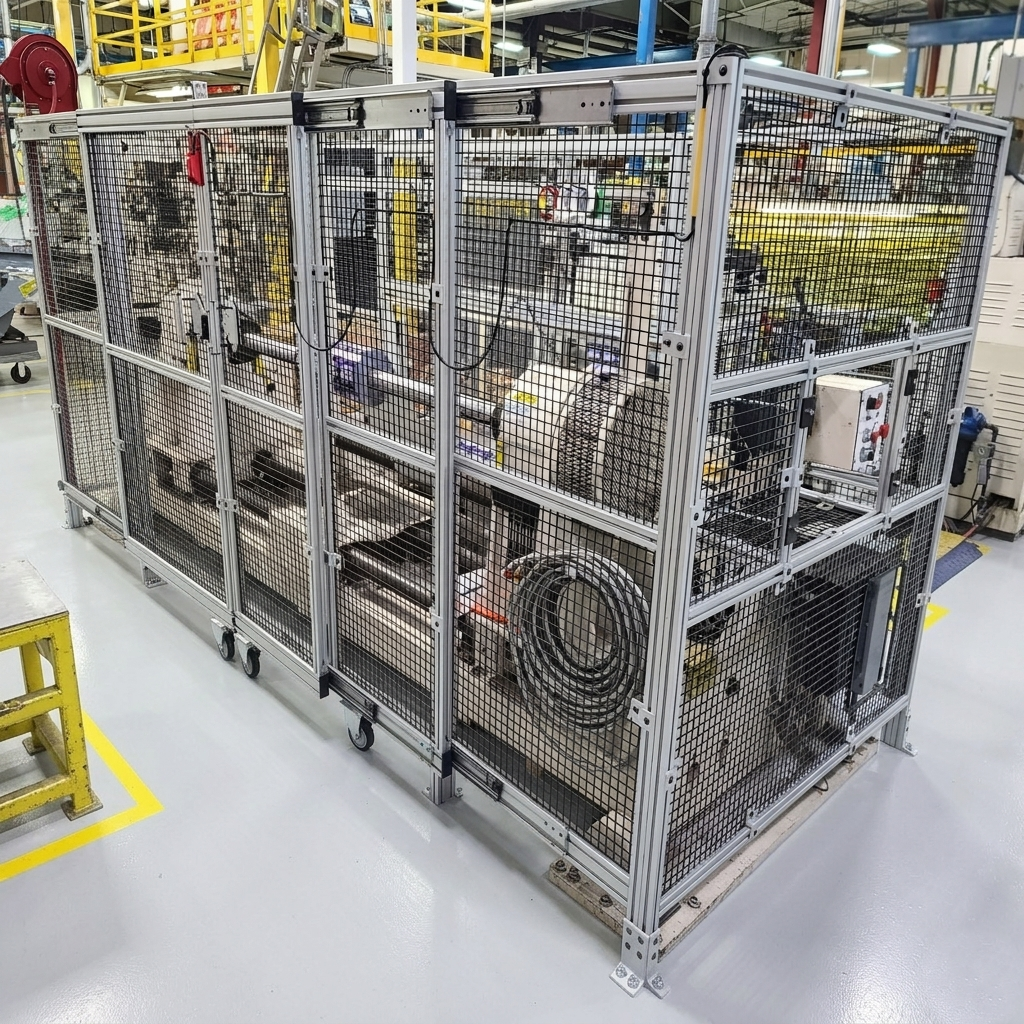
Press brake injuries are among the most severe in fabrication — crushing and amputation hazards at the point of operation demand engineered guarding, not afterthought solutions.
Front guard barriers prevent operator hands from entering the die closure zone during the press stroke — sized and positioned per OSHA minimum opening requirements.
Rear-of-machine guards covering back gauge actuators, ball screws, and servo drives prevent operator contact from the back side during set-up and production operations.
Side curtain provisions or physical side guards covering the full press length address reach-around hazards from either end of the press brake bed during bending operations.
Precision mounting brackets for Fiessler, LCI, RoboForm, and Lazer Safe press brake laser safety systems — correctly positioned per the system manufacturer's specifications.
Guards designed in accordance with ANSI B11.3 for power press brakes — addressing all hazard zones specific to hydraulic and servo-electric press brake operation.
Guards include provisions for safe tooling access — hinged sections, quick-release panels, or drop-down guards that maintain protection during production but allow efficient die changes.
Press brake guarding from Modular Solutions is engineered for the operational realities of fabrication shops and stamping departments.
Guard mounting frames with height and depth adjustment accommodate different tooling heights, part sizes, and back gauge positions without re-engineering the guard for each job changeover.
Guards designed for sheet metal bending operations where long workpieces extend beyond the machine ends — clearance provisions for safe handling of oversized parts.
Extended guard systems for two-operator press brake operations — covering the full bed length with individual operator access points and coordinated activation provisions.
Foot pedal guards preventing accidental actuation from dropped parts, debris, or unexpected operator contact — required by OSHA for all press brake foot controls.
Mounting brackets for SICK, Keyence, and Banner Type 4 light curtains at the front of the press brake — providing presence-sensing protection without obstruction of operator view.
Quick-release front guard sections allow tooling installation and inspection in under 2 minutes — reducing setup time penalty from guarding while maintaining full protection during production.
Press brake guarding from Modular Solutions is deployed in metal fabrication shops, stamping departments, and precision sheet metal facilities.
Representative system parameters — all specifications are custom-engineered to your press brake models and tooling configurations.
OSHA 29 CFR 1910.212 and ANSI B11.3 cover press brake safeguarding. Common approaches include rear guarding to prevent access from the die backside, side guards, and front safeguarding — which can be physical guards, light curtains, or two-hand controls depending on the specific operation.
Light curtains are the most common front safeguarding for press brakes because physical guarding at the front would prevent the operator from forming parts. Physical guards are required on the sides and rear where operators do not need access during the forming stroke. Light curtains must meet ANSI B11.3 minimum safety distance calculations.
Rear guarding protects the back side of the press brake die zone — where the formed part exits and where personnel could be struck by material or contact tooling during the press stroke. Modular Solutions designs press brake rear guards as removable sections for die change access with interlocked doors for production operation.
Die change requires guard removal or access provisions. Modular Solutions designs press brake guards with removable panels and interlocked doors at die change zones so guards can be opened for tooling without fully dismantling the system. Interlock logic prevents press operation while die change access doors are open.
Press brakes fall under OSHA 29 CFR 1910.212 (general machine guarding) and more specifically ANSI B11.3 (Safety Requirements for Power Press Brakes). ANSI B11.3 provides detailed safeguarding specifications for front, rear, and side guarding, as well as minimum performance levels for light curtain and interlock systems.
Contact our engineering team for press brake guarding designed to your specific machine models, tooling configurations, and compliance requirements.
Request a Custom Quote