Collaborative Robot (Cobot) Safety Guards

ISO/TS 15066 force-limiting protective barriers for collaborative robots — modular polycarbonate safety enclosures for human-robot interaction workspaces. Transparent guards for force-limited cobots in automotive assembly, precision manufacturing, and pick-and-place operations.

Request a Quote
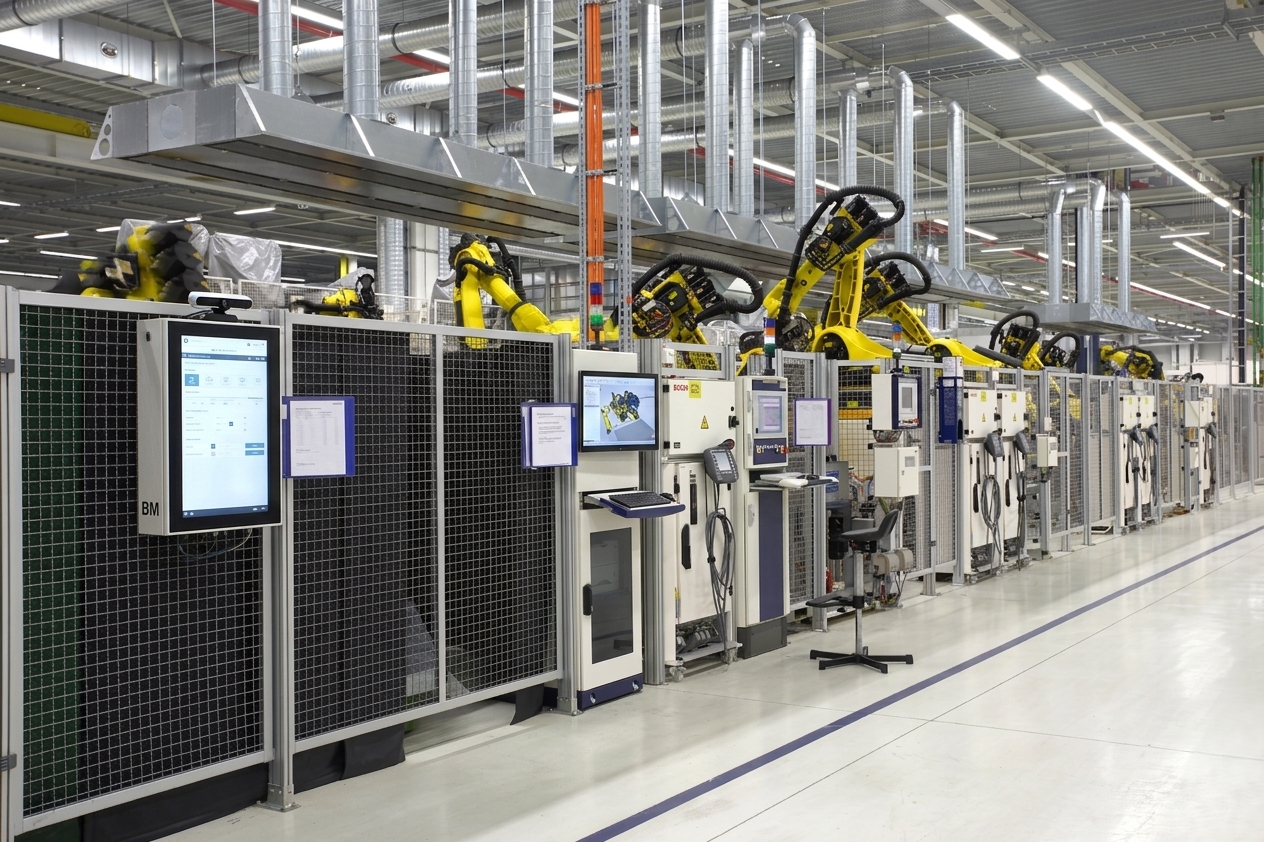
ISO/TS 15066 Collaborative Robot Safety

Collaborative robots operate near human workers using force-limiting technology to prevent serious injury on accidental contact. ISO/TS 15066 defines safe operating zones and protective barriers. Modular polycarbonate guards create defined separation zones while maintaining workspace visibility.

ISO/TS 15066 Compliance

Barriers designed per ISO/TS 15066 technical specification for force-limited collaborative robots. Documented compliance supports safety certifications and risk assessments.

Flexible Force-Limited Design

Barriers specify reduced cobot speeds and force limits in collaborative zones. Configuration supports proximity monitoring, reduced operation speeds, or full protective enclosure depending on risk level.

Tool Change & Part Access

Modular panels allow robot tool changes, workspace reconfiguration, and part setup without full barrier removal. Quick-change system enables production flexibility.

Emergency Stop Integration

Barriers integrate with cobot emergency stop systems — guard opening signals E-stop activation. Robot motion halts on barrier breach.

Vision System Compatibility

Transparent polycarbonate maintains cobot vision system operation. Machine vision, 3D sensing, and camera-based process monitoring unaffected by barriers.

Retrofit to Existing Cobots

Guards retrofit existing collaborative robots without control system modification. Safety upgrade maintains original cobot functionality and programming.

Specifications

ISO/TS 15066Cobot Safety Standard
Force-LimitedBarrier Type
IK08+Impact Rating
TransparentVisibility
E-Stop ReadySafety Integration
ModularConfiguration
Quick-ChangeTool Setup
All CobotsCompatibility

Frequently Asked Questions

What is the difference between a collaborative robot guard and a traditional robot guard?

Traditional industrial robot guards are fixed physical barriers designed to prevent any human entry into the robot work envelope during operation. Collaborative robot (cobot) guards operate under ISO/TS 15066 — they define the boundaries of the human-robot collaboration space and may incorporate force-limiting mechanisms, speed-and-separation monitoring, or power-and-force limiting modes that allow the cobot to continue operating (at reduced speed) when a human enters the monitored zone. The guard design must match the cobot's specific collaboration mode.

Does ISO/TS 15066 require physical guards for cobots?

ISO/TS 15066 does not require physical barriers as a mandatory safeguarding measure for cobots in collaborative mode. However, most cobot risk assessments conclude that physical barriers are still required at the perimeter of the collaboration zone to prevent unintended personnel from entering the zone and being exposed to tool hazards (sharp tools, welding arcs, material ejection) that are independent of the robot's force-limiting capability. The risk assessment for each cobot application determines whether physical guarding is required.

What vision system integration is available for cobot safety guards?

Modular Solutions cobot guard systems can integrate safety laser scanners mounted within the guard frame to monitor the collaboration zone and reduce cobot speed or stop the application when a person enters a monitored field. The scanner fields are configured in the safety PLC and correspond to the collaboration zone geometry defined by the guard. This allows the cobot to operate at full speed when the collaboration zone is clear, and automatically reduce to safe speed when a worker enters the zone boundary.

How does the physical guard height relate to cobot safety zone compliance?

The guard height determines the reach-over safety distance per ISO 13857 — a 1200mm high guard at a given distance from the robot requires a minimum horizontal safety distance from the top of the guard to the nearest robot hazard that prevents a 95th percentile adult from reaching over the guard to the hazard zone. For cobots with tools that project above the guard height, additional top guarding or a higher guard is required to maintain the ISO 13857 reach-over distance requirements.

Can cobot guards be designed for mobile cobot applications?

Yes. Mobile cobot platforms (cobots mounted on AMRs) require a guard that is either permanently attached to the mobile platform and moves with it, or a deployable guard system that is set up at each work station where the mobile cobot docks. Modular Solutions designs lightweight clip-together guard sections that attach to the AMR platform and create a compliant collaboration zone at each work station location, satisfying the ISO 10218-2 safeguarding requirements for the stationary work cycle.

Collaborative Robot Safety for Your Workspace

ISO/TS 15066 polycarbonate barriers enabling safe human-robot collaboration with force-limited cobot systems.

Request a Quote