AGV Charging Enclosures
NFPA 70 compliant modular enclosures for AGV and AMR autonomous vehicle battery charging stations — separating live electrical equipment from personnel, containing battery off-gas, managing vehicle access, and integrating with fleet management systems. Custom-engineered to your vehicle envelope, battery chemistry, and fleet size. Single-bay to 20+ vehicle multi-bay configurations built for expansion as your AGV deployment grows.
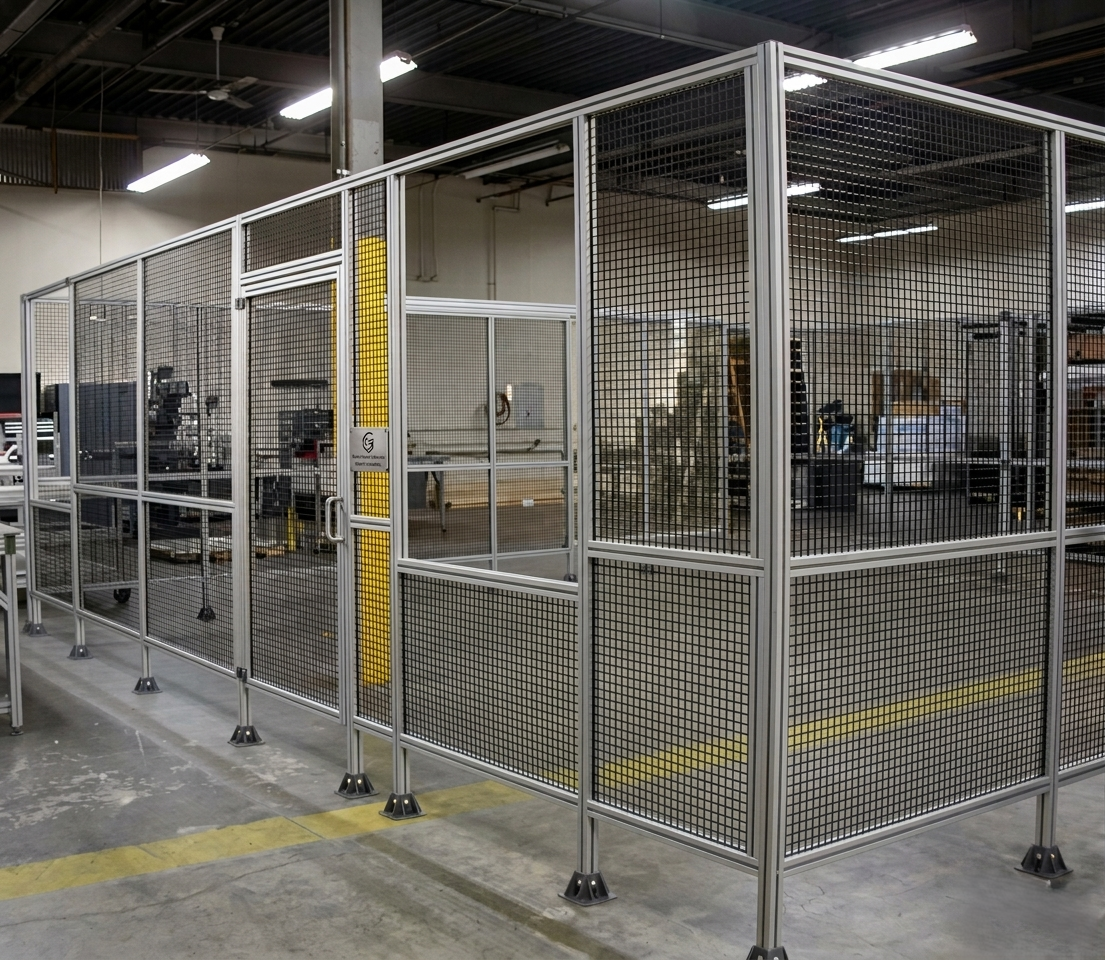
AGV Charging Enclosure Features
Every enclosure is engineered to your specific vehicle dimensions, battery chemistry, fleet size, and facility electrical infrastructure — not a catalog enclosure resized to fit.
NFPA 70 Electrical Safety Compliance
Enclosure design, panel access, working clearances, and live-parts guarding meet NFPA 70 (National Electrical Code) requirements for electrical equipment enclosures in industrial environments. Arc flash and hazard labels pre-installed on all equipment access points per NFPA 70E.
Battery Off-Gas Ventilation System
Integrated ventilation panels and optional powered exhaust fans manage hydrogen off-gassing from lead-acid battery charging. Lithium-ion configurations include thermal management provisions per NFPA 855. Ventilation rates are calculated for your battery amp-hour capacity and simultaneous charging count.
Vehicle Entry & Exit Openings
Precision-sized entry and exit openings allow AGVs and AMRs to enter charging bays autonomously without human assistance. Opening geometry matches your specific vehicle envelope with defined clearances — typically 4"–6" per side and 6" overhead for guided autonomous docking approaches.
Personnel Access Control
Keyed or keypad-controlled personnel access gates restrict unauthorized entry to charging areas containing live electrical equipment. Access control integrates with facility badge systems upon request. Access point location and swing direction designed to NFPA 70 working space requirements.
Modular Panel Wall Construction
Aluminum framed panel wall construction allows enclosure reconfiguration as charging infrastructure expands or fleet vehicles change. Panels add, remove, and reposition without demolition or structural work — end walls relocate to add bays as the fleet grows.
Overhead Cable Management
Integrated cable tray and conduit routing runs power and data cables overhead within the enclosure structure — eliminating floor-level tripping hazards and protecting cables from vehicle traffic at entry zones. Cable routing sized for current wiring plus planned expansion circuits.
Fire Suppression Provisions
Enclosure structures designed with sprinkler head clearance provisions and optional pre-engineered FM-200 or CO2 suppression system mounting for lithium-ion charging environments with elevated thermal runaway risk. Suppression system design coordinated with facility fire protection engineer.
Occupancy & Vehicle Detection Integration
Sensor mounting provisions and wiring chase infrastructure support occupancy sensors, vehicle presence detection, and bay availability indicators — connecting the enclosure to AGV fleet management software for automated routing and charging queue management.
Signage & Safety Labeling
All enclosures ship with NFPA 70E arc flash warning labels, ANSI Z535 electrical hazard signage, and vehicle entry/exit directional markings pre-installed on all appropriate panels and openings. No field labeling required before commissioning.
Technical Specifications
Specifications reflect standard engineered configurations. All parameters adjustable to vehicle type, battery chemistry, fleet size, and facility requirements.
Industries & Applications
AGV charging enclosures are deployed wherever autonomous vehicle fleets require dedicated, compliant, and safely managed charging infrastructure.
- Warehouse Automation — E-commerce and retail distribution centers deploying AMR fleets of 10 to 200+ vehicles require multi-bay charging infrastructure with fleet management integration and access-controlled maintenance areas.
- Automotive Manufacturing — Just-in-time sequencing lines using AGVs for parts delivery require charging enclosures positioned at line-side to minimize travel time from production to charge and back.
- Pharmaceutical Manufacturing — GMP facilities deploying autonomous delivery robots require enclosures that meet cleanroom adjacency standards with smooth, cleanable surfaces and controlled access.
- Cold Storage & Frozen Distribution — Low-temperature AGV operations require charging enclosures with condensation management and battery warming provisions to maintain charge cycle efficiency in sub-zero environments.
- Automotive Parts Distribution — Tier 1 and Tier 2 supplier facilities using tugger AGVs for milk-run delivery require charging bays sized for tow tractors with extended battery packs and high amp-hour charging equipment.
- Airport & Port Logistics — Baggage handling and container movement AGV systems require outdoor or semi-outdoor charging enclosures with weatherproof ratings and corrosion-resistant finishes.
- Healthcare & Hospital Systems — Autonomous delivery robots for medication, linen, and supply distribution require enclosures that comply with hospital infection control standards and integrate with building access control.
- Food & Beverage Processing — Wash-down environments require enclosures with IP-rated electrical penetrations, stainless hardware, and smooth surfaces that support sanitation without harboring bacteria.
Frequently Asked Questions
Common questions about AGV charging enclosure specification, compliance, and design.
Why do AGV charging stations need a dedicated enclosure?
AGV and AMR charging stations contain live high-voltage electrical equipment that must be physically separated from unauthorized personnel under NFPA 70 and OSHA 1910.303. Lead-acid battery charging produces hydrogen off-gas requiring ventilation. Lithium-ion charging systems carry thermal runaway risk requiring fire suppression provisions. Without an enclosure, charging infrastructure is also exposed to forklift and vehicle strike — the most common cause of charging system damage in mixed-traffic facilities. An enclosure addresses all four of these risks simultaneously.
What ventilation is required for AGV battery charging enclosures?
Lead-acid battery charging produces hydrogen gas as a byproduct. NFPA 70 Section 480 and OSHA 1910.178(g) require that battery charging areas be ventilated to prevent hydrogen accumulation above 2% of total volume — the lower explosive limit. Required ventilation rate depends on battery amp-hour capacity and number of simultaneous charges. Lithium-ion AGV charging does not produce hydrogen but does require thermal management provisions. Modular Solutions sizes ventilation based on your specific battery chemistry, charging current, and enclosure volume.
How are AGV charging enclosures sized for vehicle entry and exit?
Entry and exit openings are dimensioned from the specific vehicle envelope dimensions provided by the AGV manufacturer — body width, height, and docking approach tolerances. Standard clearance is 4" to 6" per side and 6" overhead for guided autonomous approach. Enclosure footprint is sized to accommodate the vehicle fully inside the bay with charging connector docked, plus working clearance on equipment access sides per NFPA 70 working space requirements.
Can one enclosure serve multiple AGV charging bays?
Yes. Multi-bay charging enclosures are built as a single modular structure with individual bay openings for each vehicle. Fleet sizes from 2 to 20+ vehicles are accommodated in a single enclosure footprint. Multi-bay designs share common ventilation, fire suppression, personnel access, and fleet management integration — reducing cost and installation complexity compared to individual single-bay enclosures for each vehicle.
What happens to the enclosure when the AGV fleet expands?
Modular panel wall construction allows enclosure expansion by adding bay sections without demolishing the existing structure. End wall panels remove, new bay frame sections bolt to the existing structure, and end walls reinstall at the new perimeter. Electrical, ventilation, and fire suppression systems extend in parallel. Most fleet expansion projects are completed in a single weekend shift to avoid operational disruption.
Does the enclosure need to comply with specific electrical codes?
Yes. NFPA 70 (National Electrical Code) governs the electrical installation inside the enclosure — working clearances, live-parts guarding, conduit routing, and panel access. NFPA 70E governs electrical safety work practices and requires arc flash hazard labeling on equipment worked on in an energized state. OSHA 1910.303 and 1910.305 reference NEC requirements. Enclosures built by Modular Solutions include the structural provisions required for NEC-compliant electrical installation, with arc flash and hazard labeling pre-installed.
Engineer Your AGV Charging Infrastructure
Get an enclosure specification for your AGV or AMR fleet — vehicle dimensions, battery chemistry, bay count, ventilation, and electrical compliance documentation included from day one.
Request a Quote Email Us Directly