AGV Lane Barriers
ISO 3691-4 modular floor-mounted systems that define autonomous guided vehicle traffic lanes, enforce pedestrian exclusion zones, and deliver OSHA-compliant collision prevention. Precision lane definition for every AGV, AMR, and automated material handling system — bolted, reconfigurable, and field-adjustable without facility shutdown.
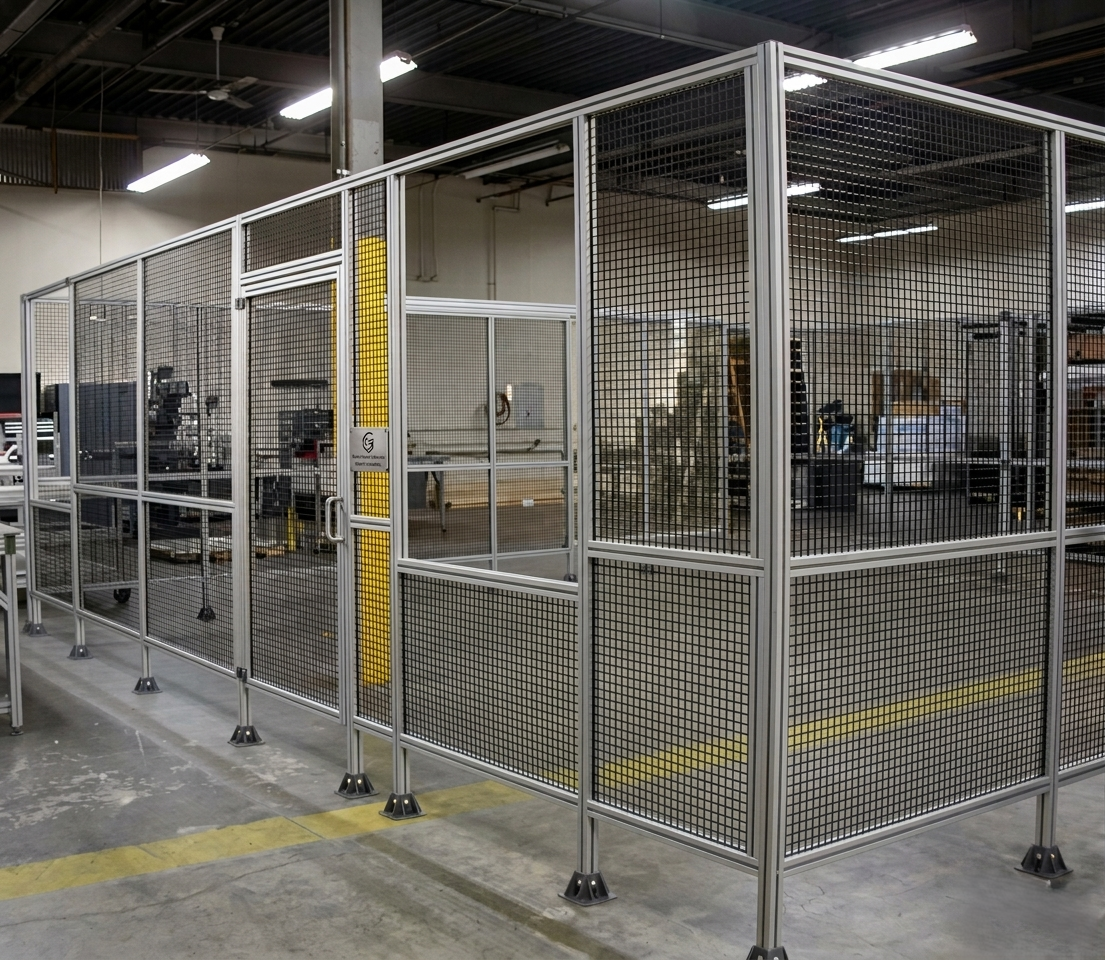
ISO 3691-4 AGV Lane Barrier Features
Modular lane barriers engineered for autonomous vehicle environments — precision placement, pedestrian exclusion, and reconfigurability built into every system.
Dedicated AGV Traffic Lane Definition
Floor-mounted barrier sections establish exclusive navigation corridors for autonomous guided vehicles. Precisely positioned lane boundaries align with vehicle routing maps, RFID waypoints, and magnetic tape guidance systems to physically enforce programmed travel paths.
Pedestrian Exclusion Zones
High-visibility yellow and black barriers communicate restricted areas to personnel at a glance. Physical lane boundaries prevent accidental pedestrian entry into active AGV corridors without relying solely on operator awareness or painted floor markings.
ISO 3691-4 & OSHA 1910.178 Compliance
Barrier geometry, impact rating, and placement specifications meet ISO 3691-4 automated guided vehicle safety requirements and OSHA 1910.178 powered industrial vehicle regulations. Compliance documentation supports facility safety audits and certifications.
Impact-Rated Bumper Sections
Barrier sections are rated for the specific AGV vehicle mass and operating speed profile. Deformable bumper cores absorb incidental contact without bouncing the vehicle into adjacent pedestrian areas. Post-impact inspection indicates maintenance or replacement need.
Modular & Rapidly Reconfigurable
Bolted section connections allow lane barriers to add, remove, extend, or redirect without facility shutdown. When AGV routes change or production lines reorganize, barriers reconfigure in hours — no welding, no core drilling, no construction permits required.
Corner, Curve & Intersection Designs
Straight sections, 90-degree corners, curve segments, and T-intersection guards accommodate any AGV routing geometry. Consistent module sizing maintains visual continuity and prevents gap exploitation at lane transitions and crossing points.
High-Contrast Visibility Marking
Factory-applied yellow and black safety striping maintains visibility under variable facility lighting, dust, and moisture conditions. Marking durability meets ANSI Z535 safety color standards for industrial hazard communication.
Navigation System Coordination
Barrier placement is coordinated with AGV navigation system layouts — magnetic tape routes, RFID landmark grids, LiDAR reference targets, and vision guidance systems. Physical lane boundaries reinforce electronic guidance without interfering with vehicle sensor operation.
Scalable Facility-Wide Systems
Single lane segments connect into comprehensive facility-wide AGV infrastructure. Add lanes as automation scales, extend routes as production expands, and integrate with pedestrian crossing gates for complete vehicle traffic control coverage.
Technical Specifications
Standard configurations for modular AGV lane barrier systems. Custom specifications available for any AGV type, facility layout, or compliance requirement.
Applications & Industries
AGV lane barriers protect operations wherever autonomous vehicles and personnel share facility space.
- Warehouse & Fulfillment Centers — Lane definition for AMR and AGV picking routes; pedestrian exclusion at high-throughput conveyor discharge and sortation zones; dock door approach corridors with crossing gate integration.
- Automotive Assembly Plants — AGV material delivery lane barriers for body-in-white and powertrain assembly lines; dedicated routes for just-in-time kitting vehicles; pedestrian safe-crossing zones at assembly line interfaces.
- Lean Manufacturing Lines — Kanban delivery route barriers for tugger trains and AGV material movers; supermarket lane definition separating pick lanes from pedestrian aisles; scheduled delivery route enforcement.
- Food & Beverage Distribution — Washdown-compatible barrier sections for refrigerated and cooler environments; lane definition in high-traffic dock and staging areas; sanitation zone vehicle exclusion.
- E-Commerce Distribution — AMR picking route lane barriers in goods-to-person fulfillment; packed goods transport corridors; pedestrian/robot separation in high-density picking operations.
- Pharmaceutical Manufacturing — Controlled cleanroom AGV lane barriers with smooth, sanitizable surfaces; contamination zone exclusion; GMP-compliant barrier finishes for regulated environments.
- Aerospace & Defense — Large-frame AGV barriers for aircraft component and tooling transport; restricted access integration with facility security systems; controlled material handling zone lane definition.
- Tier-1 Auto Suppliers — Mixed AGV/forklift zone barriers with dual-rated impact specifications; production cell delivery route definition; pedestrian crossing protection at point-of-use material delivery stations.
Frequently Asked Questions
Common questions about AGV lane barrier specification, compliance, and installation.
What standard governs AGV lane barriers?
ISO 3691-4 specifies AGV safety requirements including facility infrastructure. OSHA 1910.178 covers powered industrial vehicle operation. ANSI B56.5 addresses automated guided vehicle systems. AGV lane barriers must meet all applicable standards based on vehicle type, speed, payload, and operating environment.
How are AGV lane barriers different from forklift barriers?
AGVs follow programmed routes at lower, predictable speeds — barriers primarily define lanes and exclude pedestrians rather than absorb severe impacts. Forklift barriers must withstand 6,000+ lbs at unpredictable angles. AGV lane barriers are typically lighter-duty but must be precisely positioned to match vehicle navigation maps and RFID/magnetic route systems.
Can AGV lane barriers integrate with vehicle navigation systems?
Yes. Modular barrier sections can be positioned to align with magnetic tape, RFID waypoints, or LiDAR landmark targets used by AGV navigation systems. Barrier placement defines the physical lane boundary while the navigation system manages the vehicle path within it. Changes to either must be coordinated to maintain route accuracy.
What happens when the facility layout changes?
Modular bolted systems allow rapid reconfiguration without facility shutdown. Sections add, remove, or redirect in hours — no welding, core drilling, or construction permits required. This is a critical advantage over embedded floor barriers or painted lane markings that require grinding and repainting when AGV routes change.
Do AGV barriers need to be impact-rated?
Yes. Even though AGVs operate at programmed speeds, runaway conditions, sensor failures, and payload shifts can result in unintended contact. AGV lane barriers are rated for the specific vehicle mass and speed profile. Column-adjacent barriers and charging station guards carry higher impact ratings due to concentrated structural risk.
Can the same barrier system serve both AGVs and forklifts?
In shared traffic areas, barriers must meet the higher impact rating of the two vehicle types — typically the forklift standard. Modular systems allow mixed-zone designs: lighter AGV lane definition barriers in dedicated automation areas, heavier-duty forklift barriers in shared aisles. Each zone is specified to the applicable standard.
Define Your AGV Traffic Lanes
ISO 3691-4 lane barriers engineered to your AGV routing, facility layout, and compliance requirements. Modular, reconfigurable, and ready for every autonomous vehicle system.
Request a Quote Email Our Team