Machine Buffer Zones

Modular barrier systems establishing defined physical buffer zones around machinery in compliance with ANSI/RIA R15.06 safety distance calculations and ISO 13857 safeguarding distance standards — ergonomically positioned barriers at calculated reach distance from machine hazard zones, restart prevention zone marking, integrated safety light curtain and area scanner mounting provisions, and floor-marked zone integration for a complete machine safeguarding system.

Request a Quote
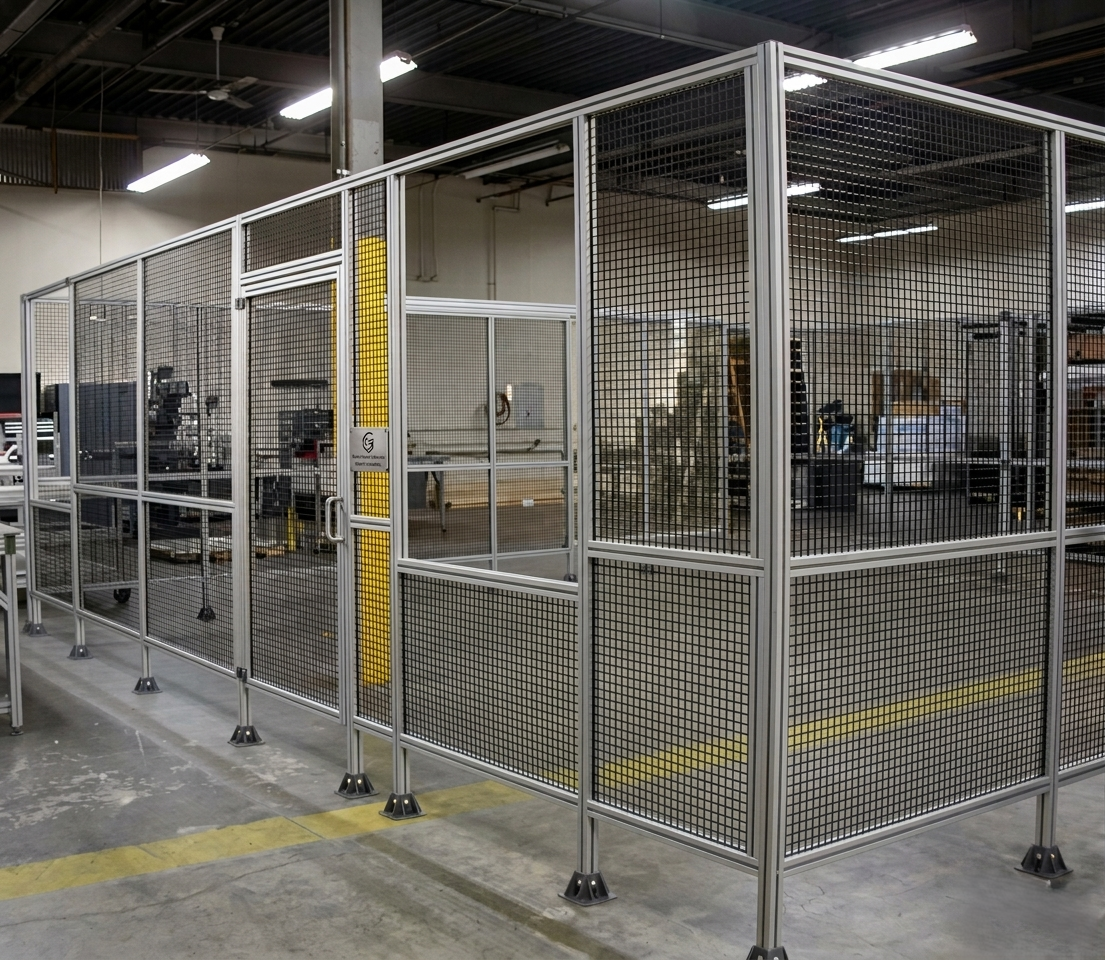
Why Choose Modular Solutions for Machine Buffer Zones?

Buffer zones are a calculated safety requirement — barrier position relative to a machine hazard point must reflect the stopping time of the machine and the speed of approach of the worker. Getting the buffer zone geometry right requires engineering rigor.

ANSI/RIA R15.06 Compliant Spacing

Buffer zone barrier positioning calculated per ANSI/RIA R15.06 robot safety standard and ISO 13857 safety distance requirements — barrier placement at the minimum safe stopping distance from the machine hazard boundary.

Safety Light Curtain Mounting

Integrated T-slot mounting provisions on buffer zone barrier uprights for SICK, Banner, Keyence, and Pilz safety light curtain transmitter and receiver columns — light curtain position maintained by the buffer zone barrier frame without independent mounting structure.

Area Scanner Integration

Buffer zone barrier configurations supporting SICK S3000 and similar area safety scanner installations — scanner field alignment maintained by the barrier geometry and upright mounting positions.

Restart Prevention Zone Design

Restart prevention buffer zone configurations requiring worker exit from the buffer zone before machine restart is permitted — barrier geometry and gate switch integration supporting OSHA restart prevention requirements.

Floor-Marking Coordination

Buffer zone barrier systems coordinated with floor-marked safety zones — barrier base aligning with floor zone line positions for visually consistent, multi-layer machine safeguarding systems.

Ergonomic Work Access

Buffer zone barrier gate positions and widths designed for daily operator work access — operators reaching over or through the buffer zone boundary only at designated tool and part transfer points without barrier defeat.

Key Features & Capabilities

Machine buffer zone barriers from Modular Solutions integrate with machine safety systems to create compliant, functional, and maintainable safeguarding installations.

Adjustable Buffer Depth

Buffer zone barrier depth adjustable from 300 mm to over 3,000 mm from the hazard boundary — accommodating the range of machine stopping times and operator approach speeds used in buffer zone calculations.

Pass-Through Windows

Defined part pass-through window openings in buffer zone barriers — window geometry designed to ISO 13857 Table 4 opening size and distance-from-hazard requirements to prevent limb reach-through.

Muting Zone Integration

Buffer zone barrier configurations supporting safety light curtain muting segments for parts introduction — muting sensor brackets integrated into buffer zone barrier uprights for consistent muting sensor positioning.

Multiple Barrier Height Options

Buffer zone barriers from 36-inch waist-height to 7-ft full-height — barrier height selected based on machine reach hazard height and the safeguarding strategy for the machine application.

Gate Interlock Wiring Channels

Integral cable management channels in buffer zone barrier uprights — routing gate position switch and safety device wiring from field-mounted sensors to machine safety relay or safety PLC without exposed cable runs.

Risk Assessment Documentation

Buffer zone system supplied with engineering documentation supporting machine risk assessment — barrier position, safety distance calculation basis, and safety device integration documented for ISO 12100 risk assessment records.

Common Applications

Machine buffer zones protect operators across automated manufacturing, robotic assembly, and high-speed production applications where hazard distance must be physically enforced.

Frequently Asked Questions

What is a machine buffer zone and why is it required?

A machine buffer zone is a physically defined safety envelope around a machine or process that prevents personnel from entering the hazard zone during normal operation. ISO 13857 (Safety Distances) provides the calculation method for the minimum distance at which a physical barrier must be placed to prevent a person from reaching a hazard with their hand, arm, or body before the machine can stop. The required distance depends on the body part reaching toward the hazard (hand, arm, or full body), the approach direction, and the machine's stopping time or stopping distance.

How is machine buffer zone depth calculated?

The safety distance formula from ISO 13857 is: Ds = (K × T) + C, where Ds is the minimum safety distance, K is the approach speed of the body part (1600mm/s for hand/arm approach, 1600mm/s for whole body approach), T is the total stopping time of the machine (including detection time and stopping time), and C is the intrusion distance (additional distance a body part can reach toward the hazard after the barrier triggers). Modular Solutions engineers use the machine stopping time, the type of approach, and the hazard geometry to calculate the minimum buffer zone depth.

Can machine buffer zones use light curtains instead of physical barriers?

Yes. Light curtains (opto-electronic presence-sensing devices) and safety laser scanners are used as non-physical safeguarding devices that detect intrusion into the buffer zone and stop the machine. ISO 13855 provides the installation position requirements for these devices. Physical barriers are used when the machine cannot stop fast enough for a light curtain to provide adequate protection, when the safeguarding objective is to prevent material ejection (chips, sparks, coolant), or when a light curtain-based system is not cost-effective for the application.

How is a machine buffer zone fenced without blocking operator access?

Machine buffer zone fencing is designed with interlocked access gates at the operator access points. The gate interlock switch signals the machine safety circuit; when the gate is opened, the machine stops (or cannot be started). Gate design follows ISO 14119 (Interlocking Devices Associated with Guards). For machines that require frequent operator access during changeovers, a hold-to-run or enabling device arrangement can be used so the machine can be jogged slowly with the gate open.

What height does machine buffer zone fencing need to be?

ISO 13857 Table 4 provides minimum fence heights and minimum safety distances for fixed guards (including fencing) around equipment. For example, a 1400mm high fence at a horizontal safety distance of 100mm from the hazard zone boundary is sufficient to prevent an adult from reaching over the top of the fence to the hazard. For guards that need to prevent reaching through openings, the opening size and the distance from the opening to the nearest hazard are governed by ISO 13857 Table 3.

Ready to Engineer Your Machine Buffer Zone?

Contact our engineering team for buffer zone barrier systems designed to your machine application, stopping time, and applicable safety standard requirements.

Request a Custom Quote