Manufacturing AGV Barriers
ISO 3691-4 compliant AGV lane barriers built for lean manufacturing environments — protecting kanban supermarkets, assembly line pick zones, and milk-run tugger routes while supporting the continuous improvement and layout flexibility that production operations require. Modular aluminum construction reconfigures in hours during kaizen events without tools, permits, or facility downtime. Designed for automotive Tier 1 and Tier 2 plants, assembly operations, and high-mix lean production facilities.
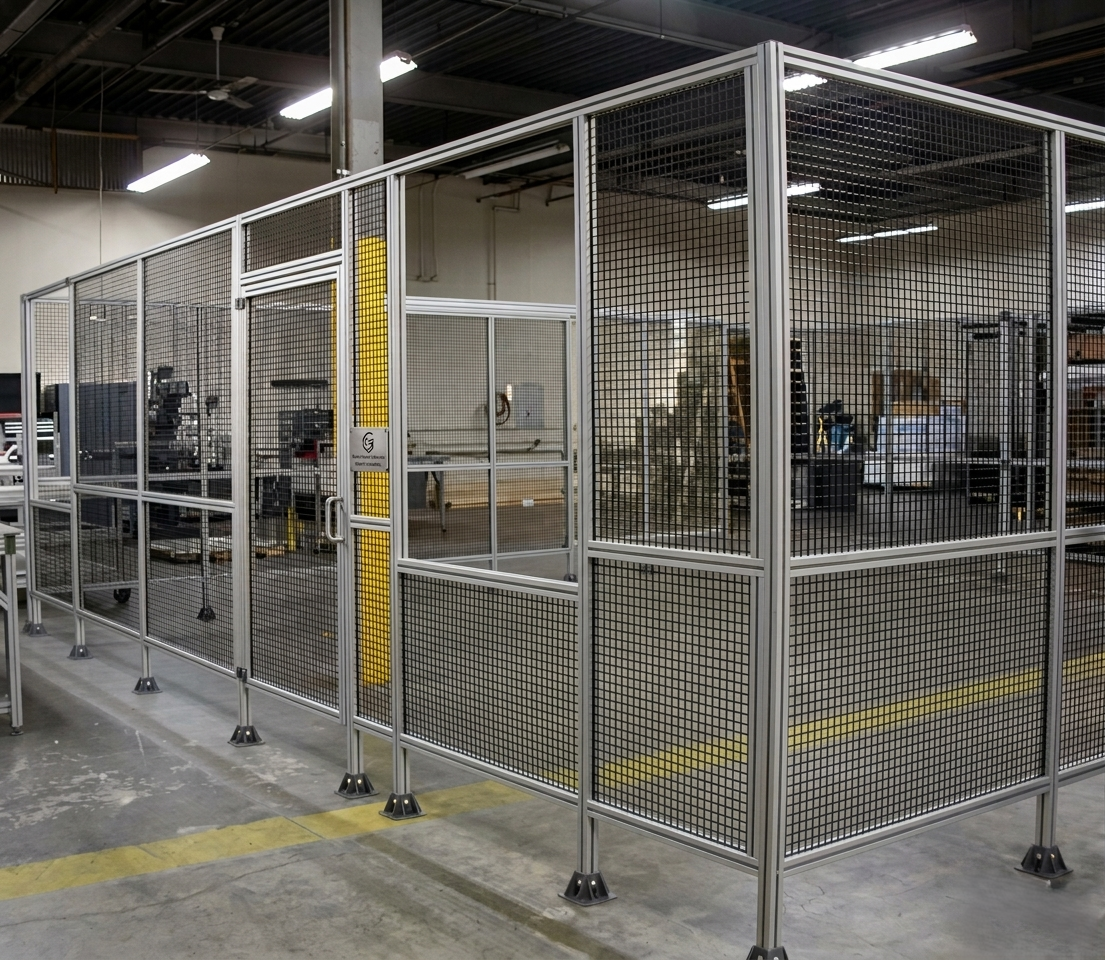
Manufacturing AGV Barrier Features
Every barrier system is configured to your specific AGV route geometry, production line layout, kanban station access patterns, and lean manufacturing change cadence.
ISO 3691-4 Compliant Lane Configuration
AGV lane barrier geometry, detection zone provisions, and stopping distance clearances are engineered to ISO 3691-4 requirements for driverless industrial vehicles operating in manufacturing environments with pedestrian co-presence. Compliance documentation available for customer safety assessments.
Kanban Station Protection
Barrier configurations protect supermarket kanban stations and lineside sequencing areas from AGV route intrusion — defining clear zones for parts picker access separate from AGV travel lanes without restricting operator ergonomics or standard work reach envelopes.
Lean-Compatible Modular Aluminum
T-slot aluminum framing allows barrier systems to be reconfigured, extended, or relocated during kaizen events without cutting, drilling, or disposal. Components reuse in new configurations — supporting continuous improvement without recurring capital spend on barrier replacement.
Milk-Run Tugger Lane Separation
Dedicated lane separation systems for electric tugger and tow tractor milk-run routes — defining fixed travel lanes adjacent to assembly lines and separating tugger traffic from line workers, kit carts, sequencing equipment, and in-process inventory at line-side.
Assembly Line Interface Barriers
Barrier configurations at assembly line interfaces allow AGV parts delivery to designated drop zones while preventing vehicle intrusion into the active line area. Drop zone barriers define the handoff boundary between AGV and operator work zones with designated loading/unloading openings.
Low-Profile Line-Side Design
Line-side barriers designed at 900mm to 1100mm height — maintaining operator visibility across the production floor while clearly delineating AGV lanes. Avoids the visual obstruction of full-height barriers in environments where flow visibility is a production requirement.
AGV Fleet Management Integration
Sensor and signal infrastructure provisions allow safety zone detection systems — light curtains, safety mats, ultrasonic sensors — to mount directly to barrier framing and connect to AGV fleet management for zone-based speed reduction and stop commands.
Anti-Tip Load Support at Delivery Points
Barrier sections at AGV delivery and drop points include load support provisions — bumper rails and edge protectors — to prevent AGV loads from tipping into barrier structure during docking, undocking, and pallet or cart placement operations.
Rapid Reconfiguration for Kaizen Events
All barrier connections use standard T-slot hardware — no welding, no custom brackets, no facility permits. A full barrier section relocates in under one hour with standard tools, enabling same-shift layout changes during structured kaizen events without safety system downtime.
Technical Specifications
Specifications reflect standard manufacturing AGV barrier configurations. All parameters adjustable to production line layout, AGV fleet, and lean manufacturing requirements.
Industries & Applications
Manufacturing AGV barriers are deployed wherever autonomous vehicle routes intersect with production line workers, kanban stations, and assembly operations.
- Automotive Assembly Plants — AGV-delivered sequenced parts to assembly stations alongside moving line workers; milk-run tugger routes connecting supermarkets to line-side require continuous lane separation across multi-shift operations.
- Tier 1 & Tier 2 Automotive Suppliers — Stamping, welding, and sub-assembly plants using AGVs for in-process material movement between operations require barriers that accommodate model changeovers and annual model year layout adjustments.
- High-Mix Low-Volume Manufacturing — Job shop and custom manufacturing environments where AGV routes change with production scheduling require modular barriers that redeploy without capital expenditure on each change.
- Aerospace Component Manufacturing — Large-component manufacturing with AGV floor carts for jig and fixture movement; barriers define clearance corridors around large assemblies and protect personnel working in adjacent cells.
- Electronics & Semiconductor Manufacturing — Cleanroom and ESD-controlled manufacturing environments with AMR material delivery systems require barriers compatible with cleanroom flooring and antistatic surface requirements.
- Medical Device Manufacturing — ISO 13485 regulated facilities deploying AGVs for WIP movement require barriers with smooth, cleanable surfaces and documented compliance with site safety management systems.
- Heavy Equipment Assembly — Large equipment assembly bays with AGV-delivered sub-assemblies and components; barriers separate delivery routes from assembly cranes, overhead lifts, and stationary assembly fixtures.
- Consumer Goods & Appliance Manufacturing — High-volume appliance assembly lines with automated material delivery systems; barriers integrate with ERP-driven AGV dispatch and production sequencing systems.
Frequently Asked Questions
Common questions about manufacturing AGV barrier specification, lean compatibility, and ISO 3691-4 compliance.
What is ISO 3691-4 and how does it apply to manufacturing AGV barriers?
ISO 3691-4 is the international standard for safety requirements of driverless industrial trucks (AGVs and AMRs) and their systems. It specifies requirements for AGV design, detection systems, stopping distances, and the physical environment in which AGVs operate — including lane geometry, separation distances from pedestrian areas, and barrier provisions where detection alone is insufficient to prevent pedestrian intrusion. Manufacturing AGV barriers are engineered to satisfy the physical separation requirements of ISO 3691-4 for facilities where AGVs operate alongside production line workers.
How do manufacturing AGV barriers differ from warehouse AGV barriers?
Warehouse AGV barriers are designed for relatively stable aisle layouts with infrequent changes. Manufacturing AGV barriers must accommodate lean manufacturing principles — frequent kaizen layout changes, line rebalancing, takt time adjustments, and model changeovers. This requires modular aluminum construction that reconfigures without tools or facility permits, low-profile designs that maintain line-of-sight visibility for production supervisors, and barrier configurations compatible with kanban supermarket access patterns and assembly line ergonomics.
Can manufacturing AGV barriers be reconfigured during a kaizen event?
Yes — this is the primary design requirement. All barrier connections use standard T-slot aluminum hardware that disassembles and reassembles without cutting, welding, or drilling. A full barrier run can be dismantled, transported, and rebuilt in a new configuration in under two hours with two people and standard hand tools. Components that are no longer needed in one area store flat and redeploy in the next kaizen without purchasing new material.
What height are manufacturing AGV lane barriers?
Manufacturing AGV barriers are typically 900mm to 1100mm (35"–43") in height — tall enough to be visible to AGV detection systems and clearly delineate the lane boundary, but low enough to maintain production floor visibility for supervisors and team leaders monitoring line status. Full-height barriers (1800mm+) are specified only where containment of noise, fumes, or sparks is also required, or where visibility between zones is deliberately restricted.
How are AGV sensor systems mounted to barrier infrastructure?
T-slot aluminum barrier framing provides continuous sensor mounting capability along the full barrier height and length. Safety light curtains, ultrasonic zone sensors, safety mats, and warning light columns bolt directly to the barrier frame using standard T-slot hardware — no separate mounting structure required. Wiring chases are integrated into the extrusion profile for clean cable routing. Sensor positions adjust along the barrier without drilling new mounting holes when detection zones change.
Do manufacturing AGV barriers need to handle forklift impact as well?
In mixed AGV and forklift manufacturing environments, barrier specifications must account for the highest-impact vehicle in the area. AGV barriers are typically designed for lighter-duty AGV contact at controlled speeds. In areas where counterbalanced forklifts, tugger trains, or other powered vehicles also operate adjacent to the barrier, impact ratings must be upgraded to the heavier vehicle standard — typically 6,000 lb dynamic impact as a minimum. Modular Solutions specifies mixed-traffic barriers to the appropriate impact rating for the actual vehicle fleet in each zone.
Build AGV Infrastructure That Supports Your Lean System
Get a manufacturing AGV barrier specification for your production layout — ISO 3691-4 compliance, lean reconfigurability, and full documentation included from day one.
Request a Quote Email Us Directly