Pedestrian Crossing Gates
ANSI B56.5 powered swing gates that physically separate pedestrians from AGV lanes, forklift aisles, and industrial vehicle traffic zones. Motion-sensor vehicle detection, E-stop interlock integration, and automatic gate closure before vehicles reach the crossing — engineered to eliminate the most common cause of serious warehouse injuries. Modular, reconfigurable, and field-adjustable without facility shutdown.
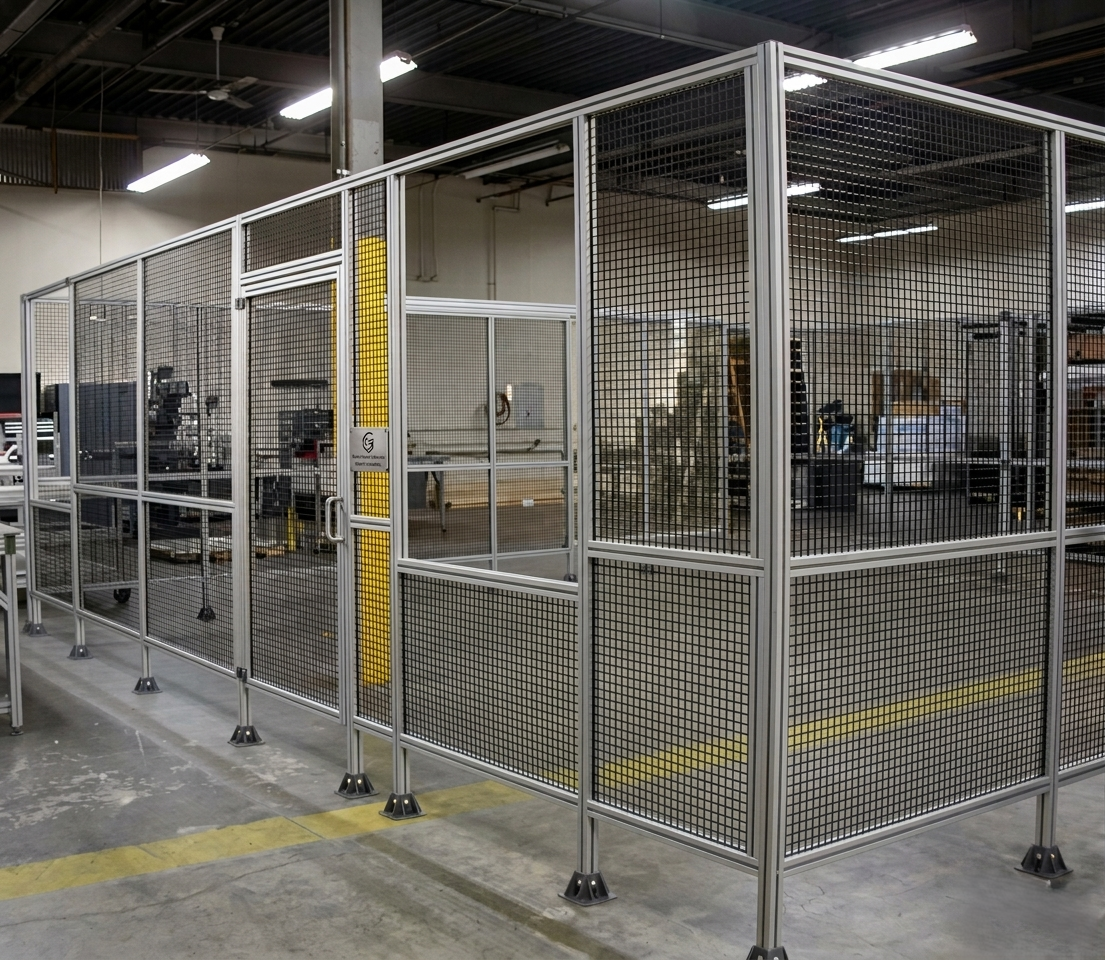
ANSI B56.5 Pedestrian Crossing Gate Features
Every crossing gate is engineered to the specific vehicle type, lane width, traffic frequency, and integration requirements of your facility — not a one-size catalog part.
Powered Swing Gate Operation
Motor-driven gate arms automatically block and clear crossing zones based on vehicle presence, scheduled timing, or operator command. Gate cycles complete in under 3 seconds to maintain material flow without creating pedestrian queuing at high-traffic crossings.
Motion-Sensor Vehicle Detection
Ultrasonic and photoelectric sensors detect approaching AGVs, forklifts, and vehicles before they reach the crossing zone. Detection triggers gate arm closure, visual indicators, and optional audio warnings — giving pedestrians time to clear before vehicle arrival.
ANSI B56.5 & OSHA 1910.178 Compliance
Gate geometry, activation timing, and safety interlock specifications meet ANSI B56.5 for automated guided vehicles and OSHA 1910.178 for powered industrial vehicles. Compliance documentation supports facility safety audits, insurance reviews, and OSHA inspections.
E-Stop Integration & Safety Interlocks
Emergency stop provisions and safety interlock circuits allow AGV routing systems, facility PLCs, and manual operators to halt gate operation instantly. Interlock states feed back to the AGV fleet management system to prevent vehicle movement during gate faults.
Manual Override & Emergency Release
Fail-safe manual override allows personnel to operate gates during power loss, maintenance, or emergency evacuation without tools. Fail-closed (gate blocks on power loss) is the default; fail-open configurations are available for designated evacuation egress routes.
High-Visibility ANSI Z535 Gate Arms
ANSI Z535 yellow and black reflective gate arms with optional LED status indicators communicate crossing state to pedestrians and vehicle operators at distance. Retroreflective striping maintains visibility under variable facility lighting and dust conditions.
Variable Lane Width Configuration
Gate arms and post systems configure to span 4 ft to 20 ft lane widths. Double-gate configurations with center posts accommodate wide-aisle and multi-lane traffic zones. Telescoping arm extensions allow fine adjustment after installation without full replacement.
Modular Post & Arm System
Bolted post bases and modular arm connections allow gate relocation as facility layouts change. No concrete anchors or structural modifications required for standard installations — post anchor plates bolt to existing concrete with standard anchors.
AGV Fleet Management Integration
Dry contact relay outputs and digital I/O interfaces connect crossing gates directly to AGV fleet management software. Two-way communication enables crossing permission logic, gate fault reporting, and automated traffic coordination without manual operator intervention.
Technical Specifications
Standard configurations for modular pedestrian crossing gate systems. All specifications are adjustable to your vehicle type, lane dimensions, and integration requirements.
Applications & Industries
Pedestrian crossing gates protect workers wherever vehicles and foot traffic share facility space — from high-throughput e-commerce fulfillment to precision aerospace manufacturing.
- Warehouse & Fulfillment Centers — Crossing gates at AGV route intersections, conveyor line crossings, and dock approach corridors. High cycle-rate gate designs for operations running hundreds of crossings per shift without bottlenecking pedestrian flow.
- Automotive Assembly Plants — AGV material delivery lane crossings at assembly line interfaces; tugger train crossing zones; pedestrian safe-crossing infrastructure integrated with body-in-white and powertrain production vehicle routing systems.
- Manufacturing & Fabrication Facilities — Forklift aisle crossings between production cells; overhead crane interaction zones; stamping and machining area material handling vehicle crossings where pedestrian traffic intersects heavy forklift operations.
- Food & Beverage Distribution — Washdown-rated crossing gates for refrigerated warehouses and production areas; stainless steel options for wet processing environments; high-visibility designs for areas with condensation and temperature-related visibility challenges.
- E-Commerce & Robotics Fulfillment — AMR and robot fleet crossing zones in goods-to-person picking operations; pedestrian-robot separation at induction and discharge stations; batch picking zone crossings where robot density creates high interaction frequency.
- Pharmaceutical & Medical Device Manufacturing — GMP-compliant crossing gate finishes for cleanroom approach corridors; AGV-to-cleanroom transition crossing gates; contamination control zone vehicle interfaces with personnel airlock integration.
- Healthcare Facilities — Automated pharmacy delivery route crossings; sterile supply cart crossing zones in hospital corridors; patient transport robot interaction gates in clinical care areas requiring HIPAA-compliant access control integration.
- Aerospace & Defense Manufacturing — Large-frame AGV and guided vehicle crossing gates for aircraft component transport routes; restricted area vehicle entry crossing gates with security access control integration; controlled facility perimeter vehicle crossing management.
Frequently Asked Questions
Common questions about pedestrian crossing gate specification, compliance, and installation in industrial and warehouse environments.
What standard governs pedestrian crossing gates in industrial facilities?
ANSI B56.5 governs automated guided vehicle safety including pedestrian crossing provisions. OSHA 1910.178 covers powered industrial vehicle operations including forklift traffic zones. OSHA 1910.176 addresses material handling area safety. All applicable standards are met based on vehicle type, traffic volume, and crossing frequency at each gate location.
How do motion sensors prevent vehicle-pedestrian collisions at crossing gates?
Sensors mounted on gate posts or ceiling brackets detect vehicle approach before the vehicle reaches the crossing zone. Detection triggers gate arm closure, visual indicators, and optional audio warnings — giving pedestrians time to clear or stop before the vehicle arrives. Sensor detection distance is calibrated to the vehicle's stopping distance at operating speed per ISO 3691-4.
Can crossing gates integrate with AGV navigation systems?
Yes. Gate dry contact outputs and digital I/O interfaces connect directly to AGV fleet management software. The AGV system can send crossing permission signals before a vehicle approaches, and the gate can confirm clearance before the AGV proceeds. This two-way integration eliminates timing gaps that create collision risk with sensor-only systems.
What happens if the gate fails or loses power?
All gates include fail-safe manual override for emergency operation and power-loss scenarios. Spring-loaded arms return to the closed (blocking) position on power loss by default — fail-open configurations are available for evacuation routes. Manual release handles allow personnel to operate the gate without tools during maintenance or emergencies.
Are pedestrian crossing gates required by OSHA?
OSHA 1910.178(e) requires clearly defined vehicle-pedestrian separation measures in powered industrial vehicle operating areas. While physical gates are not always explicitly mandated by a single regulation, citations are issued for inadequate separation under OSHA's General Duty Clause when collisions occur. Physical gates represent the strongest engineering control in the NIOSH hierarchy and provide the most defensible compliance posture.
Can the same gate system work for both AGV lanes and forklift aisles?
Yes, with appropriate specification differences. AGV crossing gates use lighter-duty arms and tighter sensor timing based on predictable AGV routes and speeds per ISO 3691-4. Forklift crossing gates require heavier-duty arm construction rated for incidental contact at OSHA 1910.178 operating speeds. Mixed-traffic zones are specified to the higher forklift standard throughout.
Protect Every Crossing in Your Facility
ANSI B56.5 pedestrian crossing gates engineered to your vehicle types, lane dimensions, traffic patterns, and control system integration requirements.
Request a Quote Email Our Team