Industrial Sound Walls

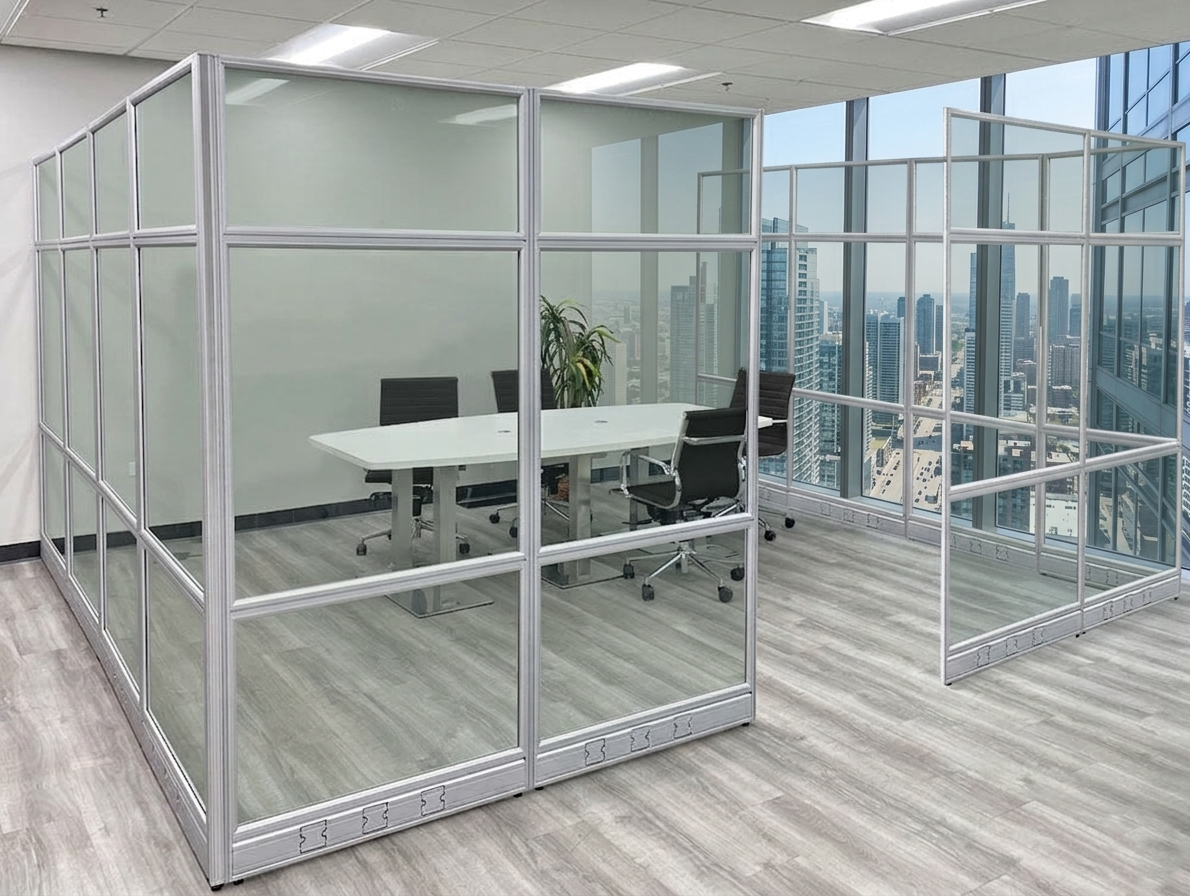
Mass-loaded vinyl core and foam-backed acoustic panel systems in modular aluminum T-slot frames — providing measurable noise reduction between noisy production operations and adjacent work areas. NRC-rated panel options for mid and high-frequency industrial noise, floor-to-ceiling and partial-height configurations, and integrated personnel door and window provisions for practical daily use.

Request a Quote
Why Choose Modular Solutions for Industrial Sound Walls?

Noise-induced hearing loss remains one of the most prevalent occupational injuries — acoustic sound walls address the source of exposure rather than relying solely on PPE programs.

Mass-Loaded Vinyl Core

Sound transmission panels with mass-loaded vinyl (MLV) core layers providing significant sound transmission loss (STC) performance — effective at the low and mid-frequency range produced by industrial machinery.

Acoustic Foam Absorption

Foam-faced panel options providing both sound transmission loss and sound absorption — reducing reflective sound energy within the enclosed production area and lowering ambient noise levels on both sides of the wall.

NRC-Rated Performance

Panel assemblies with documented Noise Reduction Coefficient (NRC) and Sound Transmission Class (STC) ratings — providing verifiable acoustic performance data for OSHA noise compliance planning and engineering control documentation.

Floor-to-Ceiling Configurations

Full-height sound wall systems from floor to roof deck or structure — eliminating the sound flanking paths that reduce acoustic performance in partial-height barrier systems.

T-Slot Frame System

Aluminum T-slot structural frames hold acoustic panels securely while allowing panel removal and replacement — panels updated to higher NRC specifications or repaired without dismantling the wall frame.

OSHA 29 CFR 1910.95 Support

Sound wall systems documented as engineering controls in OSHA noise exposure reduction hierarchy — reducing TWA exposures to protect workers without relying on hearing protection as the primary control method.

Key Features & Capabilities

Industrial sound walls from Modular Solutions combine acoustic performance with practical industrial manufacturing requirements.

Acoustic Door Systems

STC-rated personnel doors with acoustic seals at all four edges — providing consistent noise barrier performance at door openings without creating weak points in the sound wall system.

Acoustic Window Panels

Double-glazed acoustic window inserts for sound walls requiring visual transparency — laminated glass assemblies providing significant STC performance at windows for supervisor observation positions.

Partial-Height Baffles

Partial-height acoustic baffle panels for situations where floor-to-ceiling sound walls are not practical — positioned at equipment noise source height to reduce direct propagation to adjacent work areas.

Hanging Acoustic Baffles

Overhead acoustic ceiling baffle systems to address reflected sound energy in high-ceiling facilities — combined with wall systems for comprehensive noise level reduction in large open production areas.

Utility Acoustic Seals

Acoustic plug panels and sealed penetration collars for conduit, piping, and cable penetrations — maintaining sound transmission performance at all utility entries through the sound wall system.

Relocatable System

Sound wall systems that disassemble and reassemble in new positions — protecting acoustic investment when production equipment is relocated or facility layout is reconfigured.

Common Applications

Industrial sound walls reduce noise exposure where equipment-generated noise creates OSHA action level or PEL exceedances in adjacent work areas.

Frequently Asked Questions

What is an industrial sound wall and how does it work?

An industrial sound wall is a barrier system that reduces the transmission of airborne noise from a high-noise source area to adjacent occupied areas. Sound reduction is achieved through two mechanisms: sound absorption (soft, fibrous, or porous materials that convert sound energy to heat, reducing reflections inside the noisy area) and sound transmission loss (dense, heavy barrier materials that block airborne noise from passing through the wall). Effective industrial sound walls use both mechanisms — an absorptive inner face to reduce reverberation inside the noisy area, and a mass-loaded or composite wall construction to block transmitted noise.

How many decibels can an industrial sound wall reduce?

A well-designed industrial sound wall with a noise reduction coefficient (NRC) of 0.80 to 0.95 and a sound transmission class (STC) of 25 to 35 can reduce the noise level in an adjacent area by 10 to 15 dB(A) for a fully enclosed barrier. A partial barrier (not floor-to-ceiling) achieves 3 to 8 dB(A) reduction depending on how much of the noise propagation path it intercepts. OSHA uses an 85 dB(A) action level as the threshold requiring a hearing conservation program; reducing the noise level below 85 dB(A) eliminates this requirement for workers in the protected area.

What OSHA standard requires industrial noise control?

OSHA 29 CFR 1910.95 (Occupational Noise Exposure) requires employers to implement a hearing conservation program when employee noise exposure equals or exceeds 85 dB(A) TWA (time-weighted average over 8 hours). The standard requires feasible engineering controls (including sound barriers) to be applied before relying on hearing protection. Industrial sound walls that reduce noise levels below 85 dB(A) TWA in the worker's area eliminate the hearing conservation program requirement for workers in that area.

Can industrial sound walls also serve as safety barriers?

Yes. Modular Solutions designs combined sound wall and safety barrier systems where the structural frame serves as both the physical separation barrier and the acoustic enclosure. The frame is engineered to resist the required lateral load (forklift impact, wind, or seismic), and the panel infill is specified for the required sound transmission class. This dual-function approach is more cost-effective than installing separate safety fencing and acoustic panels for the same zone.

How long does it take to install an industrial sound wall?

Installation time depends on the wall length and complexity. A 30-metre run of single-sided sound wall with no penetrations typically installs in one or two working days with a two-person crew using hand tools. Complex enclosures with multiple penetrations, interlocked gates, or HVAC integration require more time for coordination with other trades. Modular Solutions provides an installation sequence drawing and a pre-installation checklist to support efficient site installation.

Ready to Reduce Noise in Your Facility?

Contact our engineering team for industrial sound walls designed to your noise source, frequency spectrum, and OSHA compliance targets.

Request a Custom Quote