Dual-function welding barriers combining UV arc flash protection with acoustic noise absorption — FR-rated welding curtains backed with open-cell acoustic foam panels that absorb both UV radiation and the high-frequency noise produced by MIG, TIG, and plasma cutting operations. Freestanding, structure-mounted, and portable configurations for manual and automated welding cells.
Request a Quote
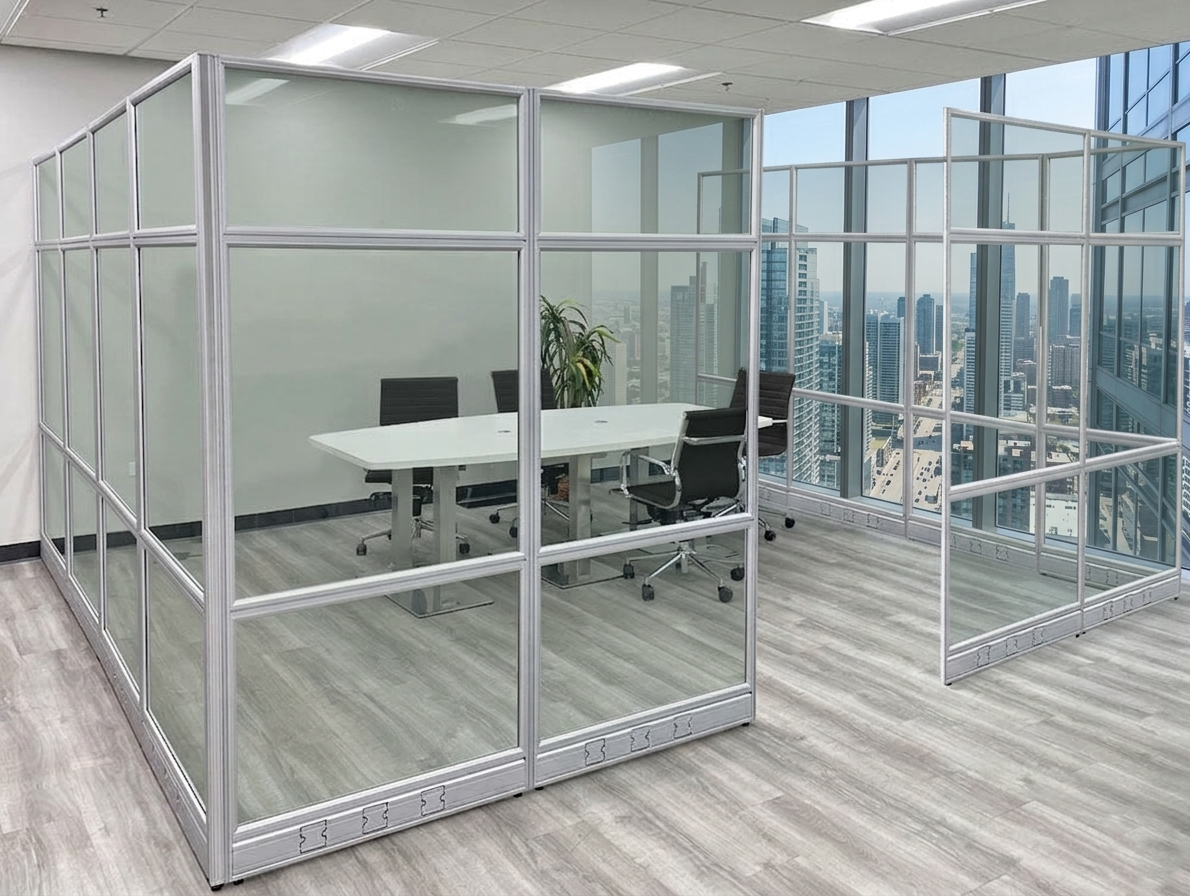
Standard welding screens address UV arc flash but ignore the noise exposure generated by arc welding processes — noise barriers address both hazards with a single integrated solution.
Flame-retardant PVC-coated or FR fabric welding curtains rated to NFPA 701 providing UV arc flash protection — blocking direct UV exposure to adjacent workers without restricting welding fume exhaust.
Open-cell melamine foam or mineral wool acoustic backing panels absorbing mid and high-frequency welding noise — reducing arc and spatter impact noise that standard welding curtains transmit without attenuation.
Weighted freestanding aluminum frame systems requiring no structural attachment — positioned anywhere in the facility and relocated as welding cell requirements change without structural work.
Overhead beam and column-mounted welding barrier systems for permanent welding cell boundaries — providing consistent protection coverage without floor space penalty from freestanding base frames.
Caster-mounted portable welding noise barrier panels that roll to position in minutes — protecting adjacent workers during spot repair, intermittent welding, and portable welding operations throughout the facility.
Welding barrier systems addressing OSHA 29 CFR 1910.252 and ANSI Z49.1 requirements for arc flash shielding — providing documented engineering control compliance for welding safety programs.
Welding noise barriers from Modular Solutions address the specific dual hazards of industrial welding — UV radiation and noise — with a practical integrated system.
Welding curtain panels in standard orange, green, and blue UV-blocking colors — preventing arc flash UV transmission to adjacent workers while providing visual welding cell identification on the production floor.
Individual panel replacement capability — welding spatter-damaged or UV-degraded curtain panels replaced without dismantling the barrier frame or replacing the acoustic backing assembly.
Panel-to-floor and panel-to-panel gap designs maintaining welding fume extraction airflow — welding cell exhaust ventilation not impaired by the acoustic barrier installation.
Overlapping curtain access openings or hinged panel sections for welder entry and fixture loading — maintaining UV and noise barrier continuity while providing practical daily workflow access.
Acoustic backing materials rated for proximity to welding spatter — non-combustible mineral wool or char-forming melamine foam options maintaining acoustic performance adjacent to active welding operations.
Panel and frame systems configured from 6 ft to 10 ft heights and unlimited bay widths — matching the specific geometry of manual welding booths and automated welding cell enclosures.
Welding noise barriers protect workers in fabrication shops, production facilities, and MRO environments with active welding operations adjacent to other work areas.
MIG and TIG welding generates noise in the range of 85 to 100 dB(A) at the operator position — plasma cutting and air arc gouging are louder at 100 to 115 dB(A). OSHA 1910.95 requires a hearing conservation program when workers are exposed to 85 dB(A) TWA or greater, and requires feasible engineering controls. Robotic welding cells can generate continuous high-level noise across large areas. Acoustic welding noise barriers reduce the transmitted noise level by 10 to 20 dB(A) in adjacent occupied areas, bringing those areas below the OSHA hearing conservation threshold.
Yes. Welding noise barrier systems can incorporate UV-blocking welding screens or welding curtain infill panels that absorb UV and visible arc flash radiation while also providing acoustic mass. Welding screens designed for UV protection use material that meets EN ISO 25980 (welding curtain standard) for UV absorption. The combination of acoustic mass and UV blocking makes these barrier systems suitable for welding bays adjacent to pedestrian walkways where both arc flash and noise exposure are concerns.
For maximum noise reduction in welding areas, composite panel barriers with an outer steel or aluminum facing (mass for transmission loss), a mineral wool core (absorption and additional transmission loss), and an inner facing are used. These panels achieve STC 30 to 40 depending on panel thickness and edge sealing quality. Welding screens and curtains are less effective (STC 10 to 20) but more flexible and less expensive for temporary or partial enclosures.
Barrier panels in welding areas must withstand weld spatter landing on the surface without igniting or deforming. Steel panel facings are the most heat-resistant; aluminum facings are suitable for most welding applications but will show discoloration and surface damage from heavy spatter exposure. Vinyl welding curtains must be specified for welding use (heavy-gauge FR vinyl, not standard PVC sheet) to provide adequate spark and spatter resistance. Modular Solutions specifies the appropriate panel or curtain material based on the welding process and the proximity of the barrier to the weld point.
Material flow openings in welding noise barriers (for conveyor pass-throughs, part staging trolleys, and forklift access) use acoustic strip door curtains (overlapping heavy vinyl or lead-loaded vinyl strips) that allow material to pass through while maintaining partial acoustic performance. Strip doors provide 5 to 10 dB(A) attenuation when properly overlapped, compared to 15 to 25 dB(A) for a closed panel. For high acoustic performance at openings, a staged acoustic vestibule with two offset strip door stages is used to increase the acoustic path length.
Contact our engineering team for welding noise barriers designed to your cell layout, welding process, and worker protection requirements.
Request a Custom Quote