Fire-resistant mesh and vinyl spark curtains and flash guards for grinding, cutting, chop-saw, and hand-held plasma operations that generate sparks and debris hazardous to adjacent workers, equipment, and combustible materials. FR-certified materials sized and positioned to intercept spark throw before it reaches people and equipment outside the hot work zone — OSHA 1910.212 and 1910.252 design reference.
Request a Quote
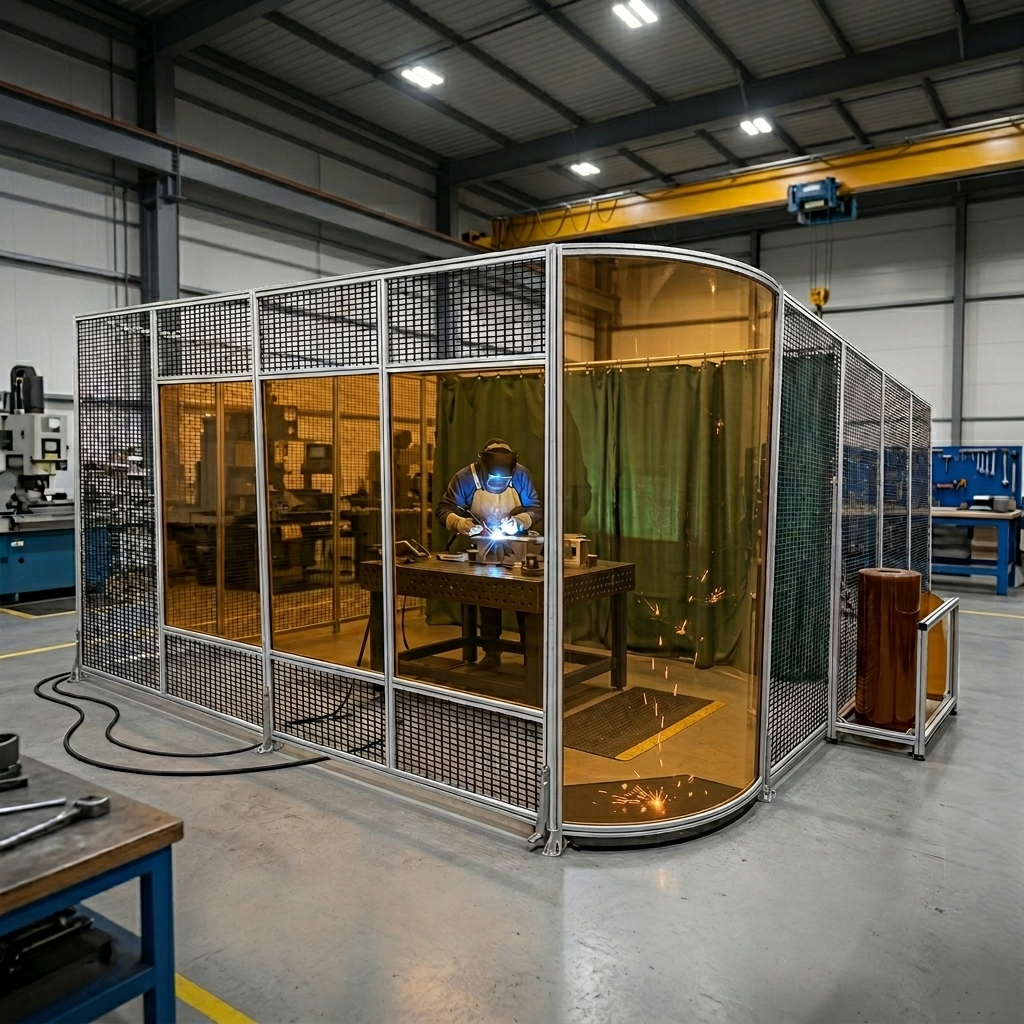
Grinding and cutting operations generate high-velocity sparks and debris that travel significantly further than many facilities account for. Flash guards position FR-rated barriers in the spark throw path before hazardous material reaches adjacent workers or equipment.
FR mesh and vinyl panels intercept sparks generated by grinding wheels, chop saws, angle grinders, and manual plasma cutters before they travel to adjacent personnel, equipment, or combustible stored materials.
Heavy-gauge FR mesh flash guards deflect grinding debris, wheel dressing chips, and cut-off fragments within the hot work zone, reducing impact hazard to workers adjacent to the grinding or cutting station.
Workers in adjacent operations who are not in the hot work area but are within spark throw distance are protected without requiring them to wear PPE for an operation they are not performing.
Grinding sparks that reach CNC machines, electrical panels, and sensitive equipment can cause surface damage and fire risk. Flash guards positioned between the grinding station and adjacent equipment eliminate that exposure.
OSHA hot work requirements mandate separation from combustible materials. Flash guards positioned in the spark throw path provide the separation barrier required for hot work permits when moving materials out of range is impractical.
Caster-mounted flash guards that position quickly around any grinding station; fixed configurations for permanent grinding bays where spark throw geometry does not change.
Flash guards and grinding curtains from Modular Solutions are built from FR-certified materials in configurations matched to spark throw distance and the specific grinding or cutting operation.
Woven FR fiberglass or steel mesh panels that contain sparks and debris while allowing air circulation through the hot work zone — reducing heat buildup in enclosed grinding areas and maintaining ventilation to the grinding operator.
Opaque FR vinyl panels for applications requiring complete light and spark blocking rather than debris deflection — used where spark containment AND visual separation from adjacent operations is required.
Angled top or side panels that redirect spark trajectories downward or away from specific equipment or personnel positions — useful where standard vertical guards cannot intercept sparks projected at specific angles by the grinding operation.
Flash guard systems that combine spark containment on the grinding side with UV-blocking panel materials on the welding side — for hot work areas where grinding and welding operations share adjacent floor positions.
Heavy base ballast options for portable flash guards used in drafty or high-airflow environments where standard caster bases could shift or tip in fan or HVAC airflows within the facility.
Flash guard configurations with sighting provisions that allow a fire watch observer to monitor the hot work zone from behind the guard without exposure to direct spark throw from the grinding or cutting operation.
Flash guards and grinding curtains are used wherever sparks, debris, and light flash from grinding, cutting, or hot work operations reach adjacent personnel or equipment.
Representative system parameters — all specifications are configured to the specific grinding operation, spark throw distance, and facility layout.
Welding screens are designed for arc welding hazards: UV arc radiation, weld spatter (molten metal), and fume. Flash guards and grinding curtains are designed for hot work that generates sparks, debris, and grinding wheel fragments — but not arc UV radiation. Flash guards use heavy-gauge FR mesh or vinyl for spark and debris deflection rather than the shade-rated UV-blocking panels used in welding screens.
Grinding and cutting operations fall under OSHA 29 CFR 1910.212 (general machine guarding) for point-of-operation hazards, and OSHA 29 CFR 1910.252 for hot work operations. Flash guards must prevent spark and debris from reaching adjacent personnel and combustible materials. Modular Solutions designs flash guard systems to support compliance with both standards.
Yes. Flash guards and grinding curtains are exposed to hot sparks generated at high velocity by grinding and cutting operations. All panel and curtain materials used by Modular Solutions in spark-exposure applications are FR-certified — resisting ignition from sparks at normal operating distances.
Yes. Hand-held plasma cutting generates both sparks/slag and some UV light. Flash guards using FR mesh or heavy opaque vinyl contain the spark and slag zone. For automated plasma cutting tables where UV arc radiation is also a concern, Modular Solutions specifies UV-blocking panel materials in addition to spark-rated curtain materials.
Flash guard placement depends on the spark throw distance of the specific grinding or cutting operation. Angle grinder sparks typically travel 6–10 feet; large grinding wheels and cutting saws can throw sparks further. Modular Solutions positions flash guards to intercept sparks before they reach personnel, equipment, or combustible materials in adjacent areas.
Contact our engineering team with your grinding operations, facility layout, and adjacent hazard zones — we will design flash guards positioned to intercept spark throw before it becomes a safety risk.
Request a Custom Quote