Modular aluminum-framed partition systems that define, separate, and protect welding cells on your production floor. UV-blocking and spark-containing panel systems with integrated ventilation gaps, personnel door provisions, and material pass-through openings — portable or anchored configurations that relocate with your production layout.
Request a Quote
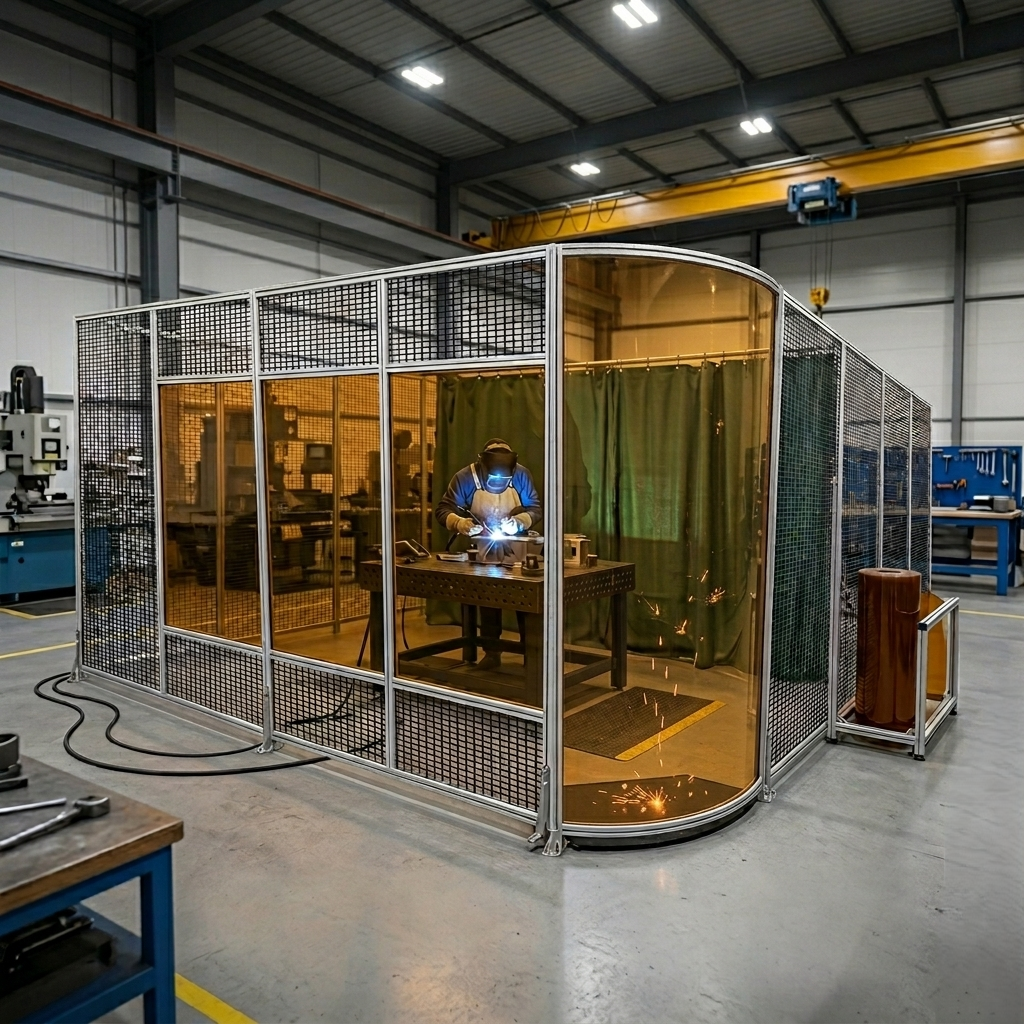
Welding cell partitions go beyond individual screens — creating complete, defined welding environments that manage arc hazards, fume control, and production flow together.
Four-sided partition systems that fully define a welding cell footprint — creating a dedicated welding environment with controlled access points, consistent arc shading, and visual workplace organization.
Solid and transparent panel options in shade 5 through shade 8 ratings for MIG, TIG, and plasma welding operations — blocking harmful UV-A and UV-B arc radiation from adjacent workers.
Lower panel sections in 10 or 14 gauge steel prevent weld spatter from projecting outside the cell footprint — reducing fire risk and protecting adjacent personnel and equipment.
Planned ventilation gaps at floor level and panel connections allow welding fume extraction systems to maintain airflow through the cell without creating arc flash escape points.
Hinged and sliding personnel doors with UV-safe vision panels at cell entrances — maintaining arc protection while providing convenient operator and material access to the cell.
Caster-mounted panel systems and modular T-slot frame connections allow full cell relocation in hours — protecting your investment as cell layouts change with production requirements.
Welding cell partitions from Modular Solutions are engineered to address each element of welding hazard management in a cohesive system.
Cells configured with solid lower panels for spatter containment and UV-transparent upper panels for supervisory visibility — tailored to the specific welding process and supervision requirements.
Roof frame provisions and partial overhead cover panels for cells requiring spatter containment above the work area — important for overhead welding and robot MIG torch configurations.
Cell dimensions engineered around your weld fixtures, positioners, and rotary tables — ensuring partition walls do not restrict fixture loading/unloading or part rotation envelopes.
Duct entry provisions and bracket mounting points for fume extraction arm systems and overhead canopy hoods — integrating ventilation infrastructure with the cell partition frame.
Base track and panel provisions for routing MIG liner packages, TIG torch leads, and shielding gas hoses within the cell footprint — avoiding trip hazards and cable damage.
Panel surfaces with low-reflectance finishes reduce secondary arc flash exposure from reflected arc radiation inside the cell — improving operator arc eye protection even at close working distances.
Welding cell partitions from Modular Solutions define welding operations across manufacturing, fabrication, and maintenance environments.
Representative system parameters — all specifications are custom-engineered to your cell size, welding process, and facility layout.
OSHA 29 CFR 1910.252 requires protection of nearby workers from arc flash and weld spatter. ANSI Z49.1 (Safety in Welding, Cutting, and Allied Processes) provides the specific shade requirements and barrier configurations. Modular Solutions designs welding cell partitions to align with both standards.
ANSI Z49.1 specifies minimum shade numbers based on welding process and amperage. For typical MIG welding (100–350A), shade 10–12 at the arc position is standard; partitions protecting adjacent workers at greater distance typically use shade 5–8 panels to block UV and IR without eliminating visibility.
Yes. Ventilation gap design places openings at floor level and at the top of panels where arc radiation does not project. This allows fume extraction airflow without creating direct line-of-sight UV exposure to adjacent workers.
Modular Solutions designs partition layouts around your welding fixture footprint, positioner rotation envelope, and forklift loading aisle — ensuring panels do not restrict production operations or require removal for normal cell function.
Yes. Modular aluminum framing and caster-mounted base sections allow full cell relocation without cutting or demolition. Panel sections disconnect at T-slot joints and reassemble in the new location.
Contact our engineering team for welding cell partition systems designed to your cell size, welding processes, and facility layout.
Request a Custom Quote