Precision-engineered enclosures designed around rotary indexing systems and turntable automation. Our modular designs accommodate 360-degree rotational movement while maintaining complete process containment and operator safety.
Request a Quote
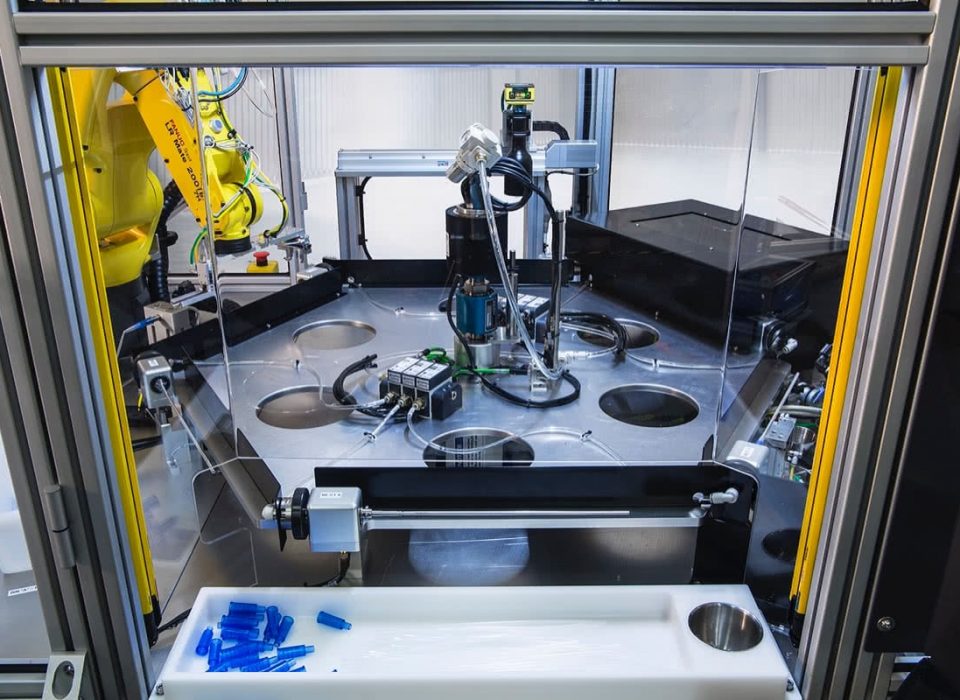
Turntable and rotary enclosures engineered for dynamic automation environments.
Carefully engineered mounting and positioning that provides full clearance for turntable rotation without interference or contact with enclosure structure.
Integrated safety gates and interlocks that prevent equipment operation when enclosure access points are open, protecting operators during rotation cycles.
Operator access points positioned at rotation pause points for safe part loading, unloading, and fixture interaction without stopping the automation cycle.
Full debris, liquid, and particle containment that remains effective throughout full rotational cycles and maintains consistent environmental control.
Slip rings, cable management, and fluid routing that accommodates the rotating heads without tangling, pinching, or operational disruption.
Viewing windows and observation points positioned to allow operators to monitor process progression across all rotation stations.
Turntable enclosures for rotary automation systems.
Rotational clearance is calculated from the maximum radial envelope of the robot arm, tooling, workpiece, and fixture at each indexed position across the full rotation. This envelope is derived from the robot model's reach data and the specific tooling and fixturing geometry. Modular Solutions engineers the enclosure inner dimension to maintain the safety distance required by ANSI/RIA R15.06 between the maximum swing radius and the nearest fixed barrier or access gate at all indexed positions.
Turntable and rotary cell enclosures use proximity sensors or coded RFID interlock switches at each access gate, wired in a dual-channel configuration to both the robot controller's safety input and the turntable indexer's safety circuit. Before any access gate can be opened, the interlock system confirms the robot is in a safe-stop state, the turntable is at the correct indexed position, and motion is inhibited on both axes. Trapped-key interlock systems are available for applications requiring a physical key to be held by the operator before the enclosure can be opened.
Yes. Multi-station turntable cells — typically 2, 3, or 4 stations — are a standard Modular Solutions configuration. Each loading and unloading station can have its own interlocked access gate, with the safety system ensuring the robot cannot enter a station while its gate is open. The enclosure perimeter is engineered to the turntable's overall dimensional envelope and the number of stations, with dedicated gate positions at each operator access point.
The minimum clearance between any rotating part and a fixed barrier is determined by the robot's maximum speed at that point and the safety distance required for the safety system's stopping time, per ANSI/RIA R15.06. For most industrial turntable cells with standard indexer speeds, 500mm between the maximum swing radius and the nearest fixed panel is a common starting point; the actual value is calculated from the specific risk assessment for the cell.
Yes. Safe-home position access is a standard feature: the interlock system is configured so that the access gate at a specific station can only be opened when the turntable has indexed to that station's safe position and the robot is confirmed to be outside the overlap zone. This is implemented through robot and indexer PLC logic in combination with dual-channel gate interlock switches. The operator receives a positive confirmation — indicator light or HMI feedback — when the gate is safe to open.
Our team will design a custom rotary enclosure that safely accommodates your rotation requirements and process parameters.
Request a Custom Enclosure