Vision System Enclosures
Modular aluminum enclosures engineered specifically for industrial machine vision systems — providing stable camera mounting, controlled lighting environments, and reliable protection from chips, coolant mist, and ambient light interference. Every enclosure is designed around your camera configuration, conveyor integration, and inspection process requirements. Custom-engineered in Auburn Hills, MI.
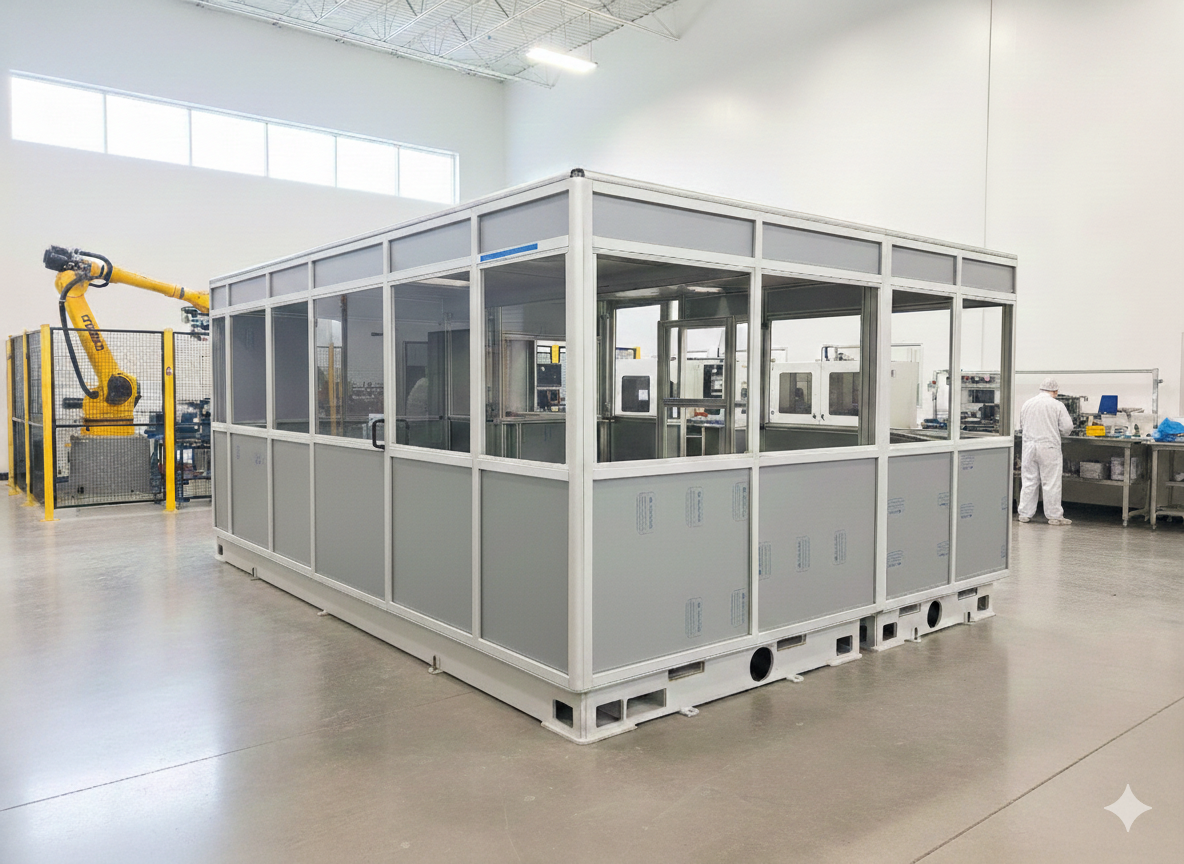
Vision Enclosure Engineering Features
Machine vision systems are only as reliable as the environment they operate in. These enclosure features address the specific challenges of industrial imaging applications.
Vibration-Isolated Camera Mounting
Cameras, lights, and sensors mount to T-slot aluminum rails integrated into the structural frame — not to removable access panels. Rail mounts are adjustable on all axes for precise positioning and maintain alignment when access doors are opened and closed during maintenance.
Ambient Light Elimination
Opaque aluminum panel infill and sealed panel joints block production floor lighting from entering the inspection zone. Pass-through conveyor openings are fitted with light baffles or brush seals. Interior surfaces specified in matte black to minimize internal reflections and improve image contrast.
Chip and Coolant Protection
Sealed enclosure design prevents metal chips, coolant mist, and airborne particulates from contaminating camera optics, sensor faces, and lighting fixtures. Reduces cleaning frequency and extends the service life of high-value imaging hardware installed near machining operations.
Conveyor Line Integration
Pass-through openings sized precisely to your conveyor belt width and part profile — with light-sealing provisions that allow part flow without ambient light intrusion. Enclosures mount directly to or independently of existing conveyor frames with no modification to the conveyor structure.
Integrated Lighting Mounts
Internal T-slot channels position LED ring lights, bar lights, coaxial lights, and backlights at precise distances and angles relative to the camera axis. Lighting positions are repeatable across multiple identical enclosures and easily adjustable during process setup without tools.
Maintenance Access Design
Hinged access panels, sliding doors, and quick-release latches provide fast access to cameras and lighting for lens cleaning, filter replacement, and calibration — without removing the enclosure from the line or disturbing conveyor components.
Vision System Enclosure Applications
Industrial machine vision enclosures are specified wherever imaging hardware must operate reliably in production environments with light contamination, particulate exposure, or vibration.
- Automated Surface Defect Inspection — End-of-line inspection enclosures for detecting surface scratches, porosity, finish defects, and dimensional non-conformance on machined, stamped, and cast components — with controlled lighting and opaque walls eliminating ambient light variables from the inspection result.
- Dimensional Measurement Cells — Stable, vibration-managed enclosures for 2D and 3D dimensional measurement systems where camera-to-part distance consistency directly affects measurement accuracy and system repeatability.
- Barcode, Label, and Marking Verification — Inline vision enclosures for reading and verifying 1D/2D barcodes, OCR characters, date codes, and part markings on production lines — with controlled backlighting and reject-lane integration provisions.
- Part Orientation and Presence Detection — High-speed inspection enclosures confirming part orientation, presence, and correct assembly before downstream operations or packaging — integrated with robot pick-and-place cells and conveyor indexing systems.
- Robot Guidance Vision Systems — Enclosures for fixed-mount vision systems that guide robotic pick operations, weld seam tracking, and assembly positioning — protecting cameras from weld spatter, grinding debris, and coolant in the robot work envelope.
- Post-Machining Quality Control — Inspection enclosures positioned at machining cell exits for 100% automated inspection of turned, milled, and ground components — protecting optics from coolant spray and chips while delivering consistent lighting for reliable AI-based defect classification.
Engineering & Specification Parameters
All vision system enclosures are engineered to your camera hardware, conveyor layout, and inspection process — no standard catalog sizes.
Frequently Asked Questions
Common engineering questions about machine vision enclosures for industrial inspection applications.
How do you prevent ambient light from interfering with machine vision systems inside an enclosure?
Vision system enclosures use opaque aluminum panel infill and sealed panel joints to block ambient light from the surrounding production floor. Pass-through openings for conveyors and part flow are fitted with light baffles or overlapping brush seals that allow parts to pass while blocking direct and reflected ambient light. Interior surfaces can be specified in matte black to minimize internal reflections that could reduce image contrast.
Can a machine vision enclosure integrate with an existing conveyor line?
Yes. Vision system enclosures are routinely designed around existing conveyor lines with precision-sized pass-through openings at the entry and exit faces. Opening dimensions and heights are matched to your conveyor belt width and part profile. Light-sealing provisions at the openings prevent ambient light intrusion without contacting or modifying conveyor components.
How is camera mounting stability addressed inside the enclosure?
Cameras, lights, and sensors mount to T-slot aluminum rails integrated into the enclosure frame — not to removable access panels. This eliminates relative movement between optical components when access doors are opened and closed. All mounts are adjustable on multiple axes for precise camera positioning and maintain repeatable alignment during setup and recalibration.
Can one enclosure accommodate multiple cameras or sensor types?
Yes. Vision system enclosures are designed around your specific camera count, sensor types, and lighting configuration. Multiple cameras for multi-angle inspection, combined 2D and 3D sensor setups, and mixed camera-laser scanner configurations are all accommodated. The T-slot frame system provides mounting flexibility for any combination of imaging hardware in a single enclosure.
Do vision system enclosures require special ventilation to prevent lens fogging?
In high-humidity environments or near coolant-heavy machining operations, enclosures can be specified with filtered ventilation provisions — low-velocity filtered air flow prevents condensation on optics without introducing particulates. For dry environments, sealed enclosures without active ventilation are standard. We evaluate your environment and recommend the appropriate configuration during the quoting process.
Engineer Your Vision System Enclosure
Share your camera hardware, conveyor layout, part dimensions, and environmental conditions — our engineering team will design an enclosure that keeps your vision system performing reliably on the production floor.
Email Us for a Quote Contact FormModular Solutions — 4280 Giddings Rd, Auburn Hills, MI 48326 | 248-625-1864