Conveyor Crossovers
Conveyor crossovers give personnel a safe, permanent route over conveyor lines instead of climbing across, ducking under, or walking the long way around. Every time a worker steps over a moving conveyor, the plant carries real exposure to falls, entanglement, and lost time — and informal crossings draw citations while slowing the flow of people across the floor. A conveyor crossover solves this with stairs up one side, a guarded bridge over the belt, and stairs down the other, engineered to provide adequate clearance above the conveyor and its product. Modular Solutions builds each crossover from T-slot aluminum, sized to the conveyor width, belt height, and required overhead clearance, with slip-resistant treads, 42-inch guarding, and self-closing gates. Because the structure bolts together, spans and stair heights adjust to the line and relocate when conveyors are re-laid. Available as compact single-belt crossovers or wider multi-line spans, conveyor crossovers create safe, obvious pedestrian routes that improve traffic flow, protect the crew, and give safety managers a clean answer to unauthorized crossing points across the material-handling floor.
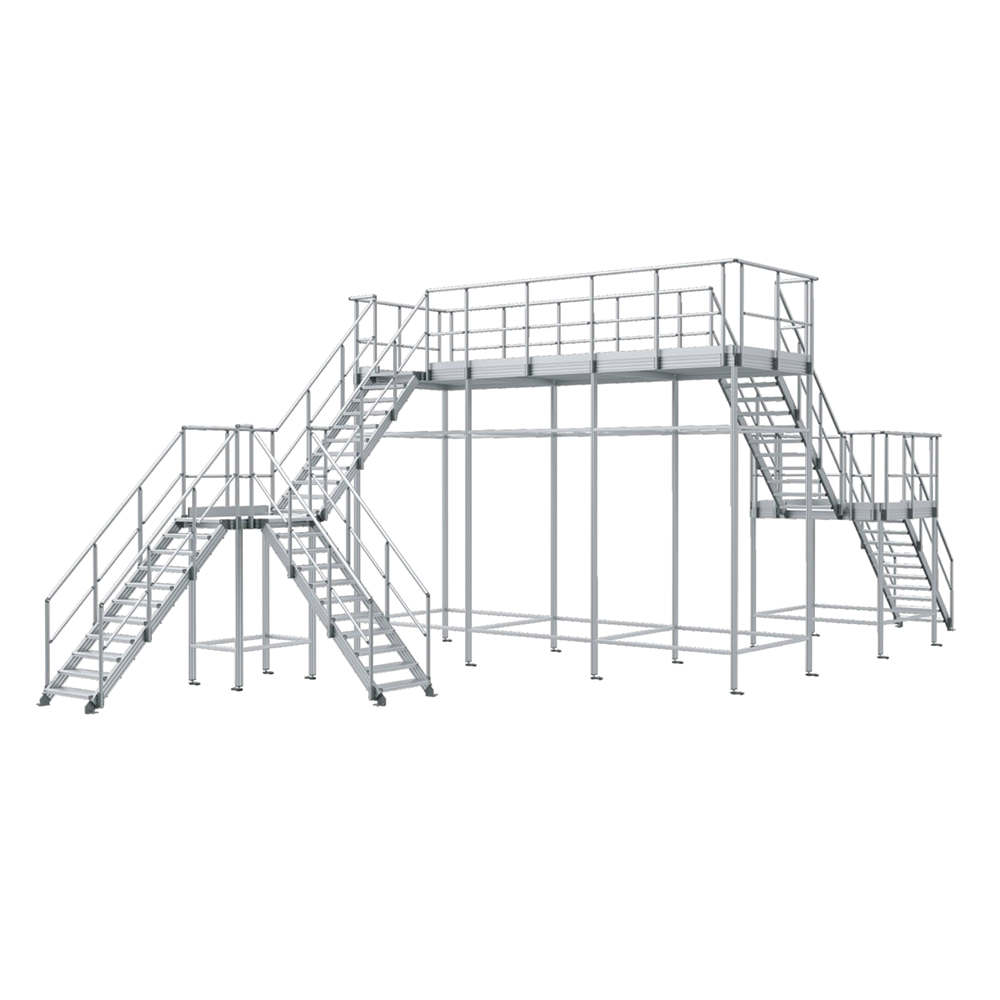
What Are Conveyor Crossovers?
A conveyor crossover is a fixed stair-bridge-stair structure that carries personnel safely over a conveyor or material-handling line. Stairs rise on one side, a guarded bridge spans the belt with adequate overhead clearance, and stairs descend on the other — replacing the hazard of stepping over or ducking under moving equipment.
Modular Solutions engineers each conveyor crossover from T-slot aluminum, sizing it to the conveyor width, belt height, and required clearance, with slip-resistant treads, full guarding, and self-closing gates per OSHA criteria. Because it bolts together, the crossover adjusts to the line and relocates when conveyors are re-laid.
Key Features
Engineered around your route, clearances, and facility — not a catalog template.
Stair-Bridge-Stair Design
Stairs up, a guarded bridge over the belt, and stairs down create a safe, obvious crossing route.
Engineered Clearance
Bridge height provides adequate clearance above the conveyor and its conveyed product.
Slip-Resistant Treads
Serrated or grated treads and bridge decking for secure footing in the plant environment.
Full Guarding & Gates
42-inch guardrails, toe boards, and self-closing gates engineered to align with OSHA 1910.29.
Single or Multi-Belt Spans
Compact crossings for one conveyor or wider spans over multiple lines.
Bolted & Relocatable
Span and stair height adjust and the crossover relocates when conveyors are re-laid — no welding.
Common Applications
Configured for the specific access and crossing demands of your facility.
- Single-Conveyor Crossings - Compact crossovers where personnel routinely cross one conveyor.
- Multi-Line Spans - Wider crossovers spanning several parallel conveyors.
- Warehouse & Distribution - Safe routes across sortation and material-handling lines.
- Packaging & Bottling - Crossings over accumulation and transfer conveyors in high-traffic areas.
- Parcel & Baggage Handling - Crossovers over belt lines in logistics environments.
- Bulk & Process Handling - Spans over drag chains, screw conveyors, and bulk lines.
Benefits
What a purpose-engineered catwalk or crossover delivers on the plant floor.
- Eliminates unsafe crossing over and under moving conveyors.
- Improves floor traffic flow with clear, obvious routes.
- Prevents entanglement and falls at informal crossing points.
- Answers audit findings with an engineered, guarded solution.
- Relocates with the line because the bolted frame adjusts.
- Installs cleanly as a modular assembly with minimal disruption.
Industries Served
Trusted for elevated access and crossings across demanding industrial environments.
Customization Options
Every structure is engineered to your route, clearances, and access requirements.
- Bridge span and clearance engineered to conveyor width, belt height, and product profile.
- Stair rise, run, and approach direction configured to the surrounding floor space.
- Single-belt and multi-line spanning configurations.
- Tread and deck materials: serrated aluminum, bar grating, or perforated plank.
- Self-closing gates, mid-landings, and switchback stairs for tall crossings.
- Floor-anchored or freestanding weighted bases per floor condition.
Why Choose Modular Aluminum T-Slot Construction
Modular aluminum T-slot catwalks and walkways bolt together without welding and reconfigure without cutting — giving you a purpose-engineered elevated route today that adapts through every equipment change, line re-lay, and facility expansion without scrapping steel. Built from 45 Series T-slot extrusion with an integrated 40mm round handrail system, the structure will not rust, flake, or require repainting, presents a clean professional appearance, and ties directly into our stair, platform, crossover, and guarding ecosystem. Open grating decking sheds debris and lets light through to the floor below, lightweight aluminum eases installation and reduces imposed loads, and every walkway is engineered and manufactured in-house in Auburn Hills, MI so the route fits your facility exactly rather than forcing your operation to fit a catalog.
Design & Engineering Considerations
How our engineers approach each catwalk and crossover project.
- Clearance engineering - Bridge elevation is set from belt height and product profile for adequate, code-referenced clearance.
- Stair geometry - Rise, run, and landings are laid out to align with OSHA 1910.25 for safe two-way travel.
- Span and load - Bridge structure is sized for pedestrian loads and span length with design margins.
- Footprint fit - Stair direction and base type are engineered to the floor around the conveyor.
- Relocation planning - Modular connections allow span and stair height to change when the line is re-laid.
Safety & Compliance Considerations
Every structure is engineered to align with OSHA 1910.28 walking-working-surface and 1910.29 guardrail criteria; installed compliance is verified with your safety authority.
- 42-inch guardrails, mid-rails, and toe boards on bridge and stairs engineered to align with OSHA 1910.29.
- Stair rise, run, and landings laid out to align with OSHA 1910.25 stairway criteria.
- Slip-resistant treads and decking selected for the environment around the line.
- Self-closing gates where the crossover meets elevated platforms or open sides.
- Overhead clearance engineered so no part contacts the conveyor or product; verified with your team.
Specifications & Configurations
Representative configurations — all dimensions and options are custom-engineered to your requirements.
| Specification | Detail |
|---|---|
| Frame Profile | 45 Series T-slot aluminum extrusion; heavy-duty for long spans |
| Configuration | Single-belt or multi-line stair-bridge-stair crossover |
| Tread/Deck Options | Serrated aluminum, bar grating, or perforated plank |
| Guardrail | 42-inch top rail with mid-rail and 4-inch toe board |
| Stairs | Configurable rise/run, mid-landings, switchbacks for tall crossings |
| Base | Floor-anchored or freestanding weighted feet |
Frequently Asked Questions
Common questions about conveyor crossovers design, configuration, and compliance.
What is a conveyor crossover?
It is a fixed stair-bridge-stair structure that carries personnel safely over a conveyor or material-handling line. Stairs rise on one side, a guarded bridge spans the belt with adequate overhead clearance, and stairs descend on the other — replacing the hazard of stepping over or ducking under moving equipment.
How much clearance is provided over the conveyor?
Bridge elevation is engineered from the belt height and the conveyed product profile to provide adequate, code-referenced clearance. We set the height so the crossing never interferes with the conveyor or its product.
Can a crossover span multiple conveyors?
Yes. We build single-belt crossovers as well as wider spans over multiple parallel conveyors, sizing the bridge for the span length and pedestrian load with appropriate design margins.
Are the stairs and bridge OSHA compliant?
The crossover is engineered to align with OSHA 1910.29 guardrail criteria and 1910.25 stairway geometry — 42-inch rails, toe boards, and compliant stairs with landings. Installed certification is verified with your safety authority.
Can the crossover be moved if the line is re-laid?
Yes. The bolted T-slot aluminum structure lets the span and stair height be adjusted and the whole crossover relocated with hand tools when conveyors are re-laid.
What about tall crossings over high conveyors?
For tall crossings we add mid-landings and switchback stairs to keep the climb safe and manageable, with appropriate bracing and footings for the increased height.
Design Your Conveyor Crossover
Give us the conveyor width, belt height, and crossing location — our engineers will return a guarded crossover design with a quote and lead time.