Maintenance Catwalk Systems
Maintenance catwalk systems create dedicated elevated walkway networks that connect the service points on your maintenance route — equipment tops, utilities, inspection positions, and access hatches — into a safe, walkable circuit. Where preventive maintenance requires reaching many elevated points across a facility, tackling each from a lift or ladder makes PM slow, schedule-bound, and hazardous, and it tempts crews to skip hard-to-reach tasks. A maintenance catwalk system links those points with guarded walkways, so technicians move directly from one service point to the next on foot with tools in hand. Modular Solutions engineers each maintenance catwalk from T-slot aluminum, routing the network to the equipment and service points with grated or serrated decking, 42-inch guarding, and integrated stairs, ladders, and gates. Because the structure bolts together, it installs around existing equipment and extends as the facility grows. For maintenance and reliability teams, a catwalk system turns scattered elevated service points into an efficient, safe, lift-free maintenance route that keeps PM on schedule and technicians protected.
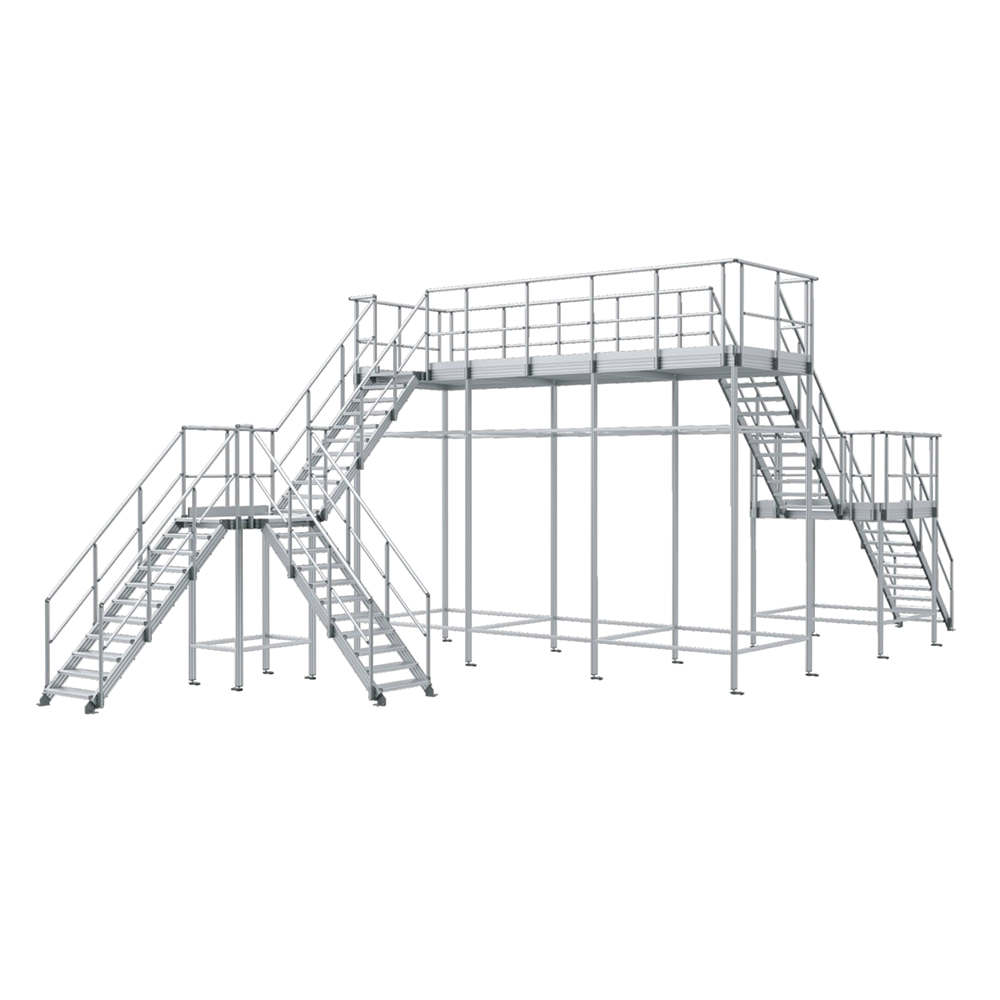
What Are Maintenance Catwalk Systems?
A maintenance catwalk system is a dedicated elevated walkway network that connects the service points on a maintenance route — equipment tops, utilities, inspection positions, and access hatches — into a safe, walkable circuit. It lets technicians move directly from one service point to the next on foot with tools in hand, instead of tackling each from a lift or ladder.
Modular Solutions engineers each maintenance catwalk from T-slot aluminum, routing the network to the equipment and service points with grated or serrated decking, full guarding, and integrated stairs, ladders, and gates. Because it bolts together, the system installs around existing equipment and extends as the facility grows.
Key Features
Engineered around your route, clearances, and facility — not a catalog template.
Connects Service Points
A walkway network links the equipment tops, utilities, and inspection points on your PM route.
Lift-Free PM Route
Technicians move on foot between service points with tools in hand — no lift setup between tasks.
Guarded Circuit
42-inch guardrails, toe boards, and self-closing gates engineered to align with OSHA 1910.29.
Open or Solid Decking
Grated decking sheds debris and lets light through; solid decking where required.
Routes to Equipment
The network is routed to the equipment and service points for efficient PM flow.
Bolted & Extendable
Installs around existing equipment and extends as the facility grows — no welding.
Common Applications
Configured for the specific access and crossing demands of your facility.
- PM Route Circuits - Walkway networks linking the elevated service points on a PM route.
- Equipment-Top Access - Walkway access to equipment tops, motors, and drives.
- Utility Service Routes - Access along pipe racks, trays, and utility runs for maintenance.
- Inspection & Monitoring - Routes to elevated inspection and condition-monitoring points.
- Access-Hatch Routes - Walkways connecting access hatches and service openings.
- Multi-Area Maintenance - Networks connecting service points across several areas.
Benefits
What a purpose-engineered catwalk or crossover delivers on the plant floor.
- Keeps PM on schedule with fast, lift-free access between points.
- Reduces skipped tasks at hard-to-reach service points.
- Cuts lift and scaffold use for routine maintenance.
- Safe guarded circuit across the maintenance route.
- Extends with the facility because the bolted frame adapts.
- Corrosion-free aluminum that needs no repainting.
Industries Served
Trusted for elevated access and crossings across demanding industrial environments.
Customization Options
Every structure is engineered to your route, clearances, and access requirements.
- Network routing engineered to the equipment and PM service points.
- Grated or serrated decking; open or solid as required.
- Width sized to technician movement and tool transport.
- Integrated stairs, ladders, gates, and landings.
- Branches and level connections across the maintenance route.
- Free-standing or building-tied support configuration.
Why Choose Modular Aluminum T-Slot Construction
Modular aluminum T-slot catwalks and walkways bolt together without welding and reconfigure without cutting — giving you a purpose-engineered elevated route today that adapts through every equipment change, line re-lay, and facility expansion without scrapping steel. Built from 45 Series T-slot extrusion with an integrated 40mm round handrail system, the structure will not rust, flake, or require repainting, presents a clean professional appearance, and ties directly into our stair, platform, crossover, and guarding ecosystem. Open grating decking sheds debris and lets light through to the floor below, lightweight aluminum eases installation and reduces imposed loads, and every walkway is engineered and manufactured in-house in Auburn Hills, MI so the route fits your facility exactly rather than forcing your operation to fit a catalog.
Design & Engineering Considerations
How our engineers approach each catwalk and crossover project.
- Route mapping - We identify the elevated service points on your PM route and how they connect.
- Network routing - The walkway network is routed to link the points for efficient PM flow.
- Structural design - Supports, spans, and decking are sized for technicians and tools with design margins.
- Access integration - Stairs, ladders, gates, and landings are designed into the network.
- Extendability - Modular connections let the system extend as the facility grows.
Safety & Compliance Considerations
Every structure is engineered to align with OSHA 1910.28 walking-working-surface and 1910.29 guardrail criteria; installed compliance is verified with your safety authority.
- 42-inch guardrails, mid-rails, and toe boards engineered to align with OSHA 1910.29 across the network.
- Grated decking selected to shed debris and, where open, provide visibility.
- Stair and ladder geometry engineered to align with OSHA 1910.25 and ladder criteria.
- Self-closing gates at access points and open ends.
- Clearances around equipment engineered and verified with your safety authority.
Specifications & Configurations
Representative configurations — all dimensions and options are custom-engineered to your requirements.
| Specification | Detail |
|---|---|
| Frame Profile | 45 Series T-slot aluminum extrusion; bolted assembly |
| Configuration | Walkway network linking PM service points with branches and connections |
| Decking | Open bar grating or serrated aluminum; solid where required |
| Guardrail | 42-inch top rail with mid-rail and 4-inch toe board |
| Access | Integrated stairs, ladders, and self-closing gates |
| Support | Free-standing or building-tied |
Frequently Asked Questions
Common questions about maintenance catwalk systems design, configuration, and compliance.
What is a maintenance catwalk system?
It is a dedicated elevated walkway network that connects the service points on a maintenance route — equipment tops, utilities, inspection positions, and access hatches — into a safe, walkable circuit. It lets technicians move directly between service points on foot with tools in hand.
How does it improve preventive maintenance?
By linking elevated service points with guarded walkways, the system removes lift setup between tasks, reduces skipped hard-to-reach tasks, and keeps technicians moving — helping PM stay on schedule and improving reliability.
Does it remove the need for lifts?
For the connected service points, yes. Technicians walk the network between points instead of positioning a lift at each one, which frees that equipment and removes setup time from routine maintenance.
Can it route around existing equipment?
Yes. We route the network to the equipment and service points, holding required clearances, and the bolted structure installs around existing equipment.
Are maintenance catwalks OSHA compliant?
They are engineered to align with OSHA 1910.29 guardrail and 1910.25 stairway criteria. We design and document to these standards; installed certification is verified with your safety authority.
Can the network be extended later?
Yes. The bolted T-slot aluminum structure extends and branches with hand tools as the facility grows or the PM route changes.
Design Your Maintenance Catwalk System
Share the elevated service points on your PM route — our engineers will return a guarded maintenance-catwalk network design with a quote.