Injection Molding Machine Platforms
Injection molding machine platforms provide safe, guarded access to the elevated equipment on molding machines — hopper loaders, material dryers, feed throats, mold-area guarding, and top-of-press hydraulics that sit high above the operator on tall molding presses. Loading resin, servicing dryers and loaders, clearing feed-throat jams, and accessing the top of the mold area from ladders is slow and hazardous, and the process area can be hot. A fixed molding platform positions personnel at the working height with full fall protection, engineered to the machine footprint and the auxiliary equipment mounted above it. Modular Solutions designs each molding platform from T-slot aluminum, dimensioning the deck and stairs to clear the platen area, tie bars, and moving components while holding OSHA guarding and stairway criteria. Serrated or grated decking keeps footing secure. Because the structure bolts together rather than welding, it installs around existing machines and auxiliaries and reconfigures when the process changes. For molders running tall presses with material-handling auxiliaries overhead, injection molding machine platforms make resin loading, dryer service, and mold-area access safe, fast, and repeatable.
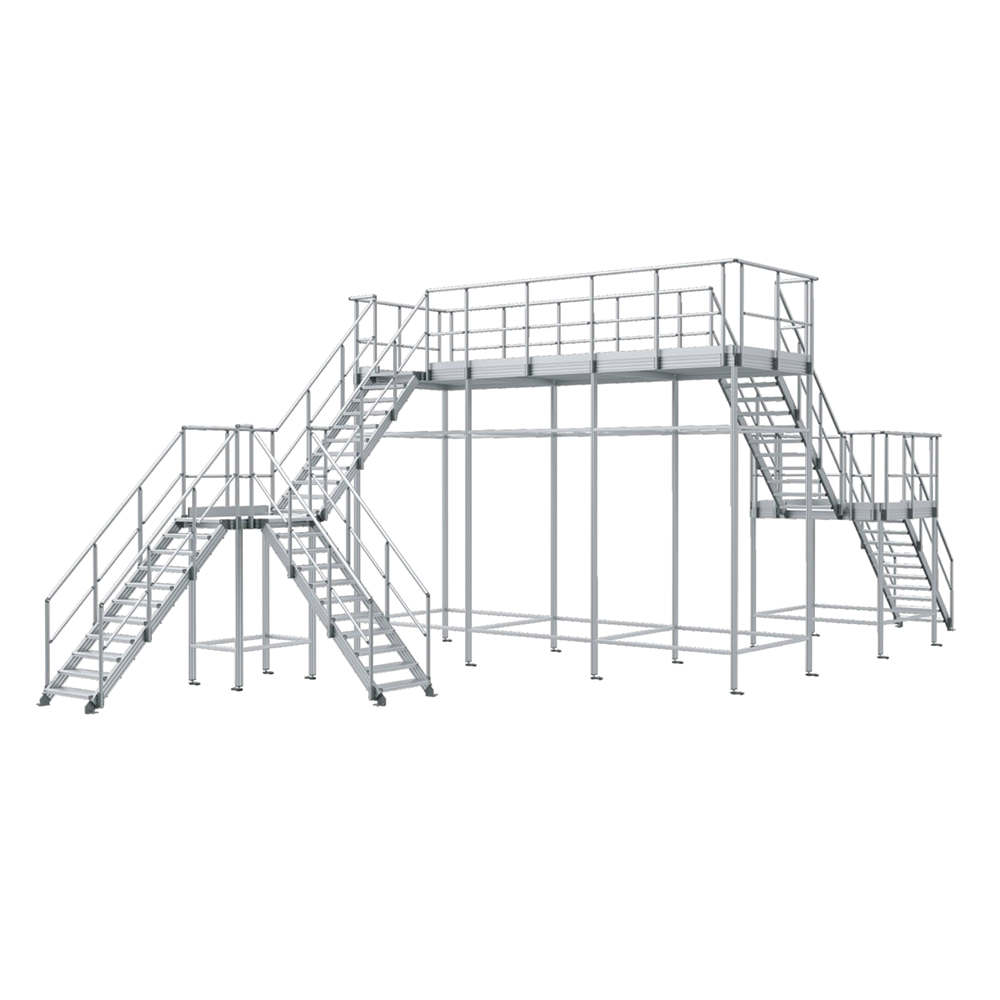
What Are Injection Molding Machine Platforms?
An injection molding machine platform is a fixed, guarded elevated work surface engineered to reach the elevated equipment on a molding machine — hopper loaders, material dryers, feed throats, mold-area guarding, and top-of-press hydraulics. It replaces ladders with a stable, code-referenced structure built to the machine and its auxiliaries.
Modular Solutions engineers each molding platform from T-slot aluminum, dimensioning the deck and stairs to clear the platen area, tie bars, and moving components per OSHA criteria. Because it bolts together, the platform installs around existing machines and auxiliaries and reconfigures when the process changes.
Key Features
Engineered around your equipment, process, and facility — not a catalog template.
Reaches Auxiliary Equipment
Positions personnel at hopper loaders, dryers, and feed equipment mounted above the press.
Built to the Molder
Deck and stairs are engineered to clear the platen area, tie bars, and moving components.
Secure Footing
Serrated or grated decking keeps footing secure in the process environment.
Full Fall Protection
42-inch guardrails, toe boards, and self-closing gates engineered to align with OSHA 1910.29.
Resin & Dryer Service Ready
Stable positioning for resin loading, dryer and loader service, and jam clearing.
Bolted & Reconfigurable
Installs around existing machines and reconfigures when the process changes — no welding.
Common Applications
Configured for the specific access demands of your equipment and environment.
- Resin Loading - Access to hopper loaders and material feed for resin loading and changes.
- Dryer & Loader Service - Reaching material dryers, loaders, and conveying equipment.
- Feed-Throat Jam Clearing - Safe access to clear feed-throat and hopper jams.
- Mold-Area Access - Positioning at mold-area guarding and top-of-press components.
- Top Hydraulics & Service - Reaching top hydraulics, valves, and service points.
- Auxiliary Equipment Maintenance - Access to elevated auxiliary and process equipment.
Benefits
What a purpose-engineered machine-access structure delivers on the plant floor.
- Protects operators from molding-machine fall risk.
- Speeds resin loading and dryer service with stable access.
- Secure footing in the process environment.
- Built to your molder and its auxiliaries.
- Reconfigures on process change because the bolted frame adapts.
- Corrosion-free aluminum with a clean professional appearance.
Industries Served
Trusted for machine and equipment access across demanding industrial environments.
Customization Options
Every structure is engineered to your equipment, floor space, and access requirements.
- Deck and stair layout engineered to the machine and auxiliary footprint.
- Cutouts and offsets to clear platen, tie bars, and moving components.
- Deck materials: serrated aluminum, bar grating, or perforated plank.
- Self-closing gates at access and material-loading openings.
- Bolt-on tool trays, lighting, and utility drops at the working level.
- Multi-machine configurations with connecting walkways.
Why Choose Modular Aluminum T-Slot Construction
Modular aluminum T-slot platforms and stairs bolt together without welding and reconfigure without cutting — giving you a purpose-engineered machine-access structure today that adapts through every retool, line change, and equipment replacement without scrapping steel. Built from 45 Series T-slot extrusion and aluminum stair profile with an integrated 40mm round handrail system, the structure will not rust, flake, or contaminate the work area, presents a clean professional appearance, and ties directly into our stair, platform, guarding, and gate ecosystem. It installs around existing machines with minimal disruption, relocates easily, and is engineered and manufactured in-house in Auburn Hills, MI so the structure fits your equipment exactly rather than forcing your process to fit a catalog.
Design & Engineering Considerations
How our engineers approach each machine-access project.
- Machine survey - We map the machine, platen area, and overhead auxiliaries from your dimensions or CAD.
- Clearance design - Deck and stairs are engineered to clear tie bars and moving components and reach the equipment.
- Access planning - Loading, service, and jam-clearing positions are designed into the deck.
- Load engineering - Structure and footings are sized for personnel and material handling with design margins.
- Adaptability - Modular connections let the platform reconfigure when the process changes.
Safety & Compliance Considerations
Every structure is engineered to align with OSHA 1910.25 stairway and 1910.29 guardrail criteria; installed compliance is verified with your safety authority.
- 42-inch guardrails, mid-rails, and toe boards engineered to align with OSHA 1910.29.
- Self-closing gates at stair and material-loading openings for continuous fall protection.
- Deck clearances engineered around platen, tie bars, and moving components.
- Slip-resistant decking selected for the process environment.
- Stair geometry engineered to align with OSHA 1910.25; installed compliance verified with your team.
Specifications & Configurations
Representative configurations — all dimensions and options are custom-engineered to your requirements.
| Specification | Detail |
|---|---|
| Frame Profile | 45 Series T-slot aluminum extrusion; heavy-duty where load requires |
| Configuration | Deck engineered to the molder and auxiliary footprint |
| Deck Options | Serrated aluminum plank, bar grating, or perforated plank |
| Guardrail | 42-inch top rail with mid-rail and 4-inch toe board |
| Access | Fixed stairs or ships ladder with self-closing gate |
| Clearances | Engineered around platen, tie bars, and moving components |
Frequently Asked Questions
Common questions about injection molding machine platforms design, configuration, and compliance.
What is an injection molding machine platform?
It is a fixed, guarded elevated work surface engineered to reach the elevated equipment on a molding machine — hopper loaders, material dryers, feed throats, mold-area guarding, and top hydraulics. It replaces ladders with a stable structure built to the machine and its auxiliaries.
What equipment does it provide access to?
Typically hopper loaders, material dryers and conveying equipment, feed throats, mold-area guarding, and top-of-press hydraulics and service points — the overhead auxiliaries and machine components your process requires access to.
Will it clear the platen and tie bars?
Yes. We engineer the deck and stairs to clear the platen area, tie bars, and moving components from your machine dimensions or CAD, so the platform never interferes with machine operation.
Can it help with feed-throat jams?
Yes. We design safe, guarded access positions at the feed throat and hopper so operators can clear jams with stable footing and both hands free instead of working from a ladder.
Can one platform serve multiple molding machines?
Yes. We design multi-machine configurations with connecting walkways that provide guarded access across several molders where the layout allows.
Are these platforms OSHA compliant?
They are engineered to align with OSHA 1910.29 guardrail and 1910.25 stairway criteria. We design and document to these standards; installed certification is verified with your safety authority.
Design Your Injection Molding Machine Platform
Send us your molding machine and auxiliary layout — our engineers will return a guarded molding-machine platform design with a quote.