Machine Access Stairs
Machine access stairs give operators and technicians a safe, permanent climb to the elevated points on production machinery — control decks, feed openings, top-mounted components, and platform positions around presses, molders, packaging lines, and process equipment. Where workers reach these points from ladders or improvised steps, machine access stairs replace the hazard with a stable, guarded route engineered to the equipment. Often paired with a machine access platform, the stair positions personnel at the correct height and orientation to work, then keeps them protected during every transit. Modular Solutions engineers each machine access stair from aluminum stair profile with a 40mm round handrail system, fitting rise, run, width, and turn direction to the machine footprint and surrounding clearances while holding OSHA 1910.25 stairway geometry. Compact and switchback options handle the tight spaces around equipment, and self-closing gates secure the top landing. Serrated or grated treads keep footing secure in oily, coolant-laden machine areas, and the bolted structure trims and relocates when the machine is repositioned or replaced. For elevated machine interaction, these stairs turn a recurring fall risk into a designed, compliant part of the workflow.
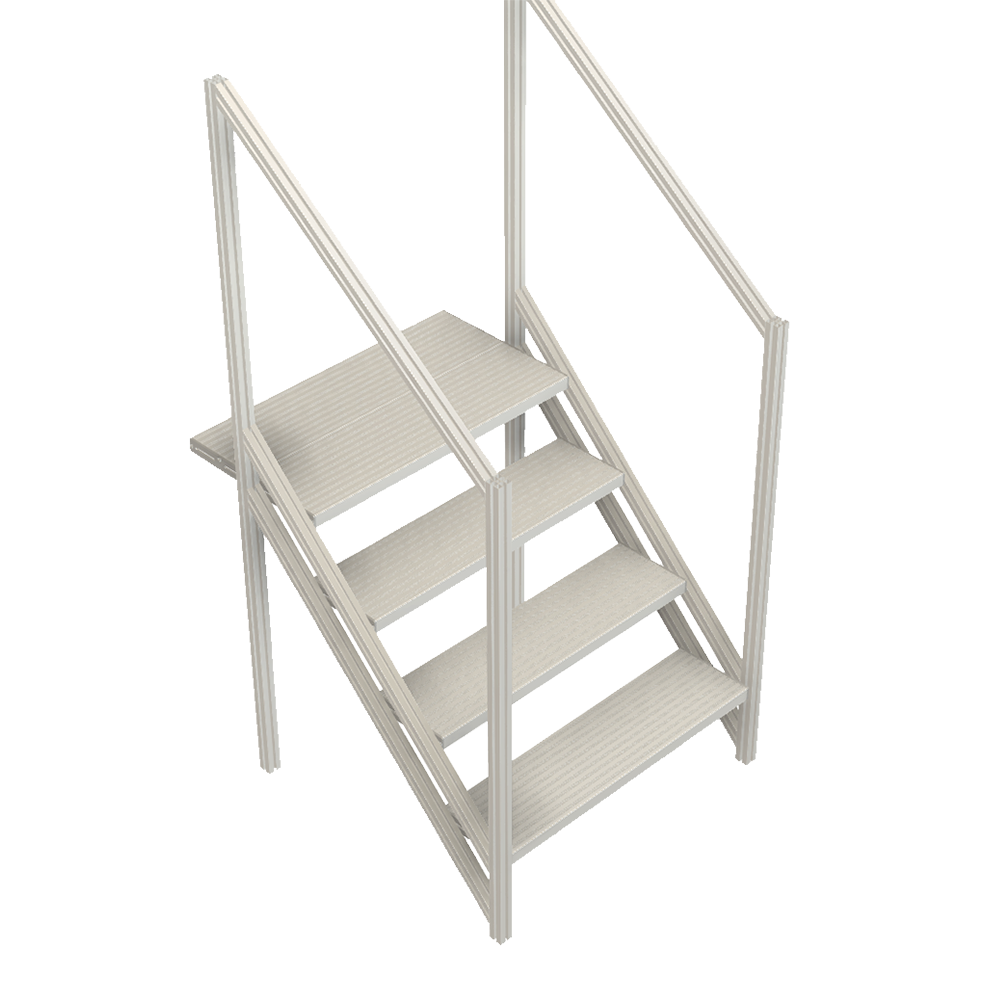
What Are Machine Access Stairs?
Machine access stairs are stairways engineered to carry operators and technicians safely to the elevated points on a specific machine — control decks, feed openings, top-mounted components, and platform positions. They replace ladders and improvised steps with a stable, guarded route built to the equipment, and are frequently paired with a machine access platform.
Modular Solutions engineers each machine access stair from aluminum stair profile with a 40mm round handrail system, fitting rise, run, width, and turn direction to the machine footprint and clearances per OSHA 1910.25. Compact and switchback options handle tight equipment areas, with self-closing gates and slip-resistant treads for oily machine environments.
Key Features
Engineered around your elevation, floor space, and facility — not a catalog template.
Fits the Machine Footprint
Rise, run, width, and turn direction are engineered to the equipment and surrounding clearances.
Pairs with Access Platforms
Integrates with machine access platforms to position personnel at the working height and orientation.
Compact & Switchback Options
Space-saving configurations handle the tight areas around presses, molders, and process equipment.
Oil-Ready Treads
Serrated or grated treads keep footing secure in oily, coolant-laden machine areas.
Top-Landing Gate
Self-closing gates secure the top landing where the stair meets the machine platform per OSHA 1910.29.
Bolted & Relocatable
The aluminum structure trims and relocates with hand tools when the machine moves or is replaced.
Common Applications
Configured for the specific access demands of your facility and environment.
- Press & Molding Machines - Access to top hydraulics, hoppers, and changeover positions on tall presses and molders.
- Packaging & Filling Lines - Climbing access to feed points, film loading, and elevated line components.
- Process & Mixing Equipment - Stairs to charging ports, agitator drives, and instrument decks.
- CNC & Machining Centers - Access to enclosure tops, tool magazines, and overhead components.
- Robotic & Automated Cells - Maintenance and teach-position access above cell guarding.
- Elevated Control Decks - Operator access to raised machine control and monitoring positions.
Benefits
What a purpose-engineered stair system delivers on the plant floor.
- Eliminates ladder use for elevated machine interaction.
- Positions personnel correctly when paired with an access platform.
- Fits tight equipment areas with compact and switchback options.
- Secure footing in oily, coolant-laden machine environments.
- Relocates with the machine because the bolted frame adapts.
- Corrosion-free aluminum that will not contaminate the work area.
Industries Served
Trusted for elevated access across demanding industrial and commercial environments.
Customization Options
Every stair is engineered to your elevation, floor space, and access requirements.
- Rise, run, width, and turn direction fitted to the machine footprint.
- Compact, straight, or switchback configuration for tight equipment areas.
- Integration with a matched machine access platform.
- Tread materials selected for oil, coolant, and debris.
- Self-closing gates at the machine platform entry.
- Notched or offset framing to clear motors, conduit, and guarding.
Why Choose Modular Aluminum Stair Construction
Modular aluminum stair systems bolt together without welding and reconfigure without cutting — giving you a purpose-engineered stair today that adapts through every platform change, layout revision, and facility expansion without scrapping steel. Built from aluminum stair profile with an integrated 40mm round handrail system, the structure will not rust, flake, or require repainting, presents a clean professional appearance, and ties directly into our platform, guarding, gate, and handrail ecosystem. It is lighter to install with minimal floor disruption, faster to relocate, and engineered and manufactured in-house in Auburn Hills, MI so the stair fits your elevation and floor space exactly rather than forcing your facility to fit a catalog.
Design & Engineering Considerations
How our engineers approach each stair-system project.
- Machine survey - We map the equipment footprint, elevated points, and clearances from your dimensions or CAD.
- Configuration selection - Compact, straight, or switchback layouts are chosen to fit the space around the machine.
- Platform integration - The stair ties into a machine access platform at the correct working height.
- Footing and clearance - Framing is routed to clear motors, conduit, and guarding while holding stairway geometry.
- Adaptability - Modular connections let the stair relocate when the machine changes.
Safety & Compliance Considerations
Stairs are engineered to align with OSHA 1910.25 stairway and 1910.29 guardrail criteria; installed compliance is verified with your safety authority.
- Stair geometry engineered to align with OSHA 1910.25; guarding to 1910.29.
- 40mm round handrails and 42-inch guardrails on flights and landings.
- Self-closing gates at the machine platform entry for continuous fall protection.
- Slip-resistant treads selected for oily and coolant-laden machine areas.
- Installed compliance verified with your internal safety authority.
Specifications & Configurations
Representative configurations — all dimensions and options are custom-engineered to your requirements.
| Specification | Detail |
|---|---|
| Structure | Aluminum stair profile with 40mm round handrail system |
| Configuration | Compact, straight, or switchback; pairs with machine access platform |
| Rise / Run | Engineered to align with OSHA 1910.25 stairway criteria |
| Tread Options | Serrated aluminum, bar grating, or perforated plank |
| Handrail / Guardrail | 40mm round handrail; 42-inch guardrail with mid-rail and toe board |
| Gate | Self-closing gate at machine platform entry |
Frequently Asked Questions
Common questions about machine access stairs design, configuration, and compliance.
What are machine access stairs?
They are stairways engineered to carry operators and technicians safely to the elevated points on a specific machine — control decks, feed openings, and top-mounted components. They replace ladders with a stable, guarded route built to the equipment and are often paired with a machine access platform.
Can the stair be combined with a platform?
Yes. Machine access stairs are frequently integrated with a machine access platform, so the stair delivers personnel to a guarded working surface at the correct height and orientation for the task.
Will the stair fit in the tight space around our machine?
Usually, yes. We offer compact and switchback configurations engineered to the machine footprint and clearances, with framing routed to clear motors, conduit, and guarding.
Are the treads safe in oily machine areas?
Yes. We specify serrated or grated treads that shed oil, coolant, and debris to maintain secure footing in machine environments.
Are machine access stairs OSHA compliant?
They are engineered to align with OSHA 1910.25 stairway geometry and 1910.29 guarding criteria, including handrails, guardrails, and a self-closing gate at the platform entry. Installed certification is verified with your safety authority.
Can the stair move if the machine is relocated?
Yes. The bolted aluminum structure trims and relocates with hand tools when the machine is repositioned, upgraded, or replaced.
Design Your Machine Access Stair
Send us your machine dimensions, photos, or CAD — our engineers will return a guarded stair-and-platform access solution with a quote.