Pneumatic Assembly Benches
Modular aluminum assembly benches purpose-built for pneumatic tool operations — with integrated air manifolds, individual tool shutoffs, self-retracting hose reels, torque reaction arms, and spring tool balancers configured to your specific air tool types, fastener sequences, and production cycle requirements. Designed and manufactured in Auburn Hills, MI.
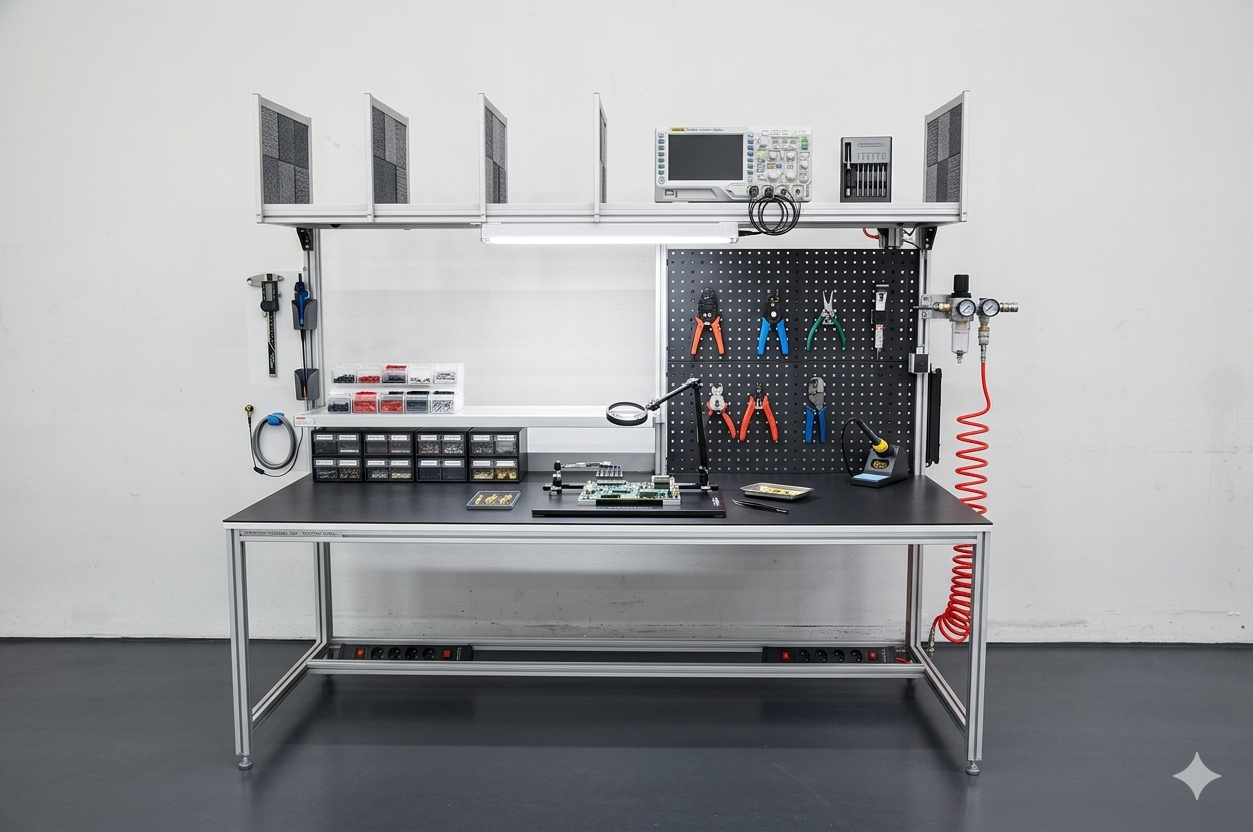
Why Choose Modular Solutions for Pneumatic Assembly Benches?
Engineered around your air tool types, torque requirements, and production cycle — not a standard bench with hose hooks added.
Modular aluminum T-slot workstations bolt together without welding and reconfigure without tools — giving you a purpose-engineered station today that adapts through every process change, product launch, and kaizen event without capital reinvestment in new furniture.
Integrated Air Manifold
Aluminum manifold block mounted to the upright structure distributes air to individual tool drops — each with its own shutoff valve, pressure regulator, and quick-connect outlet for independent tool control.
Self-Retracting Hose Reels
Overhead coiled hose reels keep air lines retracted when not in use, eliminating floor-level hose hazards and reducing operator reach time to retrieve the tool connection.
Torque Reaction Arms
Articulating reaction arms mount to the T-slot overhead structure directly above the fastener point — absorbing nut runner and impact wrench torque reaction to protect operator wrists and shoulders.
Spring Tool Balancers
Counterbalanced tool suspension arms hold air tools at the working point between cycles — reducing tool pickup time and eliminating tool rest hazards on the work surface.
Parts Presentation
Angled bin rails and gravity-fed component lanes present fasteners and parts at the work point for one-handed reach access during repetitive air tool fastening cycles.
Exhaust & Noise Control
Exhaust silencers on nut runners and acoustic panel provisions reduce station noise levels for compliance with OSHA 1910.95 hearing conservation program thresholds.
Pneumatic Assembly Bench Applications
Configured for the specific demands of air tool assembly across manufacturing environments.
- Nut Runner Fastening Lines — High-cycle nut running stations for automotive and industrial assembly where torque confirmation and cycle time control drive the station layout and tool suspension design.
- Pneumatic Screwdriving Stations — Precision air screwdriver stations for appliance, electronics, and consumer product assembly with torque-limited air supply and tool suspension for multi-screw sequences.
- Drilling & Grinding Operations — Compound stations combining drill press access, die grinding, and deburring tool positions with separate air drops and balanced suspension for each tool type.
- Aerospace Structural Assembly — Pneumatic riveting and swaging stations with reaction arm provisions and controlled air supply for aerospace assembly process requirements.
- HVAC & Plumbing Prefab — Multi-tool bench configurations for HVAC duct and pipe sub-assembly with combination pneumatic and hand tool positions integrated into a single station layout.
- End-of-Line Torque Confirmation — Dedicated torque check stations at the end of fastening lines with controlled air supply and transducer tool integration for critical joint verification.
Specifications & Configurations
Standard configurations available — all dimensions and pneumatic layouts are custom-engineered to your requirements.
| Specification | Detail |
|---|---|
| Frame Profile | 45mm or 90mm T-slot aluminum; 90mm uprights recommended for overhead reaction arm structures |
| Air Inlet | 1/2” or 3/4” NPT supply connection; rear or floor entry; pressure regulator and filter included |
| Manifold Outlets | 2–8 individual tool drops per station; each with shutoff valve, gauge, and 1/4” NPT quick-connect |
| Hose Reels | Self-retracting overhead reels; 3/8” coiled hose; 10’–20’ extension range |
| Reaction Arm Capacity | Tool reaction arms sized to torque output: 25 Nm to 500 Nm range available |
| Work Surface | 12-gauge steel standard; laminate or aluminum available; ergonomic standing height 36” |
| Lead Time | 4–6 weeks from approved drawings |
Frequently Asked Questions
Common questions about pneumatic assembly bench design and air system integration.
How is the air supply integrated into a pneumatic assembly bench?
Air supply enters the bench through a rear drop or floor penetration and connects to an aluminum manifold block mounted to the upright structure. The manifold distributes to individual tool drops — each with its own shutoff valve, pressure gauge, and quick-connect outlet. Manifold position and outlet count are specified based on the number of simultaneous tool operations at the station.
What hose management solutions are available?
Coiled self-retracting hose reels mount on overhead crossbars or side uprights, keeping air hoses retracted and out of the work area when not in use. Static coiled hose drops with quick-connect ends are available for lower-budget configurations. For high-cycle tools, a straight hose with a spring balancer and swivel fitting at the tool connection prevents hose kinking and reduces operator fatigue.
Can torque reaction arms be integrated into the bench frame?
Yes. Torque reaction arms attach to dedicated mounting brackets on the T-slot uprights or overhead crossbars, positioning the reaction point directly above the fastener location. The arm absorbs torque reaction from nut runners and impact wrenches, eliminating wrist and shoulder strain on high-torque operations. Arm reach, rotation angle, and tool weight capacity are specified per application.
What air tool types are supported at these stations?
Pneumatic assembly benches support all common air tool types including angle nut runners, inline screwdrivers, right-angle drills, die grinders, orbital sanders, and riveting hammers. Tool balancers and suspension springs are sized per tool weight. For multi-tool stations, each tool has its own dedicated air drop and balancer position.
Are noise control provisions available for pneumatic stations?
Acoustic panels can be mounted on three sides of the bench structure using T-slot panel mount channels — reducing tool noise in adjacent areas. Exhaust silencers are specified for nut runners and impact tools. For environments with strict noise requirements, the station layout is reviewed against OSHA 1910.95 hearing conservation thresholds.
Build Your Pneumatic Assembly Bench
Share your air tool types, torque requirements, and fastener sequences — our engineers will return a quote with an integrated air system layout.