Specialty Application Workstations
Workstations engineered for process requirements that don't fit standard configurations — robotics operator interfaces, pneumatic assembly stations, torque tool rigs, cobot collaboration zones, and operator environments built around the specific tool, process, and safety requirements of each application.
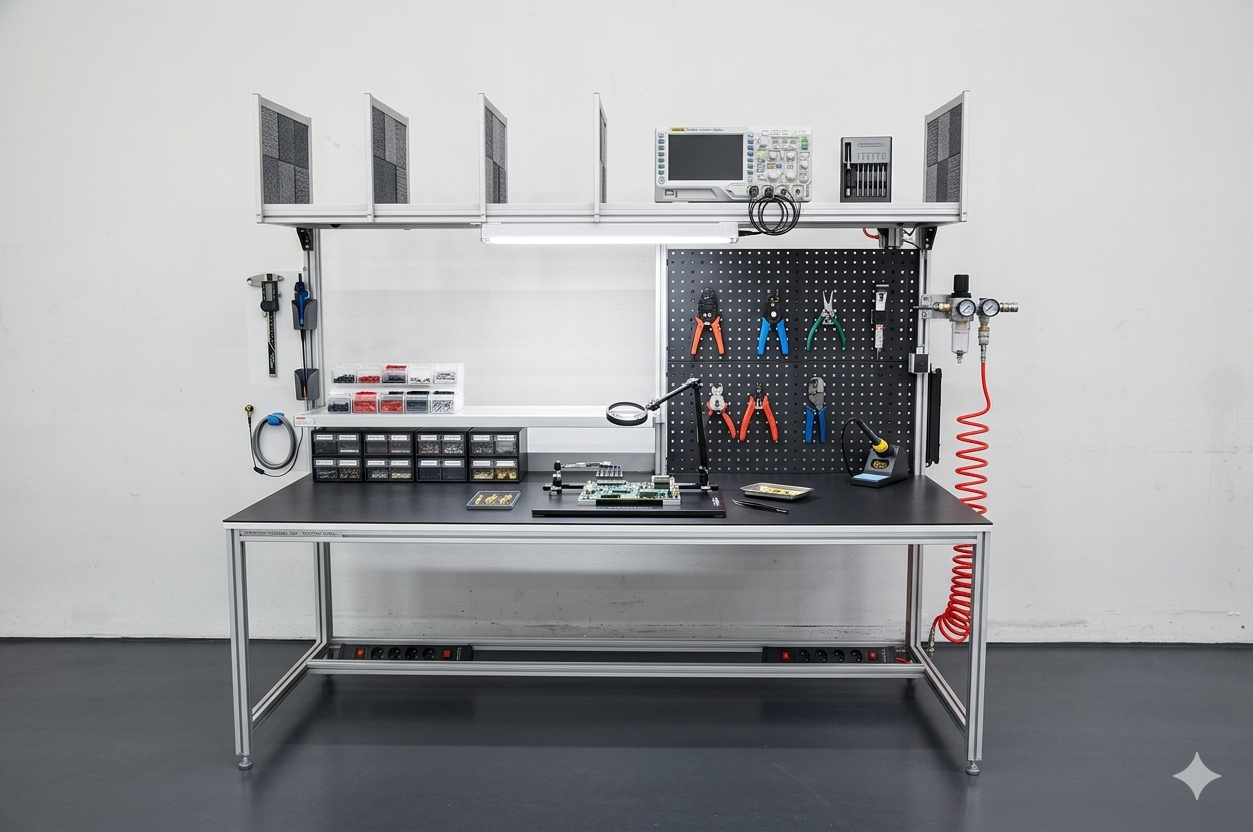
Explore by Specialty Application
Select your specific process, environment, or regulatory requirement below to see workstation designs, compliance specifications, and configurations built for that application.
Control Panel Build Benches
DIN rail work surfaces, overhead wire management, backplate staging tiers, and component bin organization for UL 508A panel shops.
Pneumatic Assembly Benches
Integrated air manifolds, self-retracting hose reels, torque reaction arms, and spring tool balancers for high-volume air tool assembly operations.
Vision Inspection Stations
Precision camera mounts, controlled lighting structures, ambient light baffles, and part fixture provisions for machine vision quality systems.
End-of-Line Packing Stations
Carton flow lanes, flush-mount scale platforms, label printer shelves, tape dispenser positions, and void fill integration for pack-out operations.
Medical Device Assembly Tables
Stainless steel surfaces, cleanroom-compatible materials, validation documentation packages, and ESD-safe options for FDA-regulated environments.
Clean Manufacturing Workstations
Non-shedding anodized frames, capped T-slot channels, wipeable surfaces, and ESD-safe options for ISO Class 5–8 controlled-environment production.
Automation Integration Work Cells
HMI & teach pendant mounts, safety light curtain provisions, E-stop positions, guarding panels, and ISO/TS 15066 collaborative zone design.
Key Features
Engineered around the specific requirements of your process, operator, and facility.
Robotics Operator Interface Stations
Control stations co-located with robotic or cobot work cells — with HMI mounts, teach pendant holders, emergency stop provisions, and guarding integration built into the aluminum frame structure.
Pneumatic Tool Assembly Rigs
Stations with integrated air manifolds, coiled hose reels, tool balancers, and torque reaction arms — designed specifically for air tool assembly processes including nut running, drilling, and grinding.
Torque Assembly Stations
Workstation structures with torque reaction provisions — articulating arms, overhead tool suspension, and counterbalanced tool positioners that keep torque tools at the work point without operator strain.
Cobot Collaboration Zones
Shared operator-cobot workstations with defined collaboration zones, force-limiting mounting provisions, and safety barrier integration — designed to meet ISO/TS 15066 collaborative robot requirements.
Multi-Process Combination Stations
Single stations housing two or more distinct process steps — such as assembly + inspection, or kitting + torque confirmation — where combining steps reduces floor space and material movement.
Custom Fixture & Tooling Integration
Workstation frames with custom fixture mounting provisions, datum locators, and clamping system integration — matching the station geometry directly to the part being assembled or inspected.
Applications
Common applications across manufacturing, laboratory, and professional environments.
- Robot Cell Operator Stations — Operator load/unload and part presentation stations integrated with robotic work cells — with guarding provisions, light curtain mounting, and HMI access built into the structure.
- Pneumatic Fastening Lines — Dedicated air tool assembly stations for high-volume fastening operations with manifolded air supply, individual tool shutoffs, and coiled hose management.
- Torque Verification Stations — Dedicated torque check stations with fixture provisions, transducer mounts, and documentation system integration for critical torque confirmation.
- Cobot-Integrated Assembly — Shared workspace stations designed for human-robot collaboration in assembly tasks — with defined reach zones, part presentation fixtures, and safety provisions for collaborative operation.
- End-of-Line Testing Rigs — Custom workstation structures for end-of-line functional testing — with fixture mounting, instrument cable management, and part flow provisions for high-throughput test operations.
- Weld Prep & Fit-Up Stations — Stations with integrated fit-up fixtures, magnetic clamp rails, and overhead fume extraction provisions for pre-weld part preparation and tack welding.
Specifications & Capabilities
Standard specifications — all dimensions and configurations are available custom.
- Frame: 45 mm or 90 mm T-slot aluminum; mixed frame sizes per process zone.
- Air Provisions: Manifolded air supply, individual shutoff valves, coiled hose reels, quick-connect fittings.
- Tool Suspension: Articulating arms, spring balancers, overhead track, and counterbalanced positioners.
- Fixture Mounting: T-slot clamping provisions, datum locator mounts, custom fixture interface plates.
- Safety Integration: Light curtain mounting provisions, E-stop mounts, HMI arms, guarding interface.
- Cobot Compliance: Designed to support ISO/TS 15066 collaborative zone requirements (customer-validated).
- Lead Time: 4–8 weeks from approved drawings; engineering review included.
Frequently Asked Questions
What types of specialty workstation requirements does Modular Solutions handle?
Specialty workstation requirements include ESD-safe electronics assembly stations, cleanroom-compatible stations with non-shedding materials and no particle traps, radiation-shielding stations for nuclear or X-ray environments, washdown-rated stations for food and pharmaceutical production, hazardous material handling stations with secondary containment and spill trays, and stations with integrated robotics or cobot safety systems. Each specialty requirement drives specific material, finish, hardware, and geometry decisions that are worked out during the design review.
How are ESD-safe workstations configured?
ESD-safe workstations use a dissipative work surface laminate or ESD mat, conductive wrist strap snap points mounted at operator height, an ESD ground point that bonds the frame to facility ground, and ESD-safe accessories such as bin rails, shelves, and storage trays. All conductive materials in the work zone are bonded to the same ground reference to prevent differential static charge buildup. Modular Solutions can supply an ESD resistance test report for the completed station confirming compliance with ANSI/ESD S20.20.
What materials are used for cleanroom-compatible workstations?
Cleanroom workstations use clear anodized or electropolished aluminum extrusion (which has no exposed raw metal to oxidize or shed particles), stainless steel fasteners, phenolic laminate or stainless steel work surfaces (both wipeable with IPA and other solvents), and no open T-slot channels in the work zone (channels are filled or covered to prevent particle accumulation). Casters, if used, are non-marking polyurethane or stainless. The station is cleaned and packaged for cleanroom delivery on request.
Can specialty workstations be certified or validated for regulatory compliance?
Modular Solutions provides material certificates, dimensional inspection reports, and assembly drawings for specialty workstations that require documentation for regulatory validation (FDA, ISO 13485, AS9100). The station BOM identifies each component with material type and finish. For pharmaceutical customers requiring IQ/OQ documentation, Modular Solutions can provide the installation and operational qualification templates based on the station drawings and specifications.
How does Modular Solutions approach a specialty workstation project that has no clear precedent?
Novel specialty requirements begin with a design workshop where Modular Solutions documents the process, environmental constraints, safety requirements, and interface dimensions. A concept sketch is produced and reviewed before detailed engineering begins. If the requirement involves untested materials or configurations, a prototype or first-article build may be recommended before committing to a full production run. Modular Solutions has experience designing for aerospace, semiconductor, medical device, and defense environments where standard workstation products cannot be used.
Start Your Workstation Project
Send us your process requirements, sketch, or CAD layout — and we'll return a quote with layout options.
Email Us for a Quote Contact FormModular Solutions — 4280 Giddings Rd, Auburn Hills, MI 48326 | 248-625-1864