AGC-Compatible Cart Frames
T-slot aluminum cart frames engineered to the interface specification of automated guided cart (AGC) platforms — including tow pin coupling provisions, battery deck mounts, brake interface routing, and floor guide clearance zones. Designed to AGC manufacturer standards for reliable production fleet deployment with full documentation for system commissioning.
Why Choose Modular Solutions for AGC-Compatible Cart Frames?
AGC cart frames must meet the AGC manufacturer's interface specification exactly — dimensional variation in the coupling geometry or drive module provisions creates system errors that are difficult to correct after the fleet is deployed.
Designed to AGC Platform Specification
We design AGC-compatible cart frames directly from the AGC manufacturer's published cart integration specification. Every coupling dimension, battery bay geometry, and brake routing provision is taken from the specification document — not estimated from a physical sample. Precision against the specification eliminates fit problems during AGC commissioning.
Tow Pin, Battery Bay, and Brake Interface
Tow pin hitch receivers, battery deck mounting provisions, and brake cable routing geometry are integrated into the T-slot cart frame structure. Steel coupling inserts provide the required interface load capacity while the T-slot aluminum frame provides the structural base, payload deck, and accessory mounting system.
Cart-to-Cart Coupling for AGC Trains
For AGC systems that pull multiple carts in a train, T-slot cart frames include front hitch receivers and rear draw bar provisions with the coupling geometry required for safe train articulation through the turns and grades in your facility route.
Floor Guide Rail Clearance
AGC systems using magnetic tape, optical guide strips, or physical guide rails require clear sensor windows and guide clearance zones on the cart base. These clearance zones are designed into the T-slot frame geometry — no profile or cross-member intrudes into the AGC navigation clearance envelope.
Dual Manual and AGC Operation
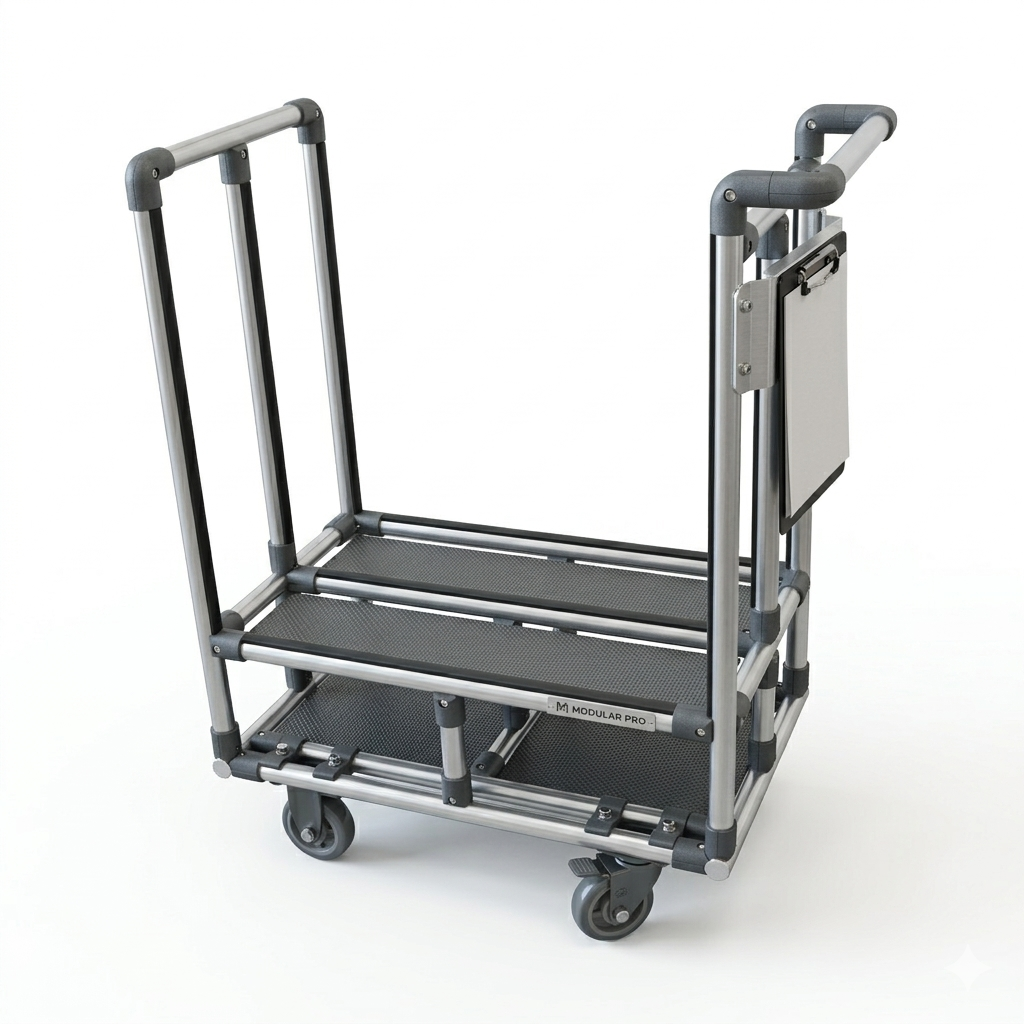
Cart frames include push handles for manual operation alongside the AGC interface provisions. Casters are selected for comfortable manual push at the loaded weight, and AGC interface hardware does not obstruct manual push access — allowing the cart to function as a conventional push cart during AGC maintenance or route changeovers.
Commissioning Documentation Package
Full dimensional drawings, loaded and unloaded weight, coupling geometry coordinates, and caster specification are provided with every AGC cart frame order in the format required for AGC manufacturer fleet commissioning review. Documentation is included with cart delivery at no additional charge.
Key Features & Benefits
Structural and integration details that make T-slot aluminum AGC cart frames reliable in daily automated production service.
Steel-Insert Coupling Hardware
Tow pin receivers, hitch brackets, and coupling plates are fabricated from structural steel and integrated into the T-slot aluminum frame at the correct height and geometry. Steel coupling components are replaceable independently of the aluminum frame structure — impact damage to the coupling hardware does not require full cart replacement.
Internal T-Slot Cable Routing
For carts with integrated sensors or electronics, cable routing channels within the T-slot aluminum profiles run cables from sensor positions to the junction box without exposed cable on the outside of the cart frame — preventing snag on AGC route features and simplifying cable management in automated service.
Load Retention for AGC Dynamics
AGC platform acceleration, deceleration, and turning forces are calculated for the specified route profile and applied to the cart payload in the structural design. Deck lips, load bars, strap anchor points, and foam inserts are incorporated as required to prevent load shift during automated transit.
ESD Provisions for Electronics Assembly
For AGC carts deployed in static-sensitive manufacturing environments, ESD deck surfaces, conductive casters, and grounding straps are integrated into the cart design as a complete ESD protection system. ESD resistance values are documented for acceptance testing.
Reflective Safety Marking
Retroreflective tape strips and edge bumpers at leading and trailing cart ends provide pedestrian visibility in shared-use AGC zones. Marking meets ANSI/ITSDF B56.5 visibility requirements and can be color-coded to match plant zone identification standards.
Field-Repairable Construction
All T-slot profiles, brackets, deck panels, and coupling hardware are individually replaceable components. Modular Solutions stocks replacement parts for quick-ship reorder. Fleet carts are repaired to original specification using replacement parts rather than full cart replacement whenever possible.
Common Applications
AGC-compatible T-slot cart frames are used in facilities deploying self-propelled cart platforms for automated material delivery in assembly, kitting, and parts distribution operations.
- Assembly Station Parts Delivery - AGC cart trains delivering Kanban replenishment parts to line-side assembly stations on scheduled routes, replacing manual tugger deliveries with automated round-the-clock material flow.
- Kitting Area Delivery Loops - AGC carts running closed-loop delivery routes between the kitting area and assembly stations, returning empty kitted containers to the kitting area automatically for refill without operator intervention.
- Supermarket Lane Replenishment - AGC-compatible T-slot carts delivering full bins from central storage to line-side supermarket lanes and returning empty bins to the storage area on the same route cycle.
- EV Battery Cell and Module Handling - Lightweight ESD-equipped AGC carts transporting battery cells and modules between process steps in EV assembly facilities where static sensitivity, cleanliness, and cart weight are design constraints.
- Medical Device Assembly Material Flow - AGC-compatible carts in medical device manufacturing environments where contamination control, documentation traceability, and cleanroom material compatibility are required.
- Multi-Shift Lights-Out Delivery Operations - AGC cart systems running scheduled delivery routes during off-shift and lights-out production periods, ensuring that line-side inventory is replenished for the following shift without manual material handler involvement overnight.
Specifications & Configurations
Standard design parameters for AGC-compatible T-slot aluminum cart frames. All AGC interface dimensions are application- and platform-specific.
| Specification | Detail |
|---|---|
| Frame Profile | 45 or 90 Series T-slot aluminum; steel-insert coupling hardware |
| AGC Platforms | iGo Neo, iGo Easy (Toyota), Creform, Toyota WMS AGC, and other OEM platforms |
| Interface Types | Tow pin receiver, battery deck mount, brake cable routing, cart-to-cart draw bar |
| Payload Capacity | 100 lb to 1,500 lb; matched to AGC platform rated payload |
| Caster Configuration | All-swivel for AGC train; rigid and swivel combinations; total-lock available |
| ESD Options | Conductive deck surface, grounding strap, ESD casters; tested to ANSI/ESD S20.20 |
| Documentation | Full dimensional drawing, coupling geometry, CoG, weight data for commissioning |
| Lead Time | 4 to 7 weeks standard; fleet orders 6 to 10 weeks with phased delivery |
Frequently Asked Questions
Common questions about AGC-compatible cart frames from Modular Solutions.
What is the difference between an AGV and an AGC?
An AGV (automated guided vehicle) typically refers to a larger, purpose-built vehicle that tows or carries carts through the facility using a dedicated vehicle body with its own drive, navigation, and safety systems. An AGC (automated guided cart) is a smaller, self-propelled cart platform where the drive and navigation components are integrated directly into the cart base — eliminating the separate tow vehicle. AGC platforms like iGo, Creform, and Toyota's automated cart systems are designed for lighter loads and smaller footprints than traditional AGV systems, making them popular in assembly, kitting, and parts delivery applications.
What AGC interface provisions are built into the T-slot cart frame?
AGC-compatible T-slot cart frames include tow pin or coupling provisions matched to the AGC platform specification, battery bay provisions for AGC drive modules that mount under or inside the cart frame, brake release cable routing for AGC platforms that use a cable-actuated brake, and floor guide rail clearance zones for magnetic or physical guide rail systems. All interface dimensions are taken from the AGC manufacturer's cart integration specification.
Which AGC platforms is the T-slot cart frame compatible with?
Modular Solutions designs AGC-compatible cart frames to the interface specification of the AGC platform selected by the customer. Common platforms include iGo Neo and iGo Easy (Toyota Material Handling), Creform pipe-and-joint AGC systems, Toyota WMS automated guided carts, and other OEM-specific platforms. The cart design is based on the manufacturer's published cart specification — if the AGC platform publishes a specification, we can design to it.
Can a cart frame be designed to work with both manual operation and AGC propulsion?
Yes. Most AGC platforms are designed for both manual and automated operation — the AGC drive unit can be removed and the cart pushed manually when the AGC is not in use or during maintenance. T-slot cart frames designed for AGC use include push handles for manual operation in addition to the AGC mounting provisions, so the cart functions as a conventional manual cart when needed and as an AGC cart when the drive module is installed.
How is the cart-to-cart coupling handled in AGC train configurations?
For AGC systems that operate cart trains (multiple carts linked behind a single AGC drive unit), T-slot cart frames include tow pin hitch receivers at the front of each cart and draw bar coupling points at the rear. The coupling geometry — tow pin height, draw bar height, and horizontal play — is designed to the AGC manufacturer's specification for the cart train configuration and the floor conditions at the deployment facility. Coupling components are fabricated from structural steel and integrated into the T-slot frame.
Ready to Engineer Your AGC Cart System?
Share your AGC platform specification, payload description, and route requirements. We will design a cart that meets the vehicle interface and delivers reliably in your automated production environment.
Modular Solutions — 4280 Giddings Rd, Auburn Hills, MI 48326