Custom Engineered Carts & Dollies
When off-the-shelf and configurable cart systems cannot meet the requirement, Modular Solutions engineers fully custom T-slot aluminum cart frames from the ground up. From AGV-interface frames and conveyor-integrated transfer carts to sensor-equipped smart carts and automation-cell-integrated systems, every custom cart is engineered to your exact specification.
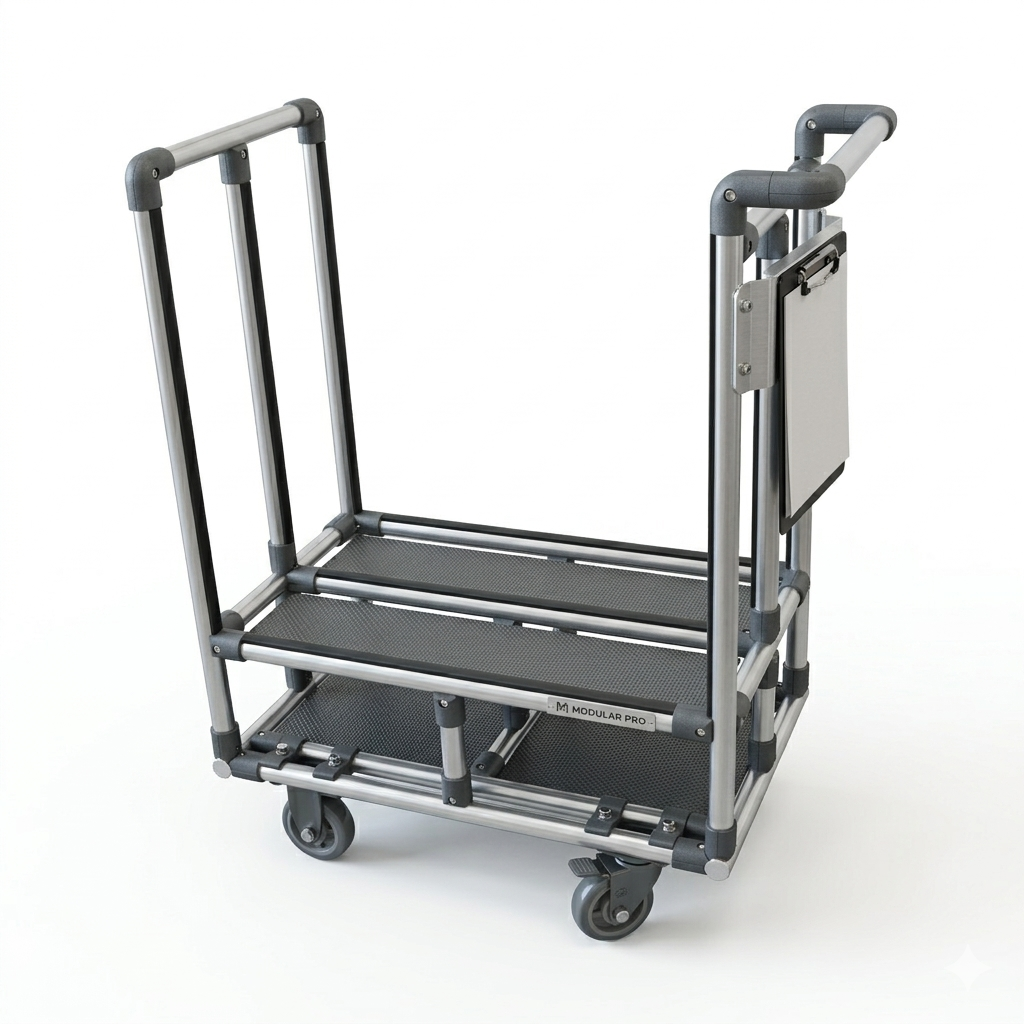
Explore by Cart System Type
Select a custom cart system type below to see engineering capabilities, design details, and application examples.
Integrated Conveyor Carts
T-slot cart frames with built-in conveyor surfaces for automated part transfer at load and unload stations.
Sensor-Integrated Smart Carts
Cart frames with integrated proximity sensors, RFID, barcode readers, and IoT modules for production tracking.
AGV-Compatible Cart Frames
Precisely engineered cart frames designed to interface with AGV coupling, hitch, and alignment systems.
AGC-Compatible Cart Frames
Cart frames sized and configured for automated guided cart tow pin, platform, and battery interface standards.
Fully Custom Engineered Carts
Ground-up cart engineering for applications requiring non-standard geometry, load paths, or interface requirements.
Automation-Integrated Cart Systems
Cart systems engineered as components of automated production cells alongside robots, conveyors, and fixtures.
Why Choose Modular Solutions for Custom Engineered Carts?
Engineered systems that work as specified — not adapted catalog products with workarounds bolted on.
Full Engineering from Concept to Drawing
Custom cart projects begin with an engineering consultation to define the load path, interface geometry, caster requirements, and integration constraints. We produce dimensioned drawings and load calculations before fabrication begins.
AGV and AGC Interface Expertise
AGV and AGC interface design requires precise control of cart geometry, tow hook position, alignment tolerance, and payload center of gravity. We have designed production-deployed cart fleets for multiple AGV and AGC manufacturers.
Conveyor and Transfer Integration
Carts that interface with conveyor lines or automated transfer stations are designed to conveyor height tolerances, indexing accuracy requirements, and the load transfer forces generated by automated pushers and lifters.
Sensor and Electronics Mounting
T-slot aluminum structure provides natural integration points for sensor brackets, cable management channels, and electronics enclosures. Custom sensor-integrated carts are designed with cable routing and service access built into the frame.
Prototype-to-Production Capability
Custom cart projects often begin with a single prototype for process validation, then scale to production quantities. T-slot construction makes prototype-to-production scaling straightforward — the prototype validates the design, production builds replicate it without retooling.
Documentation and Revision Control
Every custom cart ships with a dimensioned drawing, bill of materials, and assembly procedure. When process changes require cart modifications, we update the drawing and revise the BOM — maintaining an accurate record of the cart at every point in its service life.
Our Custom Engineering Process
From initial requirement to delivered cart system in a structured, documented process.
1. Requirements Definition
We work with your engineering and operations teams to define load, interface, motion, and integration requirements. This step produces a written specification that becomes the basis for the design.
2. Concept Design
Concept layouts showing cart frame geometry, shelf or fixture positions, caster configuration, and integration interface points. Reviewed with your team before detailed design begins.
3. Detailed Engineering
Full dimensioned drawings with tolerances, load calculations for frame and casters, BOM with all hardware and components, and interface verification against AGV, conveyor, or automation system drawings.
4. Prototype Fabrication
Prototype built to released drawings. Delivered for fit-check and process validation at your facility. Drawing revisions incorporated based on prototype feedback before production release.
5. Production Fabrication
Production quantity built to released drawings with full quality inspection against drawing dimensions. Shipping and packaging designed to protect critical interface surfaces during transit.
6. Ongoing Support
Drawing revision, spare parts, and replacement components available throughout the cart's service life. Modification assessments available when process changes require cart design updates.
Custom Engineering Capabilities
Design and fabrication parameters for custom cart engineering at Modular Solutions.
| Capability | Detail |
|---|---|
| Frame Materials | T-slot aluminum (45, 90, 135 Series), hybrid aluminum/steel, stainless steel available |
| Load Range | 50 lb to 10,000 lb per cart; higher with structural review |
| AGV Interfaces | Tow pin, push coupler, platform lift, magnetic alignment, vision target integration |
| AGC Interfaces | Tow pin standards for major AGC manufacturers; battery deck integration; brake interface |
| Conveyor Integration | Roller, belt, and chain conveyor decks; indexing surfaces; transfer lift provisions |
| Sensor Integration | RFID, barcode, proximity, vision, weight, and tilt sensor mounting and cable routing |
| Documentation | Dimensioned drawings, BOM, assembly procedures, load calculations |
| Lead Time | 4 to 8 weeks prototype; production quantities per schedule after prototype release |
Frequently Asked Questions
Common questions about custom engineered cart systems from Modular Solutions.
What information do you need to start a custom cart project?
The most useful starting information is: the load weight and dimensions, the interface system the cart must work with (AGV model, conveyor system, automation cell drawing), the floor path environment, and the operating cycle. Even partial information is enough to begin a requirements conversation — we routinely work with customers who are still developing their process when they first contact us.
Can you design a cart to work with our existing AGV or AGC system?
Yes. We work from the vehicle manufacturer's cart interface specification, or we reverse-engineer the interface geometry from an existing production cart if the specification is unavailable. The critical parameters — tow hook position, alignment feature geometry, payload platform height, and brake interface — are designed to the exact tolerances required by the vehicle system.
Do you fabricate one-off prototype carts or only production quantities?
Both. Single-unit prototype carts are a common project type for us. T-slot aluminum construction makes single-unit builds cost-effective because no tooling or fixturing is required for the frame. Prototype carts are built to the same drawing standard as production carts, so the prototype can be approved and production units ordered without design rework.
Can sensor-integrated carts interface with our plant's MES or SCADA system?
The cart hardware — sensor mounts, cable routing, enclosure positions, and connector access points — is designed as part of the cart structure. The sensor selection, communication protocol, and integration logic are coordinated with your controls engineering team or automation integrator. We design the physical cart structure to support the electronics system and work closely with your controls team throughout the design process.
What is the typical timeline from first contact to first cart delivery?
For a custom cart with a defined interface requirement and clear load specification, the typical timeline is 2 weeks for concept review and requirements sign-off, 2 weeks for detailed drawing and BOM, and 3 to 4 weeks for prototype fabrication — 7 to 8 weeks total from kickoff to prototype delivery. Production quantities following prototype approval typically run 4 to 6 weeks depending on quantity and complexity.
Ready to Start Your Custom Cart Project?
Tell us what you need to move, the system it needs to interface with, and your timeline. We will define the engineering requirements and get a concept in front of you.
Modular Solutions — 4280 Giddings Rd, Auburn Hills, MI 48326