Sensor-Integrated Smart Carts
T-slot aluminum cart frames engineered with built-in proximity sensors, RFID readers, barcode scanners, load cells, and IoT communication modules for automated production tracking, part verification, and real-time data capture. Electronics enclosures, cable routing channels, and power systems are designed into the cart frame — not retrofitted after delivery.
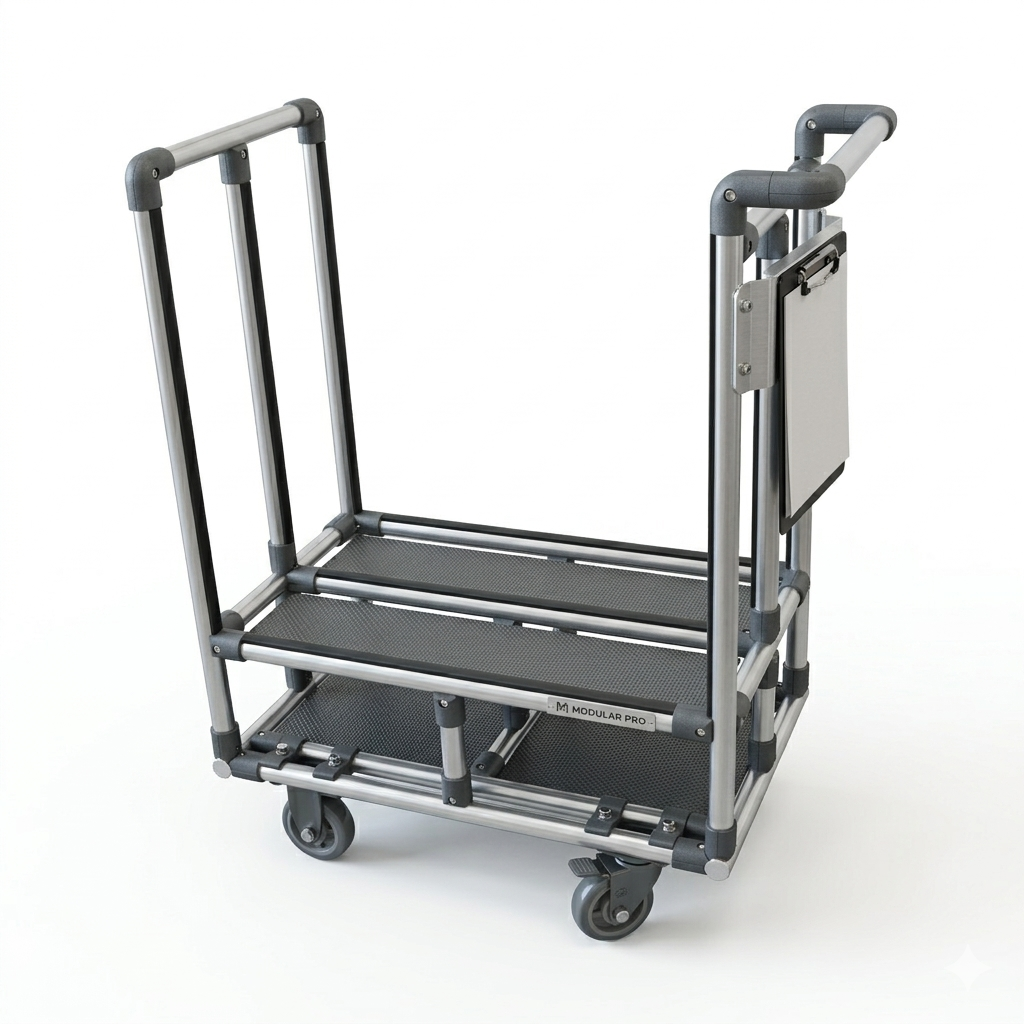
Why Choose Modular Solutions for Sensor-Integrated Smart Carts?
Sensors bolted onto a standard cart after delivery are a maintenance problem. Smart cart hardware needs to be designed into the structure from the start.
Sensors Designed Into the Frame
Sensor mounting positions, cable routing channels, and enclosure locations are part of the cart design — not add-on brackets fastened to the outside of a finished cart. Integrated design means sensors are protected, cables are managed, and the cart looks and functions like a finished industrial product.
RFID for Automatic Part Identification
RFID reader antennas mounted in the cart frame read part or container tags as materials are loaded, staged, or transported — without requiring any operator scan action. Read zone geometry and antenna position are designed for reliable tag detection with the specific parts and containers being tracked.
Barcode and QR Code Scanning
Fixed-mount barcode and QR code readers at defined scan positions enable WIP tracking without handheld scan steps. Reader position is designed for the specific label location on the part or container, ensuring reliable read at every cart load cycle.
Load Cell Weight Measurement
Integrated load cells in the cart base measure the total cart weight or individual shelf weight in real time. Weight data enables part count verification, overload detection, and inventory level monitoring without manual counting or physical checks.
Wireless Communication
Wi-Fi, Bluetooth, and LPWAN IoT modules transmit sensor data to MES, WMS, or tracking systems in real time. Wireless module selection is based on your plant network, data rate requirements, and battery or wired power availability on the moving cart.
Industrial Environment Protection
Electronics enclosures are rated IP54 to IP67 depending on the deployment environment. Vibration isolation, EMI shielding, and temperature management are designed for the specific production floor conditions at the cart's operating locations.
Key Features & Benefits
Hardware and integration details for reliable sensor-integrated cart operation in production environments.
T-Slot Internal Cable Channels
T-slot aluminum profiles include internal cable routing channels that run sensor and power cables from each sensor position to the central junction box without any exposed cable on the outside of the cart frame. Protected cable routing prevents snag, damage, and cord management problems in production environments.
Centralized Junction Box
A single junction box on the cart frame aggregates all sensor connections, provides terminal blocks for power and signal, and presents a single multi-pin connector for hardwired station connection or a single wireless module for mobile operation.
Battery or Wired Power Options
Mobile carts use onboard rechargeable battery packs with automatic charging provisions at designated dock positions. Carts used at fixed or semi-fixed stations use hardwired power connections through a quick-connect plug at the station position. Battery state-of-charge monitoring is integrated into the cart electronics for predictive charging management.
Proximity Sensor Array
Inductive, capacitive, or photoelectric proximity sensors confirm part presence, detect loading errors, and verify correct part orientation on the cart surface. Sensor outputs drive visual or audible indicators on the cart or transmit directly to the line PLC for interlock control.
Visual Status Indicators
Stack lights, LED strip lighting, or display panels mounted on the cart frame provide operator-visible status indicators for cart ID, load status, error conditions, and communication state — without requiring the operator to check a separate terminal or scan a code.
Modular Electronics Architecture
The electronics architecture uses modular components that can be upgraded or replaced independently — the RFID reader module, communication module, and sensor I/O module are separate units mounted in the same enclosure. Module replacement does not require full cart electronics replacement when a single component requires upgrade.
Common Applications
Used wherever mobile material handling needs to generate production data without adding manual scan or count steps.
- WIP Tracking at Assembly Stations - Smart carts with RFID readers tracking work-in-process part numbers and build sequence as parts are delivered to and consumed at assembly stations, feeding real-time WIP data to the MES without operator scan actions.
- Sequenced Parts Delivery Verification - Barcode-scanning carts confirming that the correct parts for the scheduled build sequence are loaded before the cart departs the kitting area, preventing wrong-part delivery errors at the assembly line.
- Inventory Count Automation - Load cell carts in supermarket lanes measuring real-time part weight to calculate remaining quantity, triggering automatic Kanban replenishment signals when the measured weight falls below the reorder threshold.
- Cold Chain and Temperature Monitoring - Smart carts with integrated temperature and humidity sensors tracking environmental conditions during transport of temperature-sensitive materials, recording condition data for quality record compliance.
- Tool Crib Accountability - RFID-equipped carts reading tool tags as tools are loaded for delivery to production areas and again when returned to the crib — providing automatic tool accountability without manual sign-out and sign-in procedures.
- Finished Goods Final Inspection Staging - Smart carts at final inspection stations reading part serial numbers and recording test result data as each unit is staged for shipment, linking physical cart position to the production quality record automatically.
Specifications & Configurations
Standard sensor and communication options for smart cart integration projects at Modular Solutions.
| Specification | Detail |
|---|---|
| Frame Profile | 45 or 90 Series T-slot aluminum with internal cable routing channels |
| RFID Options | HF (13.56 MHz), UHF (860–960 MHz); fixed-mount reader with custom antenna |
| Barcode/QR | Fixed-mount industrial readers; 1D and 2D code support; IP65 rated |
| Sensors | Inductive proximity, photoelectric, load cell, tilt, temperature/humidity |
| Communication | Wi-Fi 802.11 b/g/n/ac, Bluetooth 5.0, Ethernet (wired dock), LPWAN (LoRa) |
| Power | 24V DC battery pack (8–24 hr runtime); wired quick-connect dock charging |
| Enclosure Rating | IP54 standard; IP65 / IP67 available for washdown environments |
| Lead Time | 6 to 10 weeks from approved design including electronics integration |
Frequently Asked Questions
Common questions about sensor-integrated smart carts from Modular Solutions.
What sensors can be integrated into a T-slot cart frame?
T-slot cart frames can integrate proximity sensors for presence detection, RFID readers for part or cart identification, barcode and QR code scanners for WIP tracking, photoelectric sensors for part position confirmation, load cells for weight measurement, tilt sensors for load stability monitoring, and vision cameras for part identification or inspection at point of delivery. Sensor selection is driven by the specific data capture requirement at each station in the production flow.
How are sensor cables and power routed on a cart that moves through the facility?
Sensor-integrated carts that move through the facility use one of two power strategies: battery-powered onboard electronics with wireless data transmission, or a hardwired connection that plugs in at designated stationary charging and data exchange points. T-slot aluminum profiles include internal cable routing channels that run cables from sensors to a central junction box without exposed cable runs on the outside of the cart frame. The junction box provides a single connection point for power and data at stationary positions.
Can smart carts communicate wirelessly with our plant MES or WMS?
Yes. Wireless communication options include Wi-Fi (802.11) for high-data-rate applications, Bluetooth for short-range station-to-cart communication, and LPWAN protocols for low-power tracking applications. The wireless module selection depends on your existing plant network infrastructure, the data rate required, and the update frequency needed for your MES or WMS integration. We design the cart hardware to support the communication protocol selected by your IT and controls teams.
Can RFID readers on the cart identify parts without operator action?
Yes. Passive RFID readers mounted on the cart frame can read RFID tags on parts, containers, or bins as they are loaded onto the cart — without requiring any operator scan action. The read event, tag ID, and timestamp are recorded and transmitted to the MES or tracking system. Reader antenna position and orientation are designed to ensure reliable read of the RFID tag on the specific part or container being tracked, accounting for metal content, read range, and tag orientation.
How is the onboard electronics protected from industrial environment conditions?
Electronics enclosures on sensor-integrated carts are rated for the specific environmental conditions at the deployment location. IP54 enclosures are standard for general production floor environments with splash and dust exposure. IP65 or IP67 enclosures are used for washdown environments. Vibration isolation between the electronics enclosure and the cart frame is specified for carts that operate on rough floors or are subject to impact loading during use. Enclosure material — steel, stainless steel, or aluminum — is selected based on the chemical exposure at the deployment location.
Ready to Build Your Smart Cart System?
Tell us what data you need to capture, the sensors required, your communication infrastructure, and the production environment. We will design a smart cart that integrates with your operation.
Modular Solutions — 4280 Giddings Rd, Auburn Hills, MI 48326