Integrated Conveyor Carts
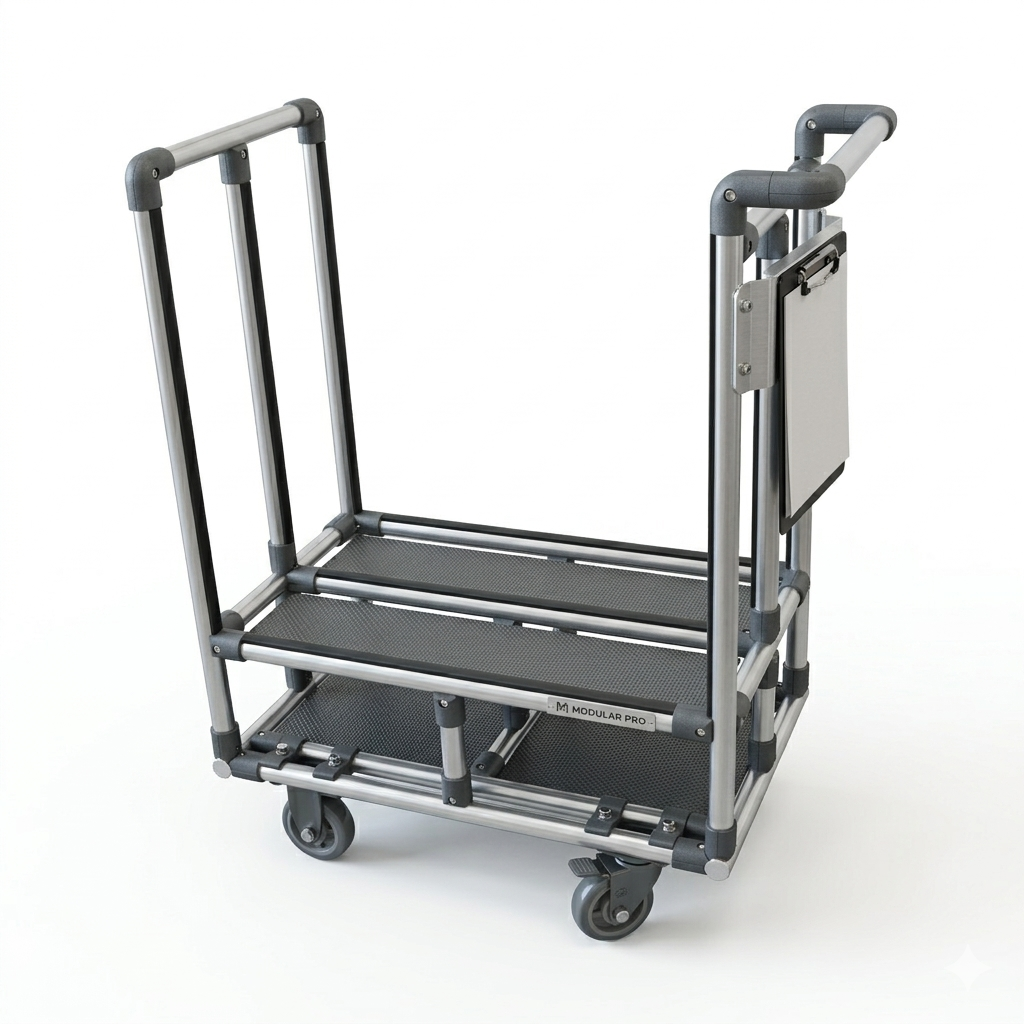
T-slot aluminum cart frames with built-in roller, belt, or chain conveyor decks engineered to interface with production line conveyors at load and unload stations. Cart deck height, drive type, and positioning features are designed to the conveyor system specification — enabling automated part transfer without manual lifting or repositioning at the cart interface.
Why Choose Modular Solutions for Integrated Conveyor Carts?
A cart that interfaces with a conveyor system is not a standard cart — it's a mechanical component of the conveyor system, and it needs to be engineered as one.
Deck Height Engineered to Line Tolerance
Conveyor transfer accuracy depends on the cart deck matching the line conveyor height within the required transfer tolerance. We design the cart height to the conveyor system drawing and verify the interface before fabrication — not by trial and adjustment after delivery.
Roller, Belt, and Chain Deck Options
Roller decks for totes and boxed goods, belt decks for irregular parts, chain decks for heavy fixtures and pallets. The deck type is selected for the specific part geometry, weight, and transfer mode required at each station in the production flow.
Powered or Gravity Transfer
24V DC powered roller and belt drives allow the cart deck to actively transfer parts rather than relying on gravity. Powered decks are used where parts cannot be transferred by inclination alone, or where controlled transfer speed is required to prevent part movement on the conveyor surface.
Cart Positioning and Alignment Features
Mechanical stop features, guide channels, and alignment pins locate the cart precisely at the transfer position without requiring an operator to position the cart by eye. Consistent cart positioning is required for reliable automated transfer — especially in high-cycle operations.
Control System Integration
Powered conveyor cart decks can be integrated with the production line PLC via standard I/O or fieldbus. Transfer sequences, deck speed, direction control, and part presence detection are coordinated with the line control logic to prevent transfer errors and part loss.
Caster Specification for Height Accuracy
Caster selection for conveyor interface carts accounts for height compression under load. Fixed-height rigid casters on critical positions, adjustable leveling feet for fine height trim, and total-lock casters to prevent cart movement during transfer operations are all standard design considerations for conveyor cart projects.
Key Features & Benefits
Engineering details that make integrated conveyor carts work reliably in production environments.
Free-Wheel Roller Gravity Deck
Free-wheel roller decks with a slight inclination allow parts to transfer under gravity when the cart is positioned at the line. No drive motor required — simpler, lower maintenance, and highly reliable for tote and box transfer at low-speed loading stations.
24V DC Powered Roller Drive
Individually powered roller zones using 24V DC motorized drive rollers allow the cart deck to operate as an extension of the line conveyor. Zone control enables accumulation, separation, and indexing on the cart deck before line entry.
Belt Conveyor Deck for Irregular Parts
Continuous belt decks handle parts that do not transfer cleanly on rollers — including bags, soft goods, and irregular machined parts. Belt tension and drive speed are designed for the specific part weight and required transfer rate.
Chain Conveyor Deck for Heavy Loads
Dual-strand chain conveyor decks handle heavy fixture and pallet loads that require positive drive rather than gravity or friction transfer. Chain pitch and sprocket geometry are matched to the production line chain specification for direct deck-to-line transfer.
Adjustable Leveling Feet
Threaded leveling feet at the cart base allow deck height to be fine-adjusted at the station to compensate for floor grade, floor unevenness, and cart deflection under load. Leveling feet are locked after adjustment to prevent height drift during operation.
Part Presence and Position Sensors
Photoelectric, proximity, or vision sensors mounted on the cart frame detect part presence, part position, and transfer completion. Sensor outputs are routed to the cart junction box for connection to the line PLC or local controller without requiring exposed cable runs across the cart deck.
Common Applications
Used in automated assembly lines, parts distribution, and production logistics where carts must interface with fixed conveyor infrastructure.
- Assembly Line Buffer Carts - Conveyor carts as mobile buffer zones between production operations, accumulating parts on the cart deck before transferring to the downstream line when the next station signals ready.
- Tote and Container Delivery - Cart decks matching tote conveyor height at goods-to-person stations, allowing totes to be transferred from the cart deck to the pick station conveyor without lifting or manual placement.
- Fixture Transfer at Machine Load Stations - Heavy-duty chain deck carts delivering loaded fixtures from a staging area to the machine load station conveyor, positioning the fixture at transfer height and driving it onto the machine infeed.
- Parts Accumulation Before Automated Lines - Gravity roller carts accumulating parts from a batch process before controlled-rate transfer to an automated inspection or assembly line, providing a mobile surge buffer between batch and flow operations.
- Finished Goods Off-Load Carts - Powered belt deck carts positioned at the end of a production line, receiving finished goods from the line belt and accumulating them on the cart deck for transport to packing without manual transfer.
- AGV Cart with Conveyor Interface - Cart frames designed for AGV tow with an integrated conveyor deck that allows the AGV-delivered cart to receive or deliver parts automatically when it arrives at a powered conveyor station.
Specifications & Configurations
Design parameters for integrated conveyor carts. Deck type, height, drive, and control interface are application-specific.
| Specification | Detail |
|---|---|
| Frame Profile | 45 or 90 Series T-slot aluminum depending on load and deck span |
| Deck Types | Free-wheel roller (gravity), 24V DC powered roller, continuous belt, dual-strand chain |
| Deck Load Capacity | 50 lb to 2,000 lb per cart depending on deck type and frame configuration |
| Deck Height Accuracy | ±0.25 in. standard; ±0.050 in. with rigid casters and leveling feet |
| Drive Voltage | 24V DC standard; 120V AC available for high-speed belt and chain drives |
| Control Interface | Discrete I/O (24V DC), DeviceNet, EtherNet/IP per line control system |
| Positioning Features | Mechanical stop, guide channel, alignment pin, or powered docking options |
| Lead Time | 5 to 8 weeks from approved design |
Frequently Asked Questions
Common questions about integrated conveyor carts from Modular Solutions.
What conveyor deck types can be integrated into a cart frame?
Roller conveyor decks use gravity or powered rollers to transfer parts across the cart surface — suitable for boxed goods, totes, and pallets. Belt conveyor decks provide a continuous moving surface for irregular parts, bags, or items that don't roll cleanly on rollers. Chain conveyor decks are used for heavy or fixture-mounted loads that require positive drive rather than gravity or friction transfer. The deck type is selected based on the part geometry, weight, surface condition, and whether powered or gravity transfer is required at the interface.
How is the conveyor deck height aligned to the production line conveyor?
Cart conveyor deck height is designed to match the production line conveyor height within the positioning tolerance of the cart at the load or unload station. Cart height is set at fabrication using T-slot frame geometry and is verified against the production line drawing. Adjustable leveling feet on the cart base provide fine-height adjustment at the station to compensate for floor unevenness and cart loading deflection. For high-accuracy transfer applications, a positive stop and alignment feature engage the cart precisely at the transfer point.
Can the conveyor deck on the cart be powered or does it need to be gravity-only?
Both powered and gravity conveyor decks are available. Powered deck options include 24V DC roller drives, belt drive systems with variable speed control, and chain drive with indexing control. Gravity deck options use slight inclination for passive transfer. For carts used in automated systems, the powered deck typically interfaces with the main line conveyor control using a simple I/O handshake — the cart deck powers on when the load transfer signal is received and stops when the transfer is complete.
How are the casters specified for conveyor carts that interface with fixed conveyors?
Caster specification for conveyor interface carts focuses on loaded height accuracy and height consistency under load variation. Casters are selected for minimal height compression under the loaded cart weight so that the deck height remains within the transfer tolerance after loading. For high-accuracy applications, fixed-height non-swivel rigid casters are used on two of four positions with total-lock swivel casters on the other two to prevent cart height change at the interface position.
Can conveyor carts be designed to operate as part of an automated transfer system without an operator?
Yes. Integrated conveyor carts designed for fully automated operation include powered deck drives, cart positioning sensors, cart presence detection, and interlock provisions that prevent transfer until the cart is confirmed in position and locked. The cart electrical system is designed for integration with the main automation PLC using standard I/O or fieldbus communication. Cart positioning at the transfer station is achieved through mechanical stop features, guide rails, or AGV/AGC positioning depending on the system design.
Ready to Engineer Your Conveyor Cart Interface?
Tell us your conveyor system type, deck height, transfer load, and control interface requirements. We will design a cart that integrates cleanly into your line.
Modular Solutions — 4280 Giddings Rd, Auburn Hills, MI 48326