AGV-Compatible Cart Frames
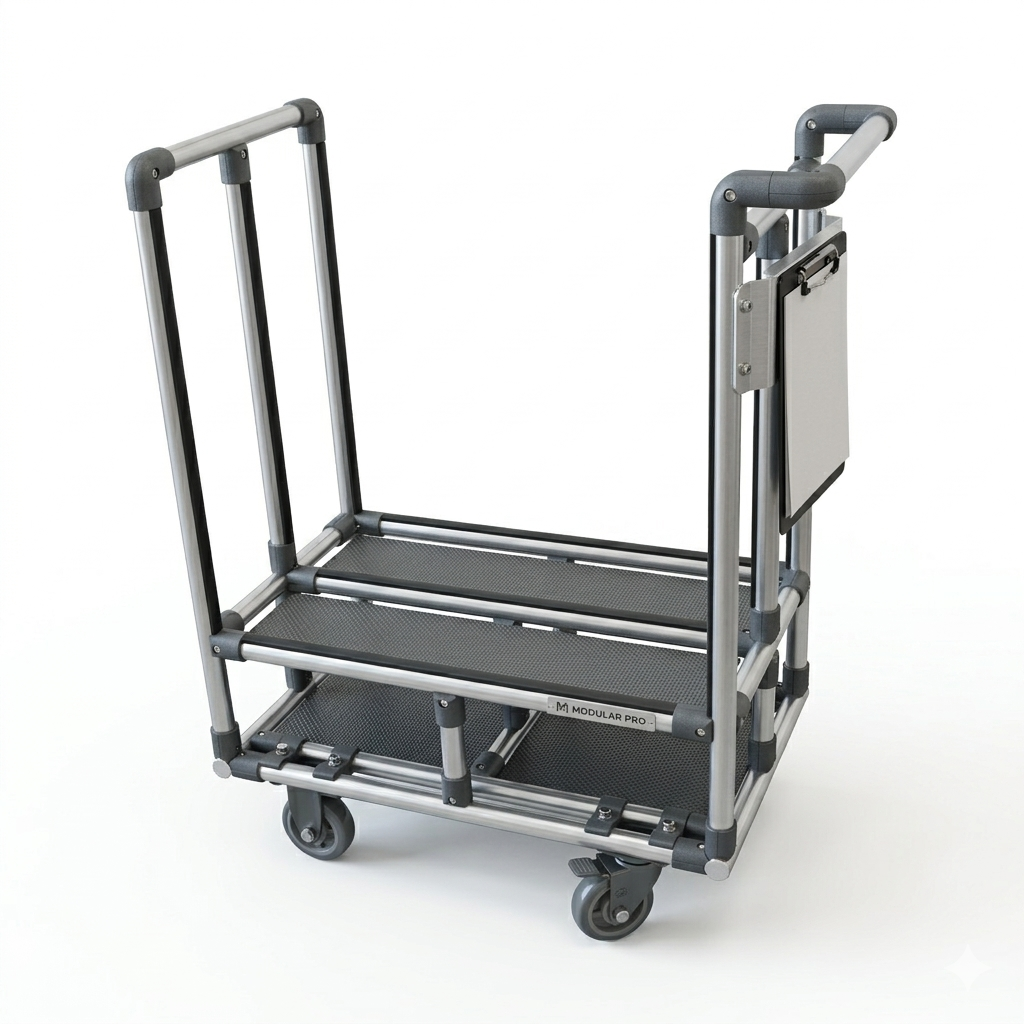
T-slot aluminum cart frames engineered to the interface specification of automated guided vehicle (AGV) systems — including tow pin receivers, push coupler plates, and platform lift decks. Designed for production fleet deployment with full dimensional documentation for AGV manufacturer review and system commissioning.
Why Choose Modular Solutions for AGV-Compatible Cart Frames?
The AGV interface on a cart is not a bolt-on addition — it must be designed into the cart structure from the beginning to meet the vehicle specification and perform reliably in fleet operation.
Designed to AGV Manufacturer Specification
We work from the AGV manufacturer's published cart interface specification — tow pin height and geometry, coupler plate dimensions, lift deck size and load capacity. Every AGV-compatible cart we build is designed against the specification document, not by trial fit. This eliminates the interface problems that arise when cart geometry is guessed rather than engineered.
Tow, Push, and Platform Lift Interfaces
Tow pin receivers for tow-type AGV trains, push coupler plates for push-type vehicles, and platform lift deck provisions for underbody lift AGVs are all available as part of the T-slot cart frame design. Interface hardware is fabricated from steel or stainless steel and integrated into the aluminum T-slot frame structure for the required coupling load capacity.
Fleet Deployment Documentation
Every AGV-compatible cart project is delivered with a full dimensional drawing package including coupling point coordinates, loaded and unloaded CoG, caster configuration, and weight data — in the format required for AGV manufacturer review and fleet commissioning documentation. Documentation is included with the cart delivery at no additional charge.
Payload CoG Optimization
Tow force and turning behavior of an AGV cart train depend directly on the loaded cart's center of gravity relative to the coupling point. We calculate the loaded CoG for the specified payload and optimize the deck layout to keep the CoG within the AGV manufacturer's recommended range for all expected load conditions.
All-Swivel Caster Configuration for Tow Trains
AGV tow train carts use all-swivel caster configurations so that trailing carts can track through curves and turns independently without fighting the vehicle's steering. Caster wheel material, bearing type, and load rating are selected for the specific AGV travel speed, floor condition, and cart weight in the deployment environment.
Manual and AGV Dual-Mode Operation
AGV-compatible cart frames include push handles for manual operation alongside the AGV interface components. Casters are specified for comfortable manual push effort at the loaded cart weight, and the AGV interface hardware is positioned to not obstruct manual push access or create trip hazards during manual operation in the same facility.
Key Features & Benefits
Engineering details that make T-slot aluminum AGV cart frames reliable in production fleet service.
Steel Insert Tow Pin Receiver
The tow pin receiver is fabricated from structural steel and fastened into the aluminum T-slot frame at the correct coupling height and geometry. Steel-to-T-slot integration provides the required coupling load capacity without welding the T-slot profiles, preserving the modular repairability of the frame structure after impact or wear.
Reflective Marking and High-Visibility Edging
AGV-compatible carts include retroreflective tape strips and high-visibility edge bumpers at the leading and trailing ends for pedestrian visibility in shared-use AGV zones. Marking meets ANSI/ITSDF B56.5 visibility provisions and can be configured to match plant-specific color coding for AGV zones.
Load Retention for AGV Dynamics
AGV acceleration, deceleration, and cornering generate lateral and longitudinal forces on cart payloads. Retaining lips, load bars, strap provision points, and foam edge inserts are designed into the deck as required for the specific parts and containers being transported — preventing load shift and damage during AGV transit.
Multi-Interface Compatibility
Carts designed for facilities running multiple AGV platforms include modular interface assemblies — tow pin receivers, coupler plates — that are field-swappable to adapt the same cart frame for different vehicle types on different route assignments. This reduces cart inventory and simplifies fleet management.
Navigation Target Provisions
Magnetic target mount pockets, retroreflective target positions, and RFID tag mounts at the defined AGV navigation target location are included in the cart design for AGV systems that use cart-side targets for precise positioning at load and unload stations.
Field-Repairable T-Slot Construction
Damaged profiles, brackets, and deck panels are replaced as individual T-slot components without welding. Spare parts are stocked and can ship next day for fast field repair. The same cart design can be re-fabricated in 2 to 4 weeks if severe damage requires full cart replacement rather than component repair.
Common Applications
AGV-compatible cart frames are used in automated material flow systems where reliable vehicle interface and fleet-level documentation are required.
- Automotive Assembly Tow Train Systems - High-volume tow train cart fleets delivering sub-assemblies, fasteners, and components to line-side stations following the AGV route schedule programmed into the plant material management system.
- EV Battery Assembly Material Flow - AGV-compatible carts delivering cell trays, module components, and battery pack hardware to assembly stations in EV battery plants where floor space is constrained and manual cart flow creates traffic conflicts.
- Underbody Lift AGV Systems - Platform lift deck carts designed for underbody lift vehicles, allowing the AGV to lift the loaded cart and deliver it to the unload station without a tow pin coupling or push interface.
- Point-of-Use Replenishment Routes - AGV tow train carts running scheduled replenishment routes from supermarket lanes to assembly stations, replacing manual tugger routes with automated delivery on the same schedule.
- Cross-Dock Sortation - Push-type AGV cart delivery in distribution and fulfillment operations, where carts receive sorted goods at the induction station and are pushed by the AGV to the correct outbound lane for loading.
- Precision Parts Delivery in Electronics Manufacturing - Lightweight AGV-compatible T-slot carts delivering precision components and assemblies in electronics manufacturing environments where floor contamination, cart weight, and corrosion are design constraints.
Specifications & Configurations
Standard design parameters for AGV-compatible T-slot aluminum cart frames. All interface dimensions are application-specific.
| Specification | Detail |
|---|---|
| Frame Profile | 45 or 90 Series T-slot aluminum; steel insert coupling components |
| Interface Types | Tow pin receiver, push coupler plate, platform lift deck, combination |
| Payload Capacity | 200 lb to 2,000 lb standard; hybrid steel-aluminum frames for higher loads |
| Caster Configuration | All-swivel for tow trains; rigid + swivel combinations available; total-lock options |
| AGV Compatibility | Designed to manufacturer spec: JBT, Dematic, Elettric80, OTTO, and others |
| Navigation Provisions | Magnetic target mounts, reflective target locations, RFID tag mounts per system spec |
| Documentation | Full dimensional drawing, CoG analysis, BOM, weight data for AGV vendor review |
| Lead Time | 4 to 8 weeks from approved design; fleet orders support phased delivery |
Frequently Asked Questions
Common questions about AGV-compatible cart frames from Modular Solutions.
What AGV interface types can be built into a T-slot cart frame?
T-slot cart frames can be built with tow pin receivers for tow-type AGVs that drag a train of carts through the facility, push coupler plates for push-type AGVs that push carts from the rear, and platform lift decks for underbody lift AGVs that raise the cart off the floor. The interface geometry, height, clearance, and load capacity are designed to the AGV manufacturer's cart specification for the specific vehicle being deployed.
Does the AGV manufacturer need to approve the cart design?
Most AGV manufacturers publish cart interface specifications that define the tow pin height, coupler geometry, platform lift dimensions, and weight limits. Modular Solutions designs the cart to meet the published specification. For fleet deployment, we recommend sharing the cart drawing with the AGV manufacturer before fabrication to confirm that the interface geometry is within the vehicle's operational parameters. We provide drawings in the format required for that review.
How is payload center of gravity managed for AGV-towed cart trains?
AGV tow force and turning dynamics are affected by the loaded cart's center of gravity relative to the cart wheelbase and coupling point. For heavy or concentrated loads, we calculate the loaded CoG position and design the cart deck layout to keep the CoG within the AGV manufacturer's recommended range. Adjustable shelf positions and deck geometry are used to optimize CoG for the heaviest and most off-center load conditions expected in the production environment.
Can AGV-compatible carts also be pushed manually in the same facility?
Yes. AGV-compatible carts are typically designed for both automated and manual push operation. The cart frame includes conventional push handles in addition to the AGV interface geometry. Casters are selected for smooth manual push effort at the loaded cart weight, and the AGV interface components are positioned so they do not obstruct manual push access or create a trip hazard during manual operation in the same facility.
What caster configuration is required for AGV-towed carts?
Tow-type AGV cart trains use all-swivel casters on the trailing carts so the train can follow the AGV through curves and turns without requiring the rear carts to track independently. The front cart in a train may use a combination of rigid and swivel casters depending on the coupling geometry and the turning radius required. Caster wheel diameter, material, and load rating are selected based on the cart weight, floor condition, and travel speed of the AGV system.
Ready to Engineer Your AGV Cart Fleet?
Share your AGV interface specification, payload list, and route requirements. We will design a cart that meets the vehicle spec and delivers reliably in your production environment.
Modular Solutions — 4280 Giddings Rd, Auburn Hills, MI 48326