Fixture Dollies
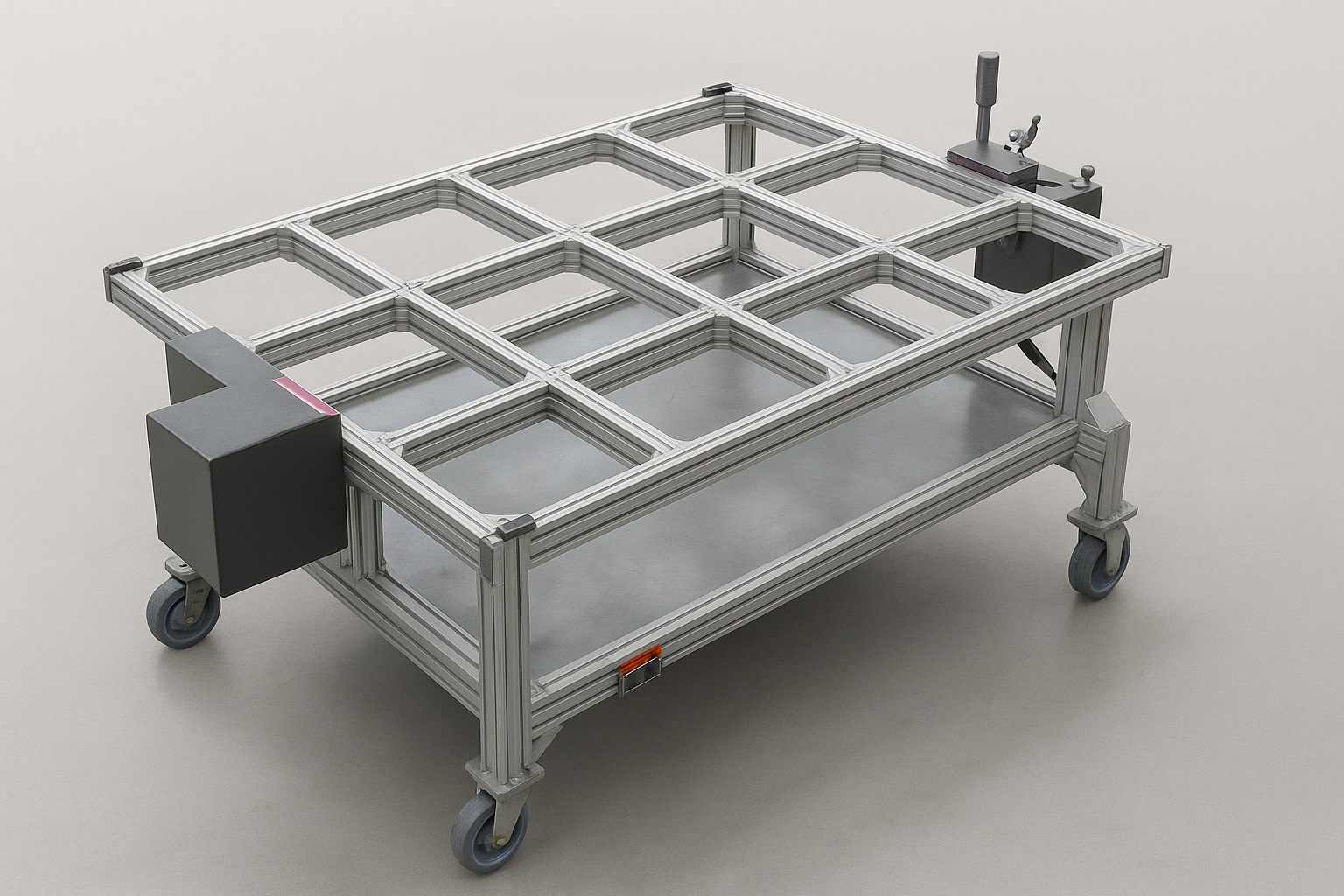
Precision fixture dollies engineered from T-slot aluminum to transport tooling, dies, gauges, and checking fixtures with datum-matched locating interfaces. Eliminates secondary blocking, reduces setup time, and protects tooling investment during floor-level transport between storage, machine load stations, and assembly cells.
Why Choose Modular Solutions for Fixture Dollies?
Engineered for your specific tooling — not a generic cart with afterthought blocking.
Datum-Matched Locating Interfaces
Locating pins, V-blocks, and nest pockets are engineered to your specific fixture datum scheme. Provide fixture drawings with locating feature dimensions and we design the dolly interface to match, eliminating manual alignment at every transfer point.
Verified Structural Load Ratings
Every fixture dolly carries a verified load rating based on the frame geometry, profile section size, and caster specification — not a catalog estimate. Load verification includes overhang loads, dynamic towing forces, and caster distribution under off-center fixtures.
Tooling Protection by Design
Fixtures loaded on properly designed dollies don't contact hard stops, shift in transit, or require hand-shimming. Locating features and soft-contact bumpers protect precision machined surfaces throughout the transport cycle.
Machine Station Docking Interface
Fixture dollies are designed to dock with your machine load stations and assembly cells. Receiver pins and height-adjustable platforms bring the fixture to the correct height and orientation for the downstream operation without manual adjustment.
T-Slot Adjustability for Multiple Fixture Families
T-slot frame construction allows locating pin positions, support rail heights, and nest pocket locations to be repositioned when fixture geometry changes. The same structural frame adapts to new tooling generations without replacement.
Built for Long Tooling Life Cycles
Fixture dollies are often in service for 10–20 years alongside the tooling they carry. T-slot aluminum resists corrosion without painting, allows field repair of individual components, and accommodates caster replacement as wheels wear.
Key Features & Benefits
Precision engineering details that separate purpose-built fixture dollies from general material handling equipment.
Precision Locating Pin Assemblies
Hardened locating pins with replaceable liners are mounted in T-slot brackets at exact positions matching the fixture datum scheme. Pin diameters, shoulder heights, and tip geometry are specified to match the fixture locating hole or slot design.
V-Block and Nest Pocket Supports
V-block supports for cylindrical components and machined nest pockets for irregular fixture geometries are fabricated from structural aluminum or steel and mounted as integral frame elements. Support positions are dimensionally verified against the fixture drawing before fabrication.
Height-Adjustable Platform Decks
Screw-adjustable platform height allows a single fixture dolly to interface with machine load stations at different floor heights. Typical adjustment range is 2–4 inches, sufficient to accommodate variation between press, CMM, and inspection station positions.
Soft-Contact Edge Protection
UHMW-PE or nylon edge rails and contact pads protect precision machined fixture surfaces during loading and transport. Edge protection contacts the fixture at non-critical surfaces only, preventing damage to datum faces, sealing surfaces, and precision bores.
Swivel and Fixed Caster Configurations
Caster configuration is designed for the specific transport path and aisle width. Four-swivel with two-brake, two-swivel-two-fixed, and rear-steer configurations are available depending on load weight and maneuverability requirements of the transport route.
Tow Bar and Hitch Provisions
Tow bar provisions allow towing by tugger or tow tractor for long-distance transport across large facilities. Tow points are positioned to prevent front caster lift and maintain steering stability. Forklift pocket provisions are available for dollies that require repositioning by forklift.
Common Applications
Proven across precision manufacturing, aerospace tooling, and automotive stamping environments.
- Press Die Transport - Fixture dollies sized to specific die families for repeatable positioning at press load stations, die storage racks, and maintenance benches without crane dependency.
- CMM and Inspection Gauge Handling - Precision dollies for coordinate measuring machine fixtures and gauge assemblies with kinematic locating features to maintain measurement datum continuity between transport and measurement.
- Welding Fixture Staging - Fixture dollies that position welding jigs and holding fixtures at correct height and orientation for loading and unloading at robotic and manual weld cells.
- Body-In-White Assembly Tooling - Automotive body panel fixture dollies with datum pins matching the assembly fixture scheme for transport between stamping, weld, and inspection stations.
- Aerospace Detail Part Tooling - AS9100-compatible fixture dollies with FOD-controlled design for transporting precision forming tools, bond fixtures, and assembly jigs.
- Injection Mold Transport - Heavy fixture dollies for injection mold transport between storage, preheat ovens, and press load positions with precision alignment features at the press station interface.
Specifications & Configurations
Standard design ranges for fixture dollies. All specifications are available custom to your exact tooling requirements.
| Specification | Detail |
|---|---|
| Frame Profile | 45 Series to 90 Series T-slot aluminum; steel-reinforced hybrid for extreme loads |
| Load Capacity | 500 lb to 8,000 lb depending on frame and caster specification |
| Platform Size | Custom to fixture envelope; typical range 18 in. x 24 in. to 48 in. x 72 in. |
| Locating Features | Precision pins, V-blocks, nest pockets, datum rails, adjustable stop blocks |
| Locating Tolerance | ±2mm positional tolerance standard; ±0.5mm available with precision machined sub-plates |
| Platform Height | Custom to machine interface height; typical range 8 in. to 18 in. at deck |
| Caster Options | 4 in. to 8 in. diameter; polyurethane, rubber, or nylon tread; brake options |
| Environment Options | Standard, anodized cleanroom, stainless washdown, ESD-dissipative |
| Lead Time | 4 to 6 weeks from approved drawings |
Frequently Asked Questions
Common questions about fixture dollies from Modular Solutions.
What locating features are available on fixture dollies?
Fixture dollies can be designed with precision locating pins, V-blocks, nest pockets, datum rail systems, or flat platform decks with adjustable stop blocks. The choice depends on your fixture datum scheme. If you supply fixture drawings with locating feature dimensions and tolerances, our engineers will design the dolly locating interface to match within a ±2mm positional tolerance.
How do fixture dollies differ from standard transport carts?
Fixture dollies are designed for a specific load geometry and include dedicated locating features that position the fixture repeatably on the dolly. Standard transport carts use shelf decks or flat platforms that require secondary blocking to stabilize fixtures during transport. For precision tooling, fixture dollies eliminate the time and variability of secondary setup while reducing damage risk.
Can fixture dollies interface with machine load stations?
Yes. Fixture dollies are frequently designed to dock with machine load stations, assembly cells, and inspection stations. Docking features such as receiver pins, kinematic couplings, and height-adjustable platforms are designed into the dolly so the fixture arrives at the correct height and orientation for the downstream operation without manual adjustment.
What is the weight range for fixture dollies?
Fixture dollies are available from approximately 500 lb to 8,000 lb total load capacity. Below 500 lb, standard caster carts are typically sufficient. Above 8,000 lb, we design heavy structural dollies using steel-reinforced aluminum or all-steel hybrid frames with high-capacity casters. The load capacity is always verified against the specific frame design, not estimated from a standard catalog.
Are fixture dollies available in stainless steel for cleanroom or washdown environments?
Yes. Fixture dollies for cleanroom, washdown, or food-grade environments are available with 316 stainless steel hardware, anodized aluminum frames, and sealed casters. For Class 6 and cleaner applications, all frame crevices are sealed and fastener types are selected to prevent particle accumulation. Cleanroom fixture dollies can be manufactured alongside cleanroom carts to maintain material consistency across the facility.
Ready to Engineer Your Fixture Dolly?
Provide your fixture weight, locating datum scheme, floor path, and machine interface dimensions. Our engineers will design a dolly that moves your tooling safely and precisely every time.
Modular Solutions — 4280 Giddings Rd, Auburn Hills, MI 48326