High-Capacity Load Dollies
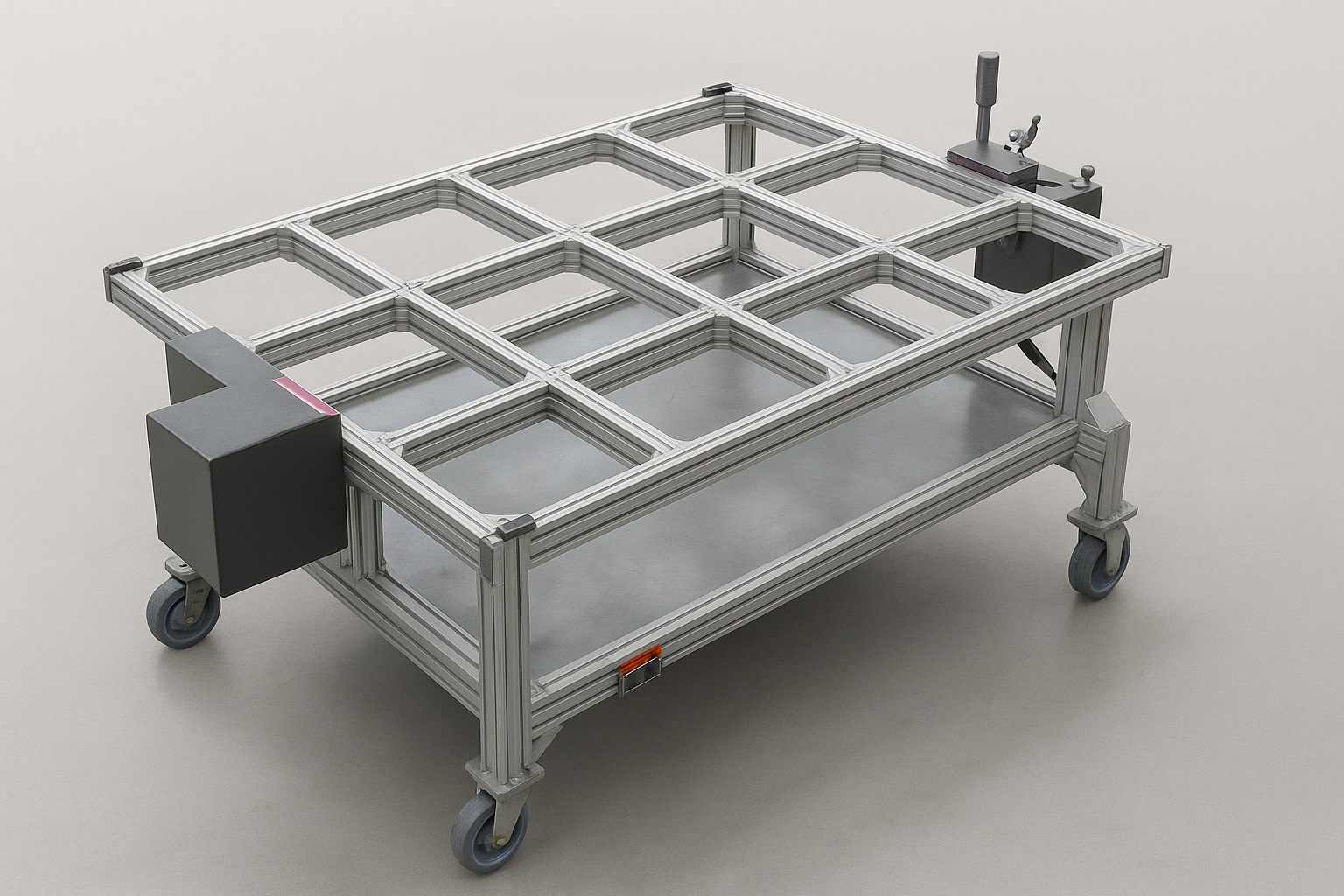
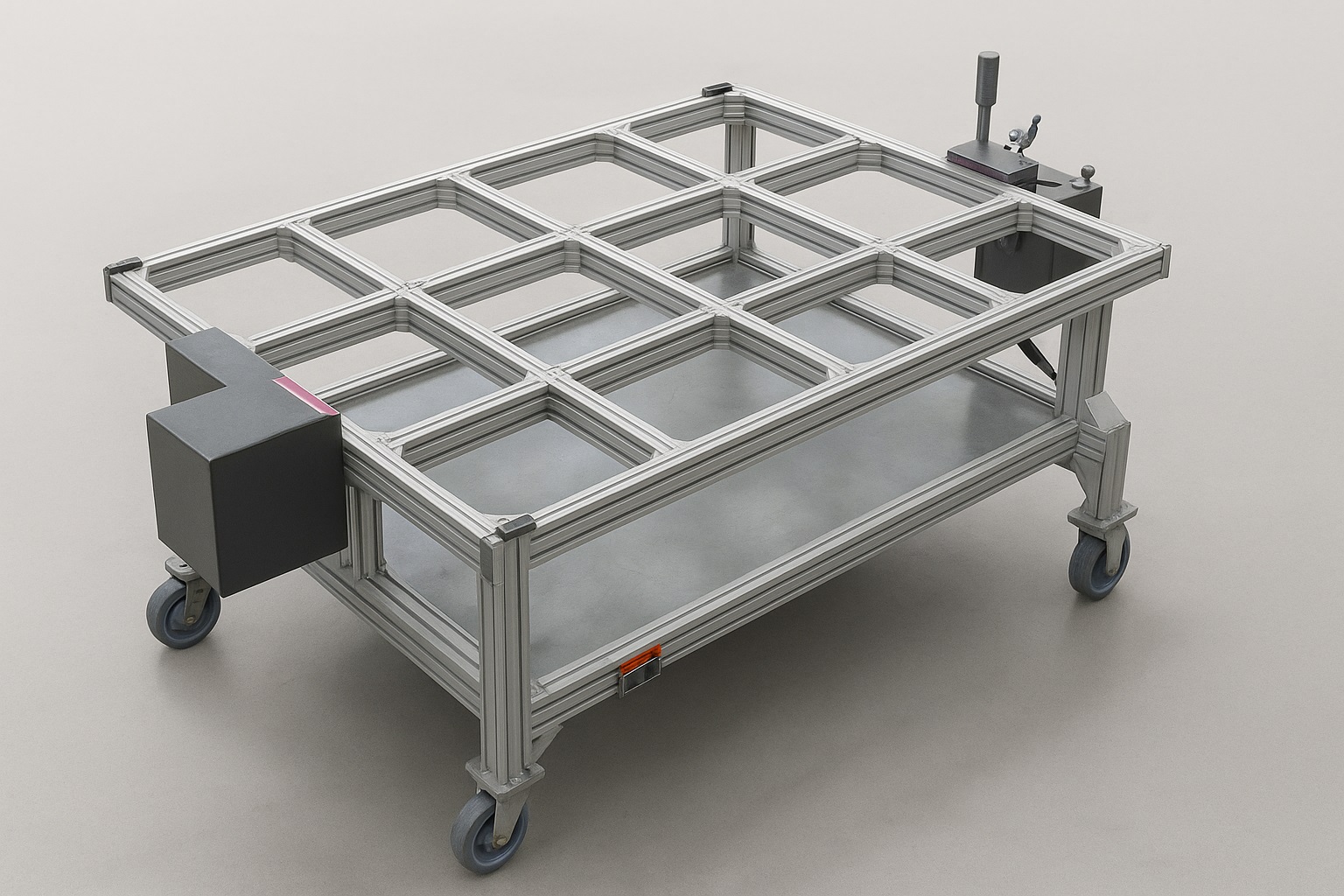
Engineered transport platforms for payloads from 5,000 lb to 20,000 lb — moving the loads that standard dollies cannot safely handle. T-slot aluminum and steel hybrid frames, six and eight caster configurations, and integrated lift provisions designed around the specific load envelope, center of gravity, and transport path.
Why Choose Modular Solutions for High-Capacity Load Dollies?
At extreme load levels, engineering is mandatory — not optional.
Full Structural Load Analysis
Frame bending capacity, torsional stiffness, caster load distribution, and dynamic towing forces are all calculated before any material is specified. For loads above 8,000 lb, this analysis determines whether aluminum, steel-reinforced hybrid, or all-steel primary frame construction is appropriate.
Steel-Reinforced Hybrid Construction
Steel primary structural members provide the bending capacity required for extreme loads while T-slot aluminum accessories allow flexible mounting of guides, stops, and support features. This hybrid approach delivers structural performance without the full weight penalty of all-steel construction.
Multi-Caster Load Distribution Arrays
Six and eight caster configurations distribute extreme loads across more contact points, reducing per-caster loading to manageable levels. Caster pattern geometry is designed to maintain maneuverability and prevent caster overload under off-center load placement.
Integrated Lift Provisions
Crane lift lugs, forklift pocket cutouts, and hydraulic jack pad positions are load-rated and integrated into the primary structural frame. Lift geometry is verified to ensure stable lift without frame deflection under the full payload at all specified lift points.
Low-Rolling-Resistance Caster Selection
At extreme loads, rolling resistance determines whether the dolly can be moved by the available motive force. Large-diameter casters with precision bearings and appropriate tread compounds minimize rolling resistance, allowing towing with appropriately sized tugger vehicles rather than requiring custom motorized platforms.
Full Engineering Documentation
Load calculations, material specifications, caster selection rationale, and lift point ratings are documented in the delivered engineering package. This documentation supports OSHA compliance, insurance requirements, and internal facility safety reviews.
Key Features & Benefits
Structural and mechanical details that enable safe, reliable transport of the heaviest industrial loads.
90 Series and Heavy Structural Profiles
90 Series T-slot aluminum profiles with multiple parallel rails and cross-bracing members are used as the primary structural elements for loads up to 10,000 lb. Above that threshold, structural steel HSS or wide-flange sections replace the primary rails while retaining T-slot aluminum for accessory integration.
12-Inch High-Capacity Casters
12-inch diameter casters rated to 3,500 lb each are available for extreme load configurations. Casters use sealed precision bearings and heavy polyurethane or rubber treads sized for the floor surface. Steel mounting plates are designed to transfer caster loads into the structural frame without stress concentration at individual fasteners.
Six and Eight Caster Configurations
Six and eight caster arrangements allow loads exceeding the four-caster maximum to be safely transported. Swivel caster arrangements in larger configurations are designed to permit steering in available aisle widths while providing sufficient braking force across multiple casters.
Forklift Pockets and Crane Lift Lugs
Forklift pockets are sized for your facility tine dimensions and positioned for stable lift geometry. Crane lift lugs are load-rated and positioned to maintain level lift attitude under the payload center of gravity. All lift provisions are documented on the engineering drawings.
Screw or Hydraulic Leveling Jacks
Leveling jack provisions allow the dolly to be raised off the casters and leveled precisely for staging, assembly, or inspection operations that require the load to be level and stationary. Jack positions are selected for stable leveling geometry under the specific load center of gravity.
Tugger Tow Hitch and Drawbar Provisions
High-capacity tow hitches and drawbar provisions rated for the towing loads of the fully loaded dolly are integrated into the structural frame ends. Hitch geometry is designed to minimize caster lift at the front of the dolly during towing with the applicable tow vehicle type and speed.
Common Applications
Deployed in heavy manufacturing, energy, aerospace, and large-equipment industries where standard platform capacities are insufficient.
- Large Press and Stamping Die Transport - High-capacity dollies for moving large stamping dies, trim dies, and progressive die sets between press lines and die storage without overhead crane dependency.
- Industrial Generator and Transformer Positioning - Load-rated dollies for moving diesel generators, dry-type transformers, and large power distribution equipment during facility construction, maintenance, and relocation.
- Large Casting and Forging Transport - High-capacity dollies for transporting large ferrous and non-ferrous castings and forgings between heat treatment, machining, and assembly operations.
- Aerospace Fuselage and Wing Structure Handling - Structural dollies for transporting large aerospace subassemblies including fuselage sections, wing spars, and engine nacelle structures between assembly stations.
- Heavy Equipment Repair and Maintenance - High-capacity dollies for moving bulldozer components, mining equipment subassemblies, and large hydraulic systems during overhaul operations.
- Marine and Defense Component Transport - Load-rated structural dollies for transporting large marine propulsion components, weapon system subassemblies, and heavy naval equipment during assembly and maintenance.
Specifications & Configurations
Design ranges for high-capacity load dollies. All specifications are engineered to your exact load and transport requirements.
| Specification | Detail |
|---|---|
| Frame Construction | 90 Series T-slot aluminum; steel-reinforced hybrid; all-steel primary with T-slot accessories |
| Load Capacity | 5,000 lb to 20,000 lb; higher loads available by custom engineering review |
| Platform Size | Custom to load envelope; typical range 48 in. x 60 in. to 96 in. x 144 in. |
| Caster Configuration | 4, 6, or 8 casters; 8 in. to 12 in. diameter; up to 3,500 lb per caster |
| Lift Provisions | Crane lift lugs, forklift pockets, or hydraulic jack pads; all load-rated |
| Tow Provisions | Tugger hitch, drawbar, or tow bar rated for loaded towing forces |
| Leveling Options | Screw leveling jacks or hydraulic bottle jack pockets |
| Documentation | Load calculation package, material certificates, lift point ratings delivered with unit |
| Lead Time | 5 to 8 weeks from approved drawings depending on construction type |
Frequently Asked Questions
Common questions about high-capacity load dollies from Modular Solutions.
How is total load capacity calculated for high-capacity dollies?
Total dolly load capacity is determined by the combination of frame structural capacity and caster array rating. We calculate the frame bending and torsional loads under the specific payload geometry, then verify that the caster array provides adequate capacity with a safety factor. For very heavy loads, we may use a 6 or 8 caster arrangement to distribute load and maintain maneuverability. The result is a verified load rating specific to the dolly design — not a generic catalog estimate.
At what load level do you switch from aluminum to steel-reinforced hybrid construction?
The crossover point depends on the frame span and load geometry, but as a general guideline, loads above 8,000–10,000 lb or with large unsupported spans typically benefit from steel-reinforced hybrid construction. A steel primary structural frame provides higher bending capacity with less material weight than an all-aluminum alternative at those load levels. T-slot aluminum sections are retained for accessory mounting points, allowing the aluminum T-slot interface benefits to be maintained even in steel-primary designs.
Can high-capacity dollies be moved without powered tow equipment?
Rolling resistance for high-capacity dollies depends heavily on the caster size, tread compound, and floor surface. A well-specified dolly with large-diameter casters on a clean, flat concrete floor can often be manually pushed for short distances at loads up to 3,000–4,000 lb. Above that, tugger tow or powered tow vehicle is strongly recommended for operator ergonomics and safety. Tow hitch provisions are standard on all high-capacity dolly designs.
What are the forklift pocket specifications for high-capacity dollies?
Forklift pockets are designed to match the tine width and tine thickness of your facility forklift. Standard tine sizes are accommodated in the pocket opening, with pocket depth designed to provide adequate engagement length for safe lift. All forklift pockets are load-rated at the full dolly payload and positioned to maintain stable lift geometry. Pocket locations are shown on the delivered engineering drawings.
Are high-capacity dollies available with turntable or multi-directional caster systems?
Yes. For very large dollies where conventional four-caster steering is inadequate for tight aisles, multi-directional caster systems including steerable axle arrangements, turntable center sections, and polyurethane wheel boogie systems are available. These allow large, heavy dollies to be navigated in confined spaces that would be inaccessible with a conventional fixed-axle platform.
Ready to Engineer Your High-Capacity Load Dolly?
Provide your load weight, dimensional envelope, center of gravity location, transport path, and lift requirements. Our engineers will design a fully verified dolly for your extreme load application.
Modular Solutions — 4280 Giddings Rd, Auburn Hills, MI 48326