Locking Wheel Dollies
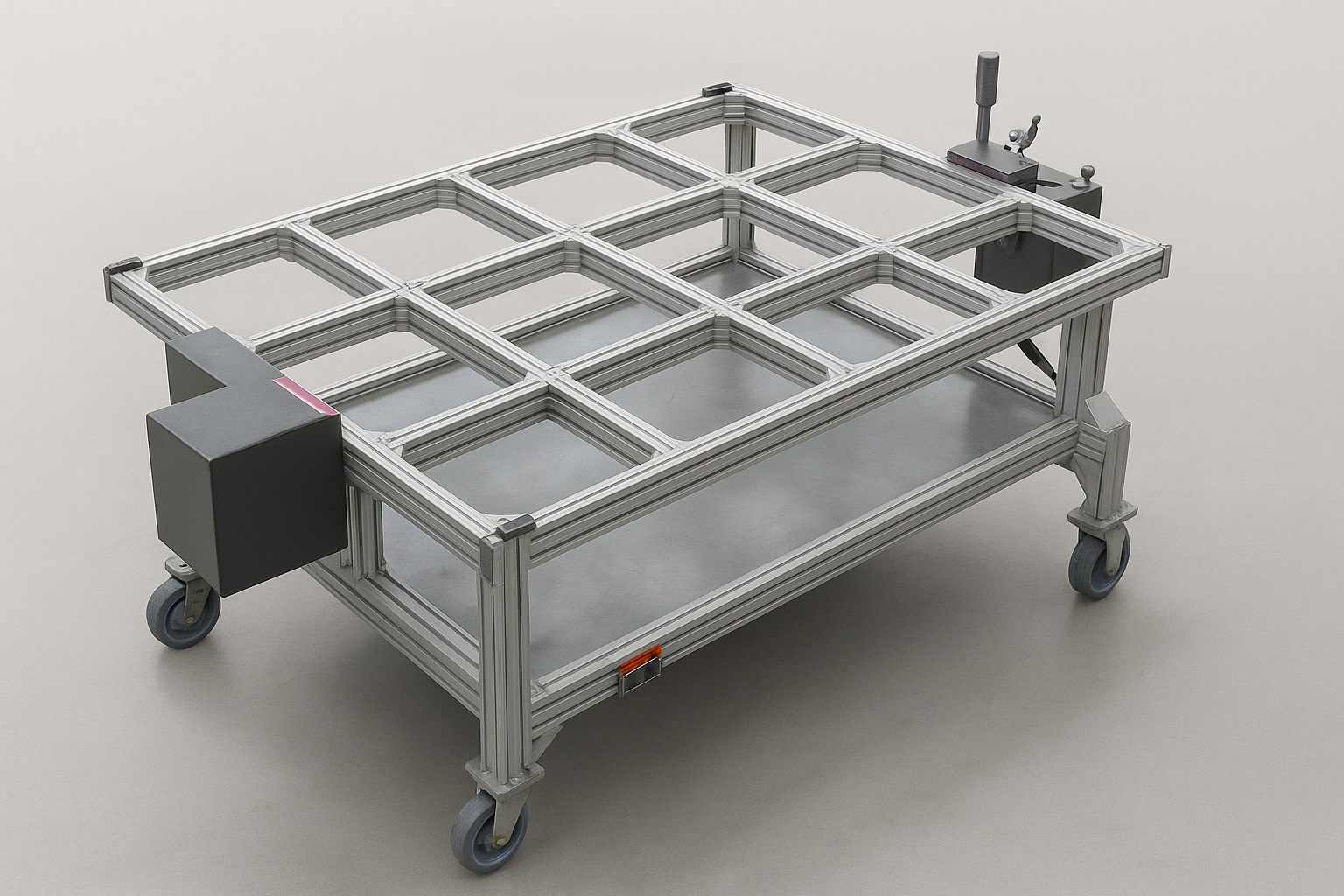
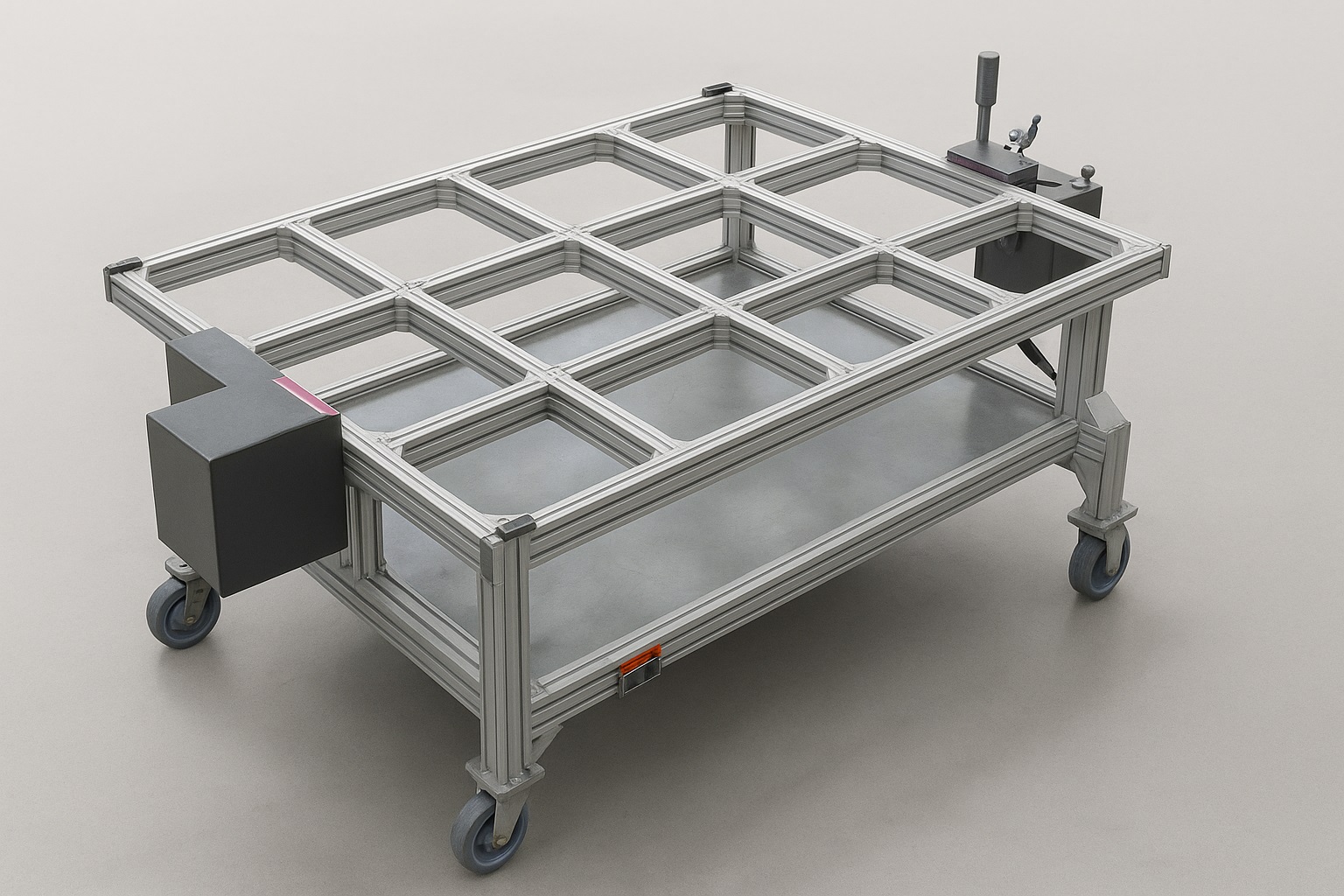
Industrial locking wheel dollies with foot-operated brake and total-lock caster configurations for secure transport and stable staging. T-slot aluminum frames sized to your load with caster braking systems selected for load weight, floor surface, and the degree of positional security required during production operations.
Why Choose Modular Solutions for Locking Wheel Dollies?
Correctly specified caster braking is as important as the frame — under-specified brakes on heavy dollies create safety hazards.
Brake System Matched to Load and Floor
Foot-operated brake casters are specified for the total load weight and floor surface condition. Brake torque rating, tread compound, and caster diameter are selected together to provide reliable stopping and holding for the specific application — not chosen from a standard catalog without load verification.
Total-Lock Casters for Assembly Stability
Total-lock casters that simultaneously lock both the wheel and swivel are specified for dollies used as temporary assembly or welding platforms. This prevents both rolling and lateral pivoting, giving the dolly the stability of a fixed workstation during operations.
Caster Count and Pattern Design
Brake caster quantity and position are designed for effective load braking based on the load center of gravity. Standard two-brake configurations are supplemented with four-brake arrangements for very heavy or unbalanced loads where two-brake systems may be insufficient.
Spring-Load Auto-Lock Options
Spring-loaded casters that automatically engage the brake under downward load are available for applications where consistent brake engagement cannot be assumed. These are used in dispensing, medical device staging, and safety-critical assembly operations.
Sealed and Stainless Options for Harsh Environments
Brake casters with sealed bearing races and stainless steel brake mechanisms are available for washdown, food-grade, and chemical-exposure environments where standard caster brake components would corrode or fail under routine cleaning cycles.
Integration with Docking Systems
Locking wheel dollies can be combined with floor-mounted receiver pins or guide rails so the dolly locks into both the caster brake and a physical docking position simultaneously. This dual-lock configuration is used for high-precision staging positions in automated assembly lines.
Key Features & Benefits
Caster braking system details that determine real-world stability and operator safety on the production floor.
Foot-Operated Brake Casters
Standard foot-operated brake casters with cast-iron or steel brake cam mechanisms allow hands-free brake engagement. Brake pedal height is positioned for comfortable foot access without bending. Available in 4-inch to 10-inch diameter for the load range.
Total-Lock Caster Mechanisms
Total-lock casters use a single pedal to simultaneously engage the wheel lock and the swivel lock, providing complete dolly immobility with one foot press. Release requires a deliberate second foot press on the release pedal, preventing accidental unlock during operations.
Side-Lock Caster Options
Side-operated locking casters are available for applications where floor access to a foot pedal is restricted by the load overhang. Side-lock casters are engaged and released using a lever at the side of the caster body rather than a top-mounted pedal.
Brake Indicator Visibility
High-visibility brake indicator collars or colored brake pedal tabs are available to provide clear visual indication of brake engagement status from operator standing height. This reduces missed-brake incidents in busy production environments.
Heavy-Duty Caster Mounting
Brake casters are mounted on steel mounting plates bolted to the T-slot aluminum base frame with load-distributing hardware. Mounting geometry is designed to keep the brake pedal accessible and clear of the dolly frame regardless of load overhang dimensions.
Swivel-Restrictor Options
Directional swivel restrictors that limit caster rotation to a set arc are available for dollies used on straight-track transport routes. Swivel restriction prevents caster shimmy under towing at speed while maintaining sufficient turning capability for docking maneuvers.
Common Applications
Locking wheel dollies are used wherever a load must be transported and then held stationary for operations without additional fixtures or restraints.
- Point-of-Use Parts Staging - Locking dollies positioned at assembly stations hold kitted parts in place during the assembly cycle. Brake prevents dolly movement during part retrieval without floor anchoring.
- Welding and Fabrication Staging - Total-lock casters hold weldment staging dollies firmly during tacking and welding operations, preventing load shift that can affect weld joint fit-up.
- Dispensing and Kitting Operations - Spring-auto-lock casters on dispensing dollies ensure the dolly is always braked when a load is present, preventing roll-away incidents during material counting and retrieval.
- Machine Setup and Changeover - Locking dollies used for tooling changeover hold tooling in position at the machine while changeover tasks are performed, then release for rapid removal when complete.
- Inspection Staging - Locking dollies used at CMM and visual inspection stations hold the part dolly in the correct position for inspection operations without requiring the inspector to maintain physical contact with the dolly.
- Medical Device and Laboratory Staging - Total-lock dollies used for sensitive instrument and device staging prevent accidental movement during calibration, testing, and measurement operations.
Specifications & Configurations
Standard design ranges for locking wheel dollies. All specifications are available custom to your load and operational requirements.
| Specification | Detail |
|---|---|
| Frame Profile | 45 Series to 90 Series T-slot aluminum depending on load |
| Load Capacity | 500 lb to 8,000 lb depending on frame and caster specification |
| Brake Type | Foot-operated wheel brake, total-lock (wheel + swivel), side-lock, or spring auto-lock |
| Brake Quantity | 2 or 4 brake casters per dolly depending on load weight and stability requirements |
| Caster Diameter | 4 in. to 10 in.; tread compound selected for floor surface and load |
| Environment Options | Standard, sealed washdown, stainless hardware, ESD-dissipative |
| Indicator Options | High-visibility brake indicators; colored pedal tabs |
| Deck Surface | Open T-slot rail, aluminum checker plate, UHMW-PE sheet |
| Lead Time | 3 to 5 weeks from approved design |
Frequently Asked Questions
Common questions about locking wheel dollies from Modular Solutions.
How many locking casters do industrial dollies typically use?
Standard industrial dollies use two foot-operated brake casters out of four total casters, typically positioned at the operator push end. For applications requiring positive lock against heavy or rolling loads, total-lock casters are available that lock both swivel and wheel rotation simultaneously. Heavy dollies used in assembly operations may use four total-lock casters for maximum staging stability.
What is the difference between a wheel-only brake and a total-lock caster?
A wheel-only brake locks the caster wheel against rotation but allows the caster to still swivel. This prevents rolling but does not prevent the dolly from pivoting in place under lateral load. A total-lock caster locks both the wheel and the swivel simultaneously, preventing both rolling and pivoting. Total-lock casters are specified for dollies used in assembly, welding, or machining operations where the dolly must be completely stationary.
Can locking wheel dollies be used on sloped or inclined floors?
Standard foot-operated brake casters are designed for level or near-level surfaces. For sloped floor applications, we specify higher-rated brake casters with locking mechanisms rated for the slope angle and load weight. For steep inclines, additional mechanical restraint such as chock blocks or floor anchor points may be required in addition to the caster brakes. Please specify your floor conditions during the design review.
Are spring-loaded automatic locking casters available?
Yes. Spring-loaded casters that automatically lock when downward load is applied are available for applications where consistent brake engagement is critical regardless of operator action. These casters engage the brake under load and require deliberate foot release to move the dolly. This configuration is used in dispensing, assembly, and welding applications where accidental dolly movement is a safety concern.
How are locking wheel dollies used in lean manufacturing environments?
In lean manufacturing environments, locking wheel dollies serve as point-of-use staging platforms that are transported to the work area and immediately secured. The dolly becomes a temporary work station — parts are consumed directly from the dolly without decanting to shelves. Locking casters ensure the dolly stays in position during the assembly cycle and is only moved when the batch is exhausted, reducing material handling waste.
Ready to Specify Your Locking Wheel Dolly?
Provide your load weight, floor surface type, staging requirements, and brake preference. Our engineers will specify the right caster braking system for reliable, safe operation.
Modular Solutions — 4280 Giddings Rd, Auburn Hills, MI 48326