Lean & Flow Carts
Kanban replenishment carts, FIFO flow carts, and line-side delivery systems built from T-slot aluminum framing. Designed for one-piece-flow and JIT production environments where material presentation, part orientation, and replenishment cycle time directly affect throughput and operator ergonomics.
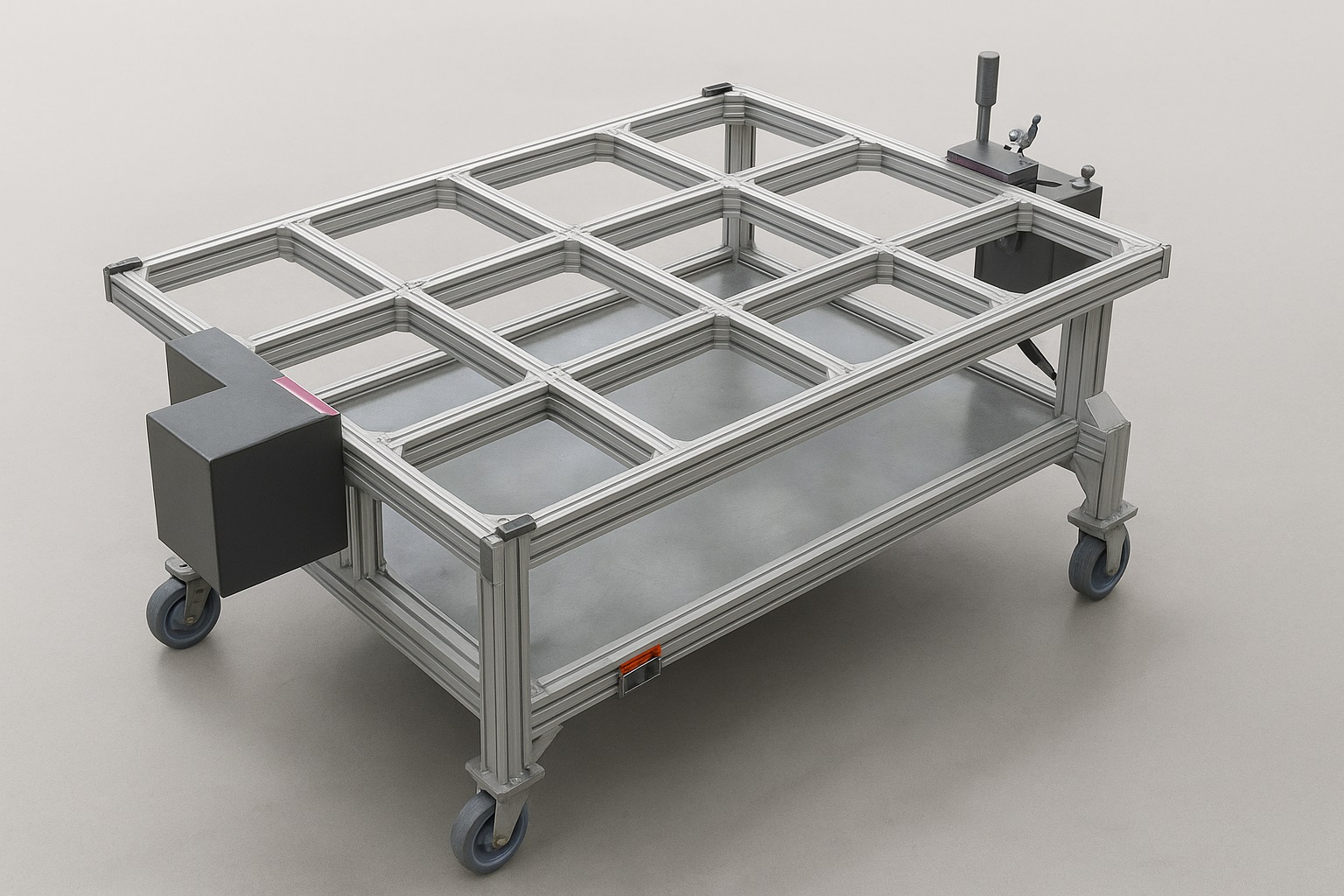
Lean & Flow Cart Types
Select the lean cart type that matches your production system, or contact our engineers for a recommendation based on your Kanban structure, container type, and replenishment cycle.

Flow Rack Carts
Mobile gravity flow rack carts combining transport and FIFO presentation in one unit — eliminating fixed racks at every line-side station.
Kanban Replenishment Carts
Two-bin and multi-card Kanban delivery carts with integrated label holders, signal flag mounts, and bin rail systems for consistent pull replenishment.
FIFO Flow Carts
First-in first-out material rotation carts with rear-load front-pick gravity lanes that enforce stock rotation by cart geometry — not operator discipline.
Line-Side Delivery Carts
JIT assembly line replenishment carts with precision docking geometry, ergonomic presentation heights, and tugger train compatible fleet standardization.
Work-In-Process Carts
WIP staging and transport carts with part-specific nesting, job traveler display, RFID tracking, and visual status management for controlled production flow.
Gravity Feed Carts
Inclined roller and smooth channel gravity feed carts for hands-free automatic container advance — zero power, zero maintenance, reliable FIFO on every cycle.
Why Choose Modular Solutions for Lean and Flow Carts?
Faster deployment, lower total cost, and the flexibility to reconfigure as your processes evolve.
Designed for JIT and Lean Environments
Lean flow carts are configured to support specific replenishment cycles, Kanban trigger points, and presentation heights. Unlike general-purpose carts, these are engineered around the process: takt time, part size, replenishment quantity, and line-side docking position are all design inputs.
FIFO Flow Lanes Built In
Gravity-fed incline lanes and rear-load front-pick configurations are integrated directly into the T-slot frame. FIFO rotation is enforced at the cart level without separate flow rack infrastructure, reducing floor space and simplifying line-side inventory management.
Standardized Docking and Connection
Cart width, docking rail height, and connector positions are standardized across a fleet so any cart can dock at any line-side station. Consistent geometry simplifies tugger train loading and unloading at multiple delivery points.
Kanban Label and Signal Integration
Kanban label holders, signal flag mounts, and RFID tag positions are integrated into the T-slot frame as standard design elements, not retrofitted add-ons. Visual management and electronic tracking are built in from the start.
Reconfigurable as Production Changes
When part families change or line layout evolves, T-slot aluminum carts can be reconfigured: lane angles adjusted, bin rail positions moved, handle heights reset. The same structural frame serves multiple lean configurations without replacement.
Lighter Than Welded Steel
Aluminum T-slot frames are significantly lighter than equivalent welded steel frames, reducing push force for operators and lowering tugger tow load. Lower push force directly supports ergonomic improvement targets and reduces worker fatigue on high-frequency replenishment cycles.
Key Features & Benefits
Engineered details that separate T-slot aluminum carts from catalog alternatives and generic welded-steel options.
Gravity-Fed FIFO Flow Lanes
Inclined roller or sliding surface lanes built into the cart frame enforce first-in, first-out rotation automatically. Rear loading and front picking are positioned at the correct ergonomic heights for the specific part and operator.
Adjustable Lane Angles
Lane incline angles are set at the design stage and can be adjusted in the field using T-slot bracket positions. Different parts require different flow angles; our design process specifies each lane based on part weight and container size.
Bin Rail and Kanban Card Holders
Standardized bin rail profiles mount directly to T-slot uprights. Kanban card holders, label brackets, and part number label strips are integrated at each lane without drilling or custom fabrication.
Docking Rail and Bumper System
Precision docking rails and rubber bumpers guide the cart to a consistent position at line-side delivery points. Docked carts are stable and correctly positioned for operator reach without manual alignment on each cycle.
Ergonomic Part Presentation Heights
Lane entry and exit heights are engineered to the specific operator reach envelope and container type. Correct presentation height reduces fatigue and reach injuries on high-frequency line-side replenishment.
Tugger Train Compatible Configuration
Lean flow carts can be configured with standardized tow hitches and drawbar connections for integration into tugger train or AGC delivery systems, supporting closed-loop material flow from supermarket to line side.
Common Applications
Proven in manufacturing, warehousing, and distribution environments across multiple industries.
- Kanban Replenishment Loops - Carts configured to carry specific part families from supermarket storage to line-side delivery points on timed replenishment cycles.
- FIFO Line-Side Delivery - Gravity-fed flow lanes that enforce first-in, first-out part rotation at assembly stations without separate flow rack infrastructure.
- Mixed-Model Assembly Lines - Configurable lane systems that accommodate multiple part families on a single cart for mixed-model production without line-side congestion.
- Tugger Train Delivery Systems - Towable lean carts sized for tugger train loops with docking rails and bumpers for consistent line-side positioning on each delivery cycle.
- Sub-Assembly Feeding - Flow carts that deliver pre-kitted sub-assembly components to main line operators at the correct presentation height and rotation sequence.
- Supermarket to Line-Side Flow - Dedicated cart designs that bridge supermarket storage positions and line-side docking points with consistent geometry and visual management provisions.
Specifications & Configurations
Standard design ranges. All specifications are available custom to your exact requirements.
| Specification | Detail |
|---|---|
| Frame Profile | 45 Series T-slot aluminum; 90 Series available for heavy-load configurations |
| Lane Configuration | 1 to 6 gravity-fed flow lanes per cart; adjustable incline angle |
| Lane Width | 6 in. to 18 in. per lane depending on container size |
| Cart Width | 18 in. to 42 in. standard; standardized fleet widths available |
| Cart Height | 42 in. to 60 in. at top rail; presentation height engineered per application |
| Load per Lane | Up to 150 lb per flow lane depending on frame and roller specification |
| Caster Size | 4 in. or 5 in. diameter; swivel with brake on rear pair standard |
| Kanban Integration | Label holder rails, signal flag mounts, RFID bracket positions |
| Lead Time | 3 to 5 weeks from approved drawings |
Frequently Asked Questions
Common questions about lean and flow carts from Modular Solutions.
What is a lean flow cart and how is it different from a standard shelf cart?
A lean flow cart is designed specifically for JIT and Kanban material delivery systems. It includes gravity-fed FIFO flow lanes, Kanban label integration, ergonomic part presentation heights, and standardized docking geometry. A standard shelf cart is a general-purpose transport tool. Lean flow carts are engineered around the specific replenishment cycle, part family, container type, and line-side docking position for each application.
Can lean flow carts be used in tugger train delivery systems?
Yes. Lean flow carts can be configured with standardized tow hitches and drawbar attachment points for use in tugger train and AGC delivery loops. Cart width, bumper height, and hitch geometry are standardized across a fleet to ensure consistent train formation and docking.
How do gravity-fed FIFO flow lanes work?
Gravity-fed flow lanes use inclined rollers or smooth lane surfaces so containers slide from the rear loading position to the front picking position under their own weight. When an operator removes the front container, the remaining containers advance automatically. This enforces first-in, first-out rotation without manual intervention and eliminates the need for operators to reach into the back of deep shelves.
Can I change the lane configuration after the cart is built?
Yes. Lane dividers, bin rail positions, and bracket heights all mount to the T-slot uprights and can be repositioned in the field. Lane angle is set by bracket position on the upright and can be adjusted with standard hex keys. If you need to add lanes or change part family assignments, the same frame accommodates the modification without replacement.
What container and bin types are compatible with these flow carts?
Our lean flow carts are designed around your specific containers. Common types include KLT plastic bins, Euro bins, cardboard Kanban containers, reusable totes, and custom trays. Lane width, incline angle, and end stop positions are all specified based on your container dimensions and weight. If you have existing containers, provide the dimensions and we will design the lanes to match.
Ready to Design Your Lean Flow Cart System?
Provide your part families, container types, and replenishment cycle requirements. Our engineers will configure a lean flow cart system that fits your production flow.
Modular Solutions - 4280 Giddings Rd, Auburn Hills, MI 48326